Addax nasomaculatus
The addax, also known as the white antelope and the screwhorn antelope, is an antelope native to the Sahara. The only member of the genus Addax, it was first described scientifically by Henri de Blainville in 1816. As suggested by its alternative name, the addax has spiral horns that are 55 to 80 cm long in females and 70 to 85 cm in males. In the winter, its coat is greyish-brown with white hindquarters and legs, and long, brown hair on the head, neck, and shoulders; in the summer, the coat turns almost completely white or sandy blonde. Males stand from 105 to 115 cm at the shoulder, with females at 95 to 110 cm. They are sexually dimorphic, as the females are generally smaller than the males.

HaytemBouchri93 · CC BY-SA 4.0 · via Wikipedia/Commons. May be a photograph of a specimen, or an artist’s reconstruction — an interpretation of a skeleton, since colour and soft tissue are almost never preserved.
On record
Recorded, not inferred- Sits inside
- AddaxPBDB
- Diet
- grazer, browserPBDB, for Bovidae
- Life habit
- ground dwellingPBDB, for Bovidae
- Motility
- actively mobilePBDB, for Osteichthyes
- Environment
- terrestrialPBDB, for Artiodactyla
- Mass
- 112.5 kgWikidata
Time the record covers
At most 12 thousand years on record.
The one occurrence read is dated to somewhere between 11.7 ka and 0 Mya, which is a dating window rather than a span.
1 occurrence of Addax nasomaculatus on record, most of them in the Holocene. The Paleobiology Database records this as a living group. Bar height is expected occurrences, not a count: each fossil is spread across the span it is dated to, so a tall narrow bar means tight dating and a low wide one means loose.
When
1 occurrences- Holocene100%
These are dates about fossils, not the animal: the record can only begin after it arose and end before it died out, so either end may reach further. Shares are expected occurrences: a fossil dated to a span is counted partly in each period it straddles. More on what this infers.
Found in
1 formation
Loading coastlines…
The named rock units Addax nasomaculatus has been recovered from, largest first. Drawn where the rock is now, not where it formed.
Addax nasomaculatus and its relatives
HoloceneWhere Addax nasomaculatus and its relatives were recorded in the Holocene.
Found in the same rock
12 taxa- Bos primigenius1 site
- Bos taurus1 site
- Canis aureus1 site
- Capra aegagrus1 site
- Damaliscus1 site
- Equus asinus1 site
- Gazella dorcas1 site
- Nanger soemmerringii1 site
- Oryx dammah1 site
- Ovis ammon1 site
- Palaeoloxodon recki1 site
- Struthio camelus1 site
The Paleobiology Database records 1 site for Addax nasomaculatus, and this reads all of them. The number is how many of those sites it was catalogued from too.
This is not a list of everything alive at the time. It is only what has come out of the same ground as this animal and been written down.
Entered from
1 referenceEach of the 1 occurrence read was entered from one of these publications, ordered by how many each accounts for. This is not a search for papers mentioning the name. Each entry links to doi.org. Relayed as the Paleobiology Database holds them, not checked against what they resolve to.
Media and terms
Media content1
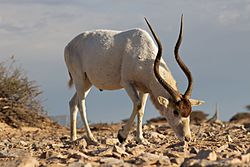
Picture of Addax nasomaculatus
- Source
- Wikipedia/Commons
- Credit
- HaytemBouchri93
- Licence
- CC BY-SA 4.0
- Commercial use
- the licence allows it
No 3D scan of Addax nasomaculatus was found in Sketchfab.
Smithsonian Open Access and MorphoSource were not reached for this taxon, so this list is what the others held rather than everything there is.
The description on this site
- Source
- Wikipedia, “Addax”
- Licence
- CC BY-SA 4.0
This is what the site found, which is not the same as what exists.
Keep going
What may have been alongside itAddax through timeFormations of the HoloceneThe world it lived on
Occurrence data from the Paleobiology Database, CC BY 4.0. (de Blainville 1816)