Aeolothripidae
The Aeolothripidae are a family of thrips. They are particularly common in the holarctic region, although several occur in the drier parts of the subtropics, including dozens in Australia. Adults and larvae are usually found in flowers, but they pupate on the ground. While they normally prey on other arthropods, many feed also on flowers.

Heeger, Ernst · Public Domain · via Wikipedia/Commons. May be a photograph of a specimen, or an artist’s reconstruction — an interpretation of a skeleton, since colour and soft tissue are almost never preserved.
On record
Recorded, not inferred- Sits inside
- TerebrantiaPBDB
- Motility
- actively mobilePBDB, for Arthropoda
- Environment
- terrestrialPBDB, for Insecta
Time the record covers
At least 90 million years on record.
The record covers at least 113.2 Mya to 23.04 Mya. No occurrence read is dated outside 121.4 Mya to 15.98 Mya.
24 occurrences of Aeolothripidae on record, most of them in the Eocene. The Paleobiology Database records this as a living group, and the chart stops with its fossils rather than at the present. Bar height is expected occurrences, not a count: each fossil is spread across the span it is dated to, so a tall narrow bar means tight dating and a low wide one means loose.
When
24 occurrencesThese are dates about fossils, not the animal: the record can only begin after it arose and end before it died out, so either end may reach further. Shares are expected occurrences: a fossil dated to a span is counted partly in each period it straddles. More on what this infers.
Found in
5 formations
- Bouldnor Formation · Solent Group7
- Zaza Formation2
- Green River Formation2
- Rott Formation2
- Raritan Formation · Potomac Group1
Loading coastlines…
The named rock units Aeolothripidae has been recovered from, largest first. Drawn where the rock is now, not where it formed. 10 occurrences have no formation on record, which is common for older literature.
Aeolothripidae and its relatives
EoceneWhere Aeolothripidae and its relatives were recorded in the Eocene.
Found in the same rock
2,317 taxa- Chironomidae5 sites
- Thripidae5 sites
- Camponotites cockerelli4 sites
- Emplastus britannicus4 sites
- Lepidoptera4 sites
- Leucotaphus gurnetensis4 sites
- Oecophylla megarche4 sites
- Sinaeolothrips brodiei4 sites
- Aeolothrips jarzembowskii3 sites
- Anglogomphaeschna eocenica3 sites
- Aphidoidea3 sites
- Beraeodes vectensis3 sites
- Berosus barclayi3 sites
- Chironomini3 sites
- Coenagrionidae3 sites
- Colopha incognita3 sites
- Culex protorhinus3 sites
- Dicranomyia (Dicranomyia) brodiei3 sites
- Elephantomyia (Elephantomyia) longirostris3 sites
- Emplastus hypolithus3 sites
- Formicidae3 sites
- Gonomyia (Gonomyia) indecisa3 sites
- Gymnastes (Paragymnastes) fasciatipennis3 sites
- Hydrochara woodwardi3 sites
The Paleobiology Database records 16 sites for Aeolothripidae, and this reads all of them. The number is how many of those sites it was catalogued from too. The 24 sharing the most are listed.
This is not a list of everything alive at the time. It is only what has come out of the same ground as this animal and been written down.
Entered from
15 references- Thrips (Insecta: Thysanoptera) from the Insect Limestone (Bembridge Marls, Late Eocene) of the Isle of Wight, UK6
- Two new species of Aeolothripidae from Baltic Tertiary amber (Insecta: Thysanoptera)2
- The oldest members of the families Aeolothripidae and Thripidae (Insecta: Thysanoptera) from the Lower Cretaceous of Transbaikalia2
- Thysanoptères des couches de potasse du Haut-Rhin2
- Physopoden aus dem Braunkohlengebirge von Rott am Siebengebirge2
- The Khasurty fossil insect Lagerstätte1
- Palaeoentomological study of the lacustrine oil-shales of the lower Miocene San Chils locality (Ribesalbes-Alcora Basin, Castellón province, Spain)1
- Mesozoic thrips and early evolution of the order Thysanoptera (Insecta)1
- Thysanoptera (Insecta) of the Tertiary amber of the Museum of the Earth, Warsaw, with keys to the species of the Baltic and Bitterfeld amber1
- Bernstein-Thysanopteren II1
- Bernstein-Thysanopteren1
- Fossil Thysanoptera, I. Terebrantia, Pt. 11
Each of the 24 occurrences read was entered from one of these publications, ordered by how many each accounts for. This is not a search for papers mentioning the name. 3 further references are not listed. Entries link to doi.org where the Paleobiology Database holds an identifier, and to its own record where it does not. Relayed as the Paleobiology Database holds them, not checked against what they resolve to.
Media and terms
Media content1
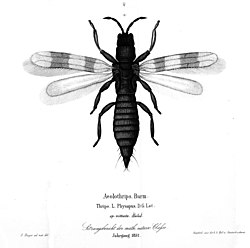
Picture of Aeolothripidae
- Source
- Wikipedia/Commons
- Credit
- Heeger, Ernst
- Licence
- Public Domain
- Commercial use
- the licence allows it
No 3D scan of Aeolothripidae was found in MorphoSource and Sketchfab.
Smithsonian Open Access was not reached for this taxon, so this list is what the others held rather than everything there is.
The description on this site
- Licence
- CC BY-SA 4.0
This is what the site found, which is not the same as what exists.
Keep going
What may have been alongside itTerebrantia through timeFormations of the EoceneThe world it lived on
Occurrence data from the Paleobiology Database, CC BY 4.0. Uzel 1895