Afrotragulus parvus
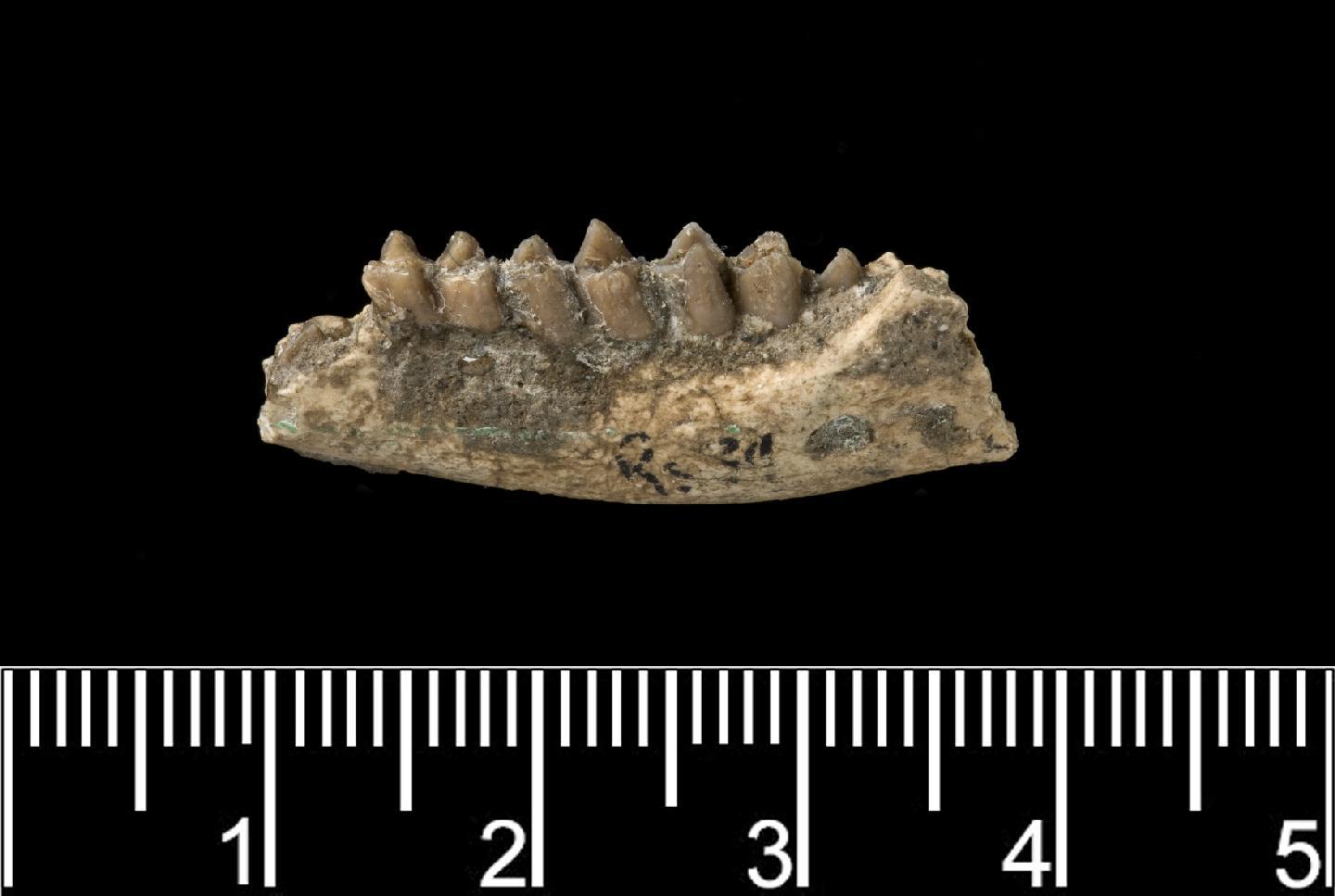
via iDigBio · CC BY · via iDigBio. May be a photograph of a specimen, or an artist’s reconstruction — an interpretation of a skeleton, since colour and soft tissue are almost never preserved.
On record
Recorded, not inferred- Sits inside
- AfrotragulusPBDB
- Diet
- frugivore, grazerPBDB, for Tragulidae
- Life habit
- ground dwellingPBDB, for Tragulidae
- Motility
- actively mobilePBDB, for Osteichthyes
- Environment
- terrestrialPBDB, for Artiodactyla
Time the record covers
At least 2.1 million years on record.
The record covers at least 15.98 Mya to 13.82 Mya. No occurrence read is dated outside 20.45 Mya to 11.63 Mya.
7 occurrences of Afrotragulus parvus on record, most of them in the Miocene. Bar height is expected occurrences, not a count: each fossil is spread across the span it is dated to, so a tall narrow bar means tight dating and a low wide one means loose.
When
7 occurrences- Miocene100%
These are dates about fossils, not the animal: the record can only begin after it arose and end before it died out, so either end may reach further. Shares are expected occurrences: a fossil dated to a span is counted partly in each period it straddles. More on what this infers.
Found in
2 formations
- Lothidok Formation2
- Upper Koru Series Formation · Kericho Phonolites Group1
Loading coastlines…
The named rock units Afrotragulus parvus has been recovered from, largest first. Drawn where the rock is now, not where it formed. 4 occurrences have no formation on record, which is common for older literature.
Afrotragulus parvus and its relatives
MioceneWhere Afrotragulus parvus and its relatives were recorded in the Miocene.
Found in the same rock
195 taxa- Dorcatherium pigotti4 sites
- Afrohyrax championi3 sites
- Brochuchus3 sites
- Bunolistriodon3 sites
- Diamantohyus africanus3 sites
- Dorcatherium chappuisi3 sites
- Gomphotheriidae3 sites
- Paraphiomys pigotti3 sites
- Aceratherium2 sites
- Afropithecus turkanensis2 sites
- Anasinopa leakeyi2 sites
- Canthumeryx sirtensis2 sites
- Crocodylus2 sites
- Dicerorhinus2 sites
- Giraffokeryx primaevus2 sites
- Kenyasus rusingensis2 sites
- Kichechia savagei2 sites
- Kichechia zamanae2 sites
- Limicolaria2 sites
- Limnopithecus legetet2 sites
- Listriodon2 sites
- Masritherium aequatorialis2 sites
- Megapedetes2 sites
- Melanoides tuberculata2 sites
The Paleobiology Database records 7 sites for Afrotragulus parvus, and this reads all of them. The number is how many of those sites it was catalogued from too. The 24 sharing the most are listed.
This is not a list of everything alive at the time. It is only what has come out of the same ground as this animal and been written down.
Entered from
6 references- Nouvelles decouvertes de vertebres miocenes dans le synclina de Dera Bugti (Balouchistan, Pakistan)2
- Fauna from a new Lower Miocene locality west of Lake Turkana, Kenya1
- A new Miocene hominoid from Kenya1
- Miocene mammals, stratigraphy and environment of Muruarot Hill, Kenya1
- New Potassium-Argon Age Determinations Relevant to the Miocene Fossil Mammal Sequence in East Africa1
- Fossil Mammal Locality on Mount Elgon, Eastern Uganda1
Each of the 7 occurrences read was entered from one of these publications, ordered by how many each accounts for. This is not a search for papers mentioning the name. Entries link to doi.org where the Paleobiology Database holds an identifier, and to its own record where it does not. Relayed as the Paleobiology Database holds them, not checked against what they resolve to.
Media and terms
Media content1
Picture of Afrotragulus parvus
- Source
- iDigBio
- Credit
- via iDigBio
- Licence
- CC BY
- Commercial use
- the licence allows it
No 3D scan of Afrotragulus parvus was found in Sketchfab.
Smithsonian Open Access and MorphoSource were not reached for this taxon, so this list is what the others held rather than everything there is.
This is what the site found, which is not the same as what exists.
Keep going
What may have been alongside itAfrotragulus through timeFormations of the MioceneThe world it lived on
Occurrence data from the Paleobiology Database, CC BY 4.0. (Whitworth 1958)