Alligatorinae
Alligatorinae is a subfamily within the family Alligatoridae that contains the alligators and their closest extinct relatives, and is the sister taxon to Caimaninae. Many genera in Alligatorinae are described, but only the genus Alligator is extant, with the remaining being extinct.

User:Catholic 85 on en: wikipedia · CC BY-SA 3.0 · via Wikipedia/Commons. May be a photograph of a specimen, or an artist’s reconstruction — an interpretation of a skeleton, since colour and soft tissue are almost never preserved.
On record
Recorded, not inferred- Sits inside
- AlligatoridaePBDB
- Diet
- carnivorePBDB, for Crocodylia
- Motility
- actively mobilePBDB, for Osteichthyes
- Environment
- marinePBDB, for Mesoeucrocodylia
Time the record covers
At least 72 million years on record.
The record covers at least 72.2 Mya to 11.7 ka. No occurrence read is dated outside 83.6 Mya to 0 Mya.
280 occurrences of Alligatorinae on record, most of them in the Eocene. The Paleobiology Database records this as a living group. Bar height is expected occurrences, not a count: each fossil is spread across the span it is dated to, so a tall narrow bar means tight dating and a low wide one means loose.
When
280 occurrences- Late Cretaceous8%
- Paleocene10%
- Eocene44%
- Oligocene2%
- Miocene12%
- Pliocene2%
- Pleistocene13%
- Holocene9%
These are dates about fossils, not the animal: the record can only begin after it arose and end before it died out, so either end may reach further. Shares are expected occurrences: a fossil dated to a span is counted partly in each period it straddles. More on what this infers.
Found in
52 formations
- Willwood Formation85
- Oldman Formation · Belly River Group12
- Ferris Formation9
- Chadron Formation9
- Fort Union Formation8
- North Horn Formation7
Loading coastlines…
The named rock units Alligatorinae has been recovered from, largest first. Drawn where the rock is now, not where it formed. 28 further formations hold fewer occurrences each and are not listed. 70 occurrences have no formation on record, which is common for older literature.
Alligatorinae and its relatives
EoceneWhere Alligatorinae and its relatives were recorded in the Eocene.
Found in the same rock
2,686 taxa- Allognathosuchus122 sites
- Lepisosteus67 sites
- Diacodexis metsiacus54 sites
- Homogalax protapirinus47 sites
- Trionychidae47 sites
- Hyopsodus loomisi41 sites
- Phenacodus intermedius41 sites
- Ectocion osbornianus40 sites
- Haplomylus speirianus36 sites
- Cantius mckennai35 sites
- Coryphodon eocaenus35 sites
- Crocodylia34 sites
- Alligator33 sites
- Esthonyx bisulcatus33 sites
- Aves31 sites
- Didymictis protenus30 sites
- Anura28 sites
- Phenacodus vortmani27 sites
- Arenahippus aemulor26 sites
- Arenahippus pernix26 sites
- Cardiolophus radinskyi26 sites
- Thryptacodon antiquus26 sites
- Sifrhippus grangeri25 sites
- Testudines25 sites
The Paleobiology Database records 272 sites for Alligatorinae, and this reads 240 of them. The number is how many of those sites it was catalogued from too. The 24 sharing the most are listed.
This is not a list of everything alive at the time. It is only what has come out of the same ground as this animal and been written down.
Entered from
114 references- Stratigraphy and mammalian paleontology of the McCullough Peaks, northern Bighorn Basin, Wyoming: Implications for biochronology, basin development, and community reorganization across the Paleocene-Eocene boundary78
- Multi-isotope analysis on the Yangtze Alligator osteoderm unearthed from Yellow River Valley during the Longshan Period19
- Vertebrate microsite assemblages (exclusive of mammals) from the Foremost and Oldman Formations of the Judith River Group (Campanian) of southeastern Alberta: an illustrated guide15
- Vertebrate faunal changes through Lancian and Puercan time in southern Wyoming9
- Paleocene (Puercan-Torrejonian) mammalian faunas of the North Horn Formation, central Utah7
- Early Eocene fossil vertebrates from the southwestern Green River Basin, Lincoln and Uinta counties, Wyoming6
- The ninth quarterly report covering the quarter ending June 30, 1941 for the state-wide paleontologic-mineralogic survey in Texas5
- Fossile Crocodiliden aus der Tertiärformation des Mainzer Beckens5
- The Lapara Creek Fauna: Early Clarendonian of south Texas, USA4
- New earliest Wasatchian mammalian fauna from the Eocene of northwestern Wyoming: composition and diversity in a rarely sampled high-floodplain assemblage4
- A transitional Paleocene-Eocene reptile fauna from the Bighorn Basin, Wyoming4
- Final report covering the period from March 4, 1939 ro September 30, 1941 for the state-wide paleontologic-mineralogic survey in Texas4
Each of the 280 occurrences read was entered from one of these publications, ordered by how many each accounts for. This is not a search for papers mentioning the name. 102 further references are not listed. Entries link to doi.org where the Paleobiology Database holds an identifier, and to its own record where it does not. Relayed as the Paleobiology Database holds them, not checked against what they resolve to.
Media and terms
Media content1
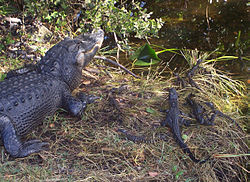
Picture of Alligatorinae
- Source
- Wikipedia/Commons
- Credit
- User:Catholic 85 on en: wikipedia
- Licence
- CC BY-SA 3.0
- Commercial use
- the licence allows it
No 3D scan was found. Smithsonian Open Access, MorphoSource and Sketchfab were all searched.
The description on this site
- Licence
- CC BY-SA 4.0
This is what the site found, which is not the same as what exists.
Keep going
What may have been alongside itAlligatoridae through timeFormations of the EoceneThe world it lived on
Occurrence data from the Paleobiology Database, CC BY 4.0. (Cuvier 1807)