Anura
A frog is any member of a diverse and largely semiaquatic group of short-bodied, tailless amphibian vertebrates composing the order Anura. Frog species with rough skin texture due to wart-like parotoid glands tend to be called toads, but the distinction between frogs and toads is informal and purely cosmetic, and does not reflect taxonomy or evolutionary history.

Charlie Jackson · CC BY 2.0 · via Wikipedia/Commons. May be a photograph of a specimen, or an artist’s reconstruction — an interpretation of a skeleton, since colour and soft tissue are almost never preserved.
On record
Recorded, not inferred- Also called
- frogPBDB
- Sits inside
- SalientiaPBDB
- Diet
- carnivorePBDB, for Temnospondyli
- Life habit
- amphibiousPBDB, for Temnospondyli
- Motility
- actively mobilePBDB, for Temnospondyli
- Environment
- brackish,freshwater,terrestrialPBDB, for Tetrapoda
Time the record covers
At least 227 million years on record.
The record covers at least 227.3 Mya to 11.7 ka. No occurrence read is dated outside 237 Mya to 0 Mya.
2,636 occurrences of Anura on record, most of them in the Pleistocene. The Paleobiology Database records this as a living group. Bar height is expected occurrences, not a count: each fossil is spread across the span it is dated to, so a tall narrow bar means tight dating and a low wide one means loose.
When
2,636 occurrences- Late Triassicunder 1%
- Early Jurassicunder 1%
- Middle Jurassicunder 1%
- Late Jurassicunder 1%
- Early Cretaceous4%
- Late Cretaceous17%
- Paleocene1%
- Eocene5%
- Oligocene3%
- Miocene18%
- Pliocene9%
- Pleistocene37%
- Holocene3%
These are dates about fossils, not the animal: the record can only begin after it arose and end before it died out, so either end may reach further. Shares are expected occurrences: a fossil dated to a span is counted partly in each period it straddles. More on what this infers.
Found in
311 formations
- Alamosa Formation53
- Dinosaur Park Formation · Belly River Group46
- Bissekty Formation43
- Valentine Formation · Ogallala Group33
- Maevarano Formation31
- Spilia Formation29
Loading coastlines…
The named rock units Anura has been recovered from, largest first. Drawn where the rock is now, not where it formed. 287 further formations hold fewer occurrences each and are not listed. 1,343 occurrences have no formation on record, which is common for older literature.
Anura and its relatives
PleistoceneWhere Anura and its relatives were recorded in the Pleistocene.
Found in the same rock
3,491 taxa- Rana70 sites
- Aves53 sites
- Scapherpeton tectum53 sites
- Opisthotriton kayi52 sites
- Teleostei52 sites
- Myledaphus bipartitus50 sites
- Hadrosauridae48 sites
- Baenidae46 sites
- Coriops amnicolus44 sites
- Multituberculata44 sites
- Trionychidae44 sites
- Chelydridae43 sites
- Saurornitholestes langstoni42 sites
- Paralbula casei41 sites
- Ceratopsidae40 sites
- Osteichthyes39 sites
- Bufo38 sites
- Crocodylia37 sites
- Lepisosteus37 sites
- Lacertilia36 sites
- Theropoda36 sites
- Paronychodon34 sites
- Lepisosteus occidentalis33 sites
- Belonostomus longirostris30 sites
The Paleobiology Database records at least 995 sites for Anura, and this reads 240 of them. The number is how many of those sites it was catalogued from too. The 24 sharing the most are listed.
This is not a list of everything alive at the time. It is only what has come out of the same ground as this animal and been written down.
Entered from
725 references- Pleistocene Amphibians and Reptiles in Britain and Europe309
- Middle Pleistocene (late Irvingtonian: Nebraskan) climatic changes in south-central Colorado52
- Pleistocene vertebrate faunas of Hungary47
- Mesozoic and Palaeocene lissamphibian assemblages of North America: a comprehensive review42
- Salientia40
- The hopping dead: Late Cretaceous frogs from the middle-late Campanian (Judithian) of western North America36
- Cretaceous anurans from Central Asia36
- A Review of New World Fossil Bufonids35
- Long-term climate record inferred from early-middle Pleistocene amphibian and squamate reptile assemblages at the Gran Dolina Cave, Atapuerca, Spain34
- New diverse amphibian and reptile assemblages from the late Neogene of northern Greece provide novel insights into the emergence of extant herpetofaunas of the southern Balkans33
- Amphibians and squamate reptiles from the late Miocene of Fălciu (Eastern Romania)29
- Amphibians and reptiles from the late Miocene and early Pliocene of the Ptolemais area (Western Macedonia, Greece)29
Each of the 2,636 occurrences read was entered from one of these publications, ordered by how many each accounts for. This is not a search for papers mentioning the name. 713 further references are not listed. Entries link to doi.org where the Paleobiology Database holds an identifier, and to its own record where it does not. Relayed as the Paleobiology Database holds them, not checked against what they resolve to.
Media and terms
Media content3

Picture of Anura
- Source
- Wikipedia/Commons
- Credit
- Charlie Jackson
- Licence
- CC BY 2.0
- Commercial use
- the licence allows it

CT scan
- Source
- MorphoSource
- Licence
- not stated by the source
- Commercial use
- cannot be read from the licence given — check the record
- Specimen
- Anura indet. · zmb:MB Am:1554
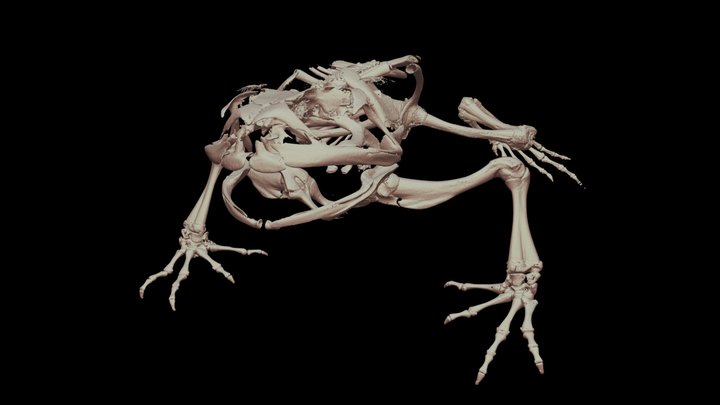
3D model
- Source
- Sketchfab
- Licence
- CC Attribution-NonCommercial-ShareAlike
- Commercial use
- the licence does not allow it
The description on this site
- Source
- Wikipedia, “Frog”
- Licence
- CC BY-SA 4.0
This is what the site found, which is not the same as what exists.
Keep going
What may have been alongside itSalientia through timeFormations of the PleistoceneThe world it lived on
Occurrence data from the Paleobiology Database, CC BY 4.0. (Fischer von Waldheim 1813)