Allotheria
Allotheria is an extinct clade of theriiform mammals known from the Mesozoic and early Cenozoic. Shared characteristics of the group are the presence of lower molariform teeth equipped with longitudinal rows of cusps and enlarged incisors. Typically, the canine teeth are also lost. Allotheria includes Multituberculata, Gondwanatheria, and probably Haramiyida, although some studies have recovered haramiyidans to be basal mammaliaforms unrelated to multituberculates. Allotherians are often placed as crown group mammals, more closely related to living marsupials and placentals (Theria) than to monotremes or eutriconodonts, though some studies place the entirety of Allotheria outside of crown Mammalia.

Kielan-Jaworowska, 2. & Nessov, L. A. · CC BY-SA 4.0 · via Wikipedia/Commons. May be a photograph of a specimen, or an artist’s reconstruction — an interpretation of a skeleton, since colour and soft tissue are almost never preserved.
On record
Recorded, not inferred- Sits inside
- MammaliaPBDB
- Diet
- insectivorePBDB, for Mammaliaformes
- Life habit
- scansorialPBDB, for Mammaliaformes
- Motility
- actively mobilePBDB, for Osteichthyes
- Environment
- terrestrialPBDB, for Mammalia
Time the record covers
At least 180 million years on record.
The record covers at least 201.4 Mya to 21 Mya. No occurrence read is dated outside 205.7 Mya to 17.5 Mya.
2,223 occurrences of Allotheria on record, most of them in the Late Cretaceous. Bar height is expected occurrences, not a count: each fossil is spread across the span it is dated to, so a tall narrow bar means tight dating and a low wide one means loose.
When
2,223 occurrences- Late Triassicunder 1%
- Early Jurassicunder 1%
- Middle Jurassic1%
- Late Jurassic5%
- Early Cretaceous5%
- Late Cretaceous46%
- Paleocene36%
- Eocene7%
- Oligoceneunder 1%
- Mioceneunder 1%
These are dates about fossils, not the animal: the record can only begin after it arose and end before it died out, so either end may reach further. Shares are expected occurrences: a fossil dated to a span is counted partly in each period it straddles. More on what this infers.
Found in
174 formations
- Hell Creek Formation · Montana Group292
- Fort Union Formation225
- Lance Formation176
- Paskapoo Formation92
- Willwood Formation76
- Cedar Mountain Formation · Dakota Group59
Loading coastlines…
The named rock units Allotheria has been recovered from, largest first. Drawn where the rock is now, not where it formed. 150 further formations hold fewer occurrences each and are not listed. 119 occurrences have no formation on record, which is common for older literature.
Allotheria and its relatives
Late CretaceousWhere Allotheria and its relatives were recorded in the Late Cretaceous.
Found in the same rock
898 taxa- Meniscoessus robustus82 sites
- Cimolodon nitidus62 sites
- Didelphodon vorax48 sites
- Theropoda47 sites
- Mesodma44 sites
- Trionychidae43 sites
- Myledaphus bipartitus41 sites
- Mesodma thompsoni40 sites
- Brachychampsa montana35 sites
- Scapherpeton tectum35 sites
- Hadrosauridae34 sites
- Lepisosteus occidentalis34 sites
- Borealosuchus sternbergii33 sites
- Albanerpetontidae32 sites
- Champsosaurus32 sites
- Paronychodon32 sites
- Protolambda hatcheri32 sites
- Ceratopsidae31 sites
- Dromaeosauridae31 sites
- Cimolomys gracilis30 sites
- Mesodma formosa30 sites
- Anura29 sites
- Gypsonictops hypoconus29 sites
- Lepisosteus29 sites
The Paleobiology Database records at least 803 sites for Allotheria, and this reads 240 of them. The number is how many of those sites it was catalogued from too. The 24 sharing the most are listed.
This is not a list of everything alive at the time. It is only what has come out of the same ground as this animal and been written down.
Entered from
474 references- The Bug Creek problem and the Cretaceous-Tertiary transition at McGuire Creek, Montana112
- Multituberculates from the Wasatchian Land-Mammal Age, Early Eocene, of Western North America68
- The succession of Paleocene mammals in western Canada61
- Fossil mammals of the type Lance Formation, Wyoming. Part I. Introduction and Marsupialia61
- The mammals and horned dinosaurs of the Lance Formation of Niobrara County, Wyoming59
- A study of Mammalia and geology across the Cretaceous-Tertiary boundary in Garfield County, Montana55
- Synonymies and reidentifications of North American fossil mammals52
- Multituberculate mammals from near the Early-Late Cretaceous boundary, Cedar Mountain Formation, Utah51
- Vertebrate palaeocommunities of the lower Judith River Group (Campanian) of southeastern Alberta, Canada, as interpreted from vertebrate microfossil assemblages48
- Late Cretaceous and Paleocene mammal localities of southern Alberta38
- The Clarkforkian Land-Mammal Age and Mammalian Faunal Composition Across the Paleocene-Eocene Boundary38
- Latest Cretaceous multituberculates of the Black Butte Station local fauna (Lance Formation, southwestern Wyoming), with implications for compositional differences among mammalian local faunas of the Western Interior37
Each of the 2,223 occurrences read was entered from one of these publications, ordered by how many each accounts for. This is not a search for papers mentioning the name. 462 further references are not listed. Entries link to doi.org where the Paleobiology Database holds an identifier, and to its own record where it does not. Relayed as the Paleobiology Database holds them, not checked against what they resolve to.
Media and terms
Media content1
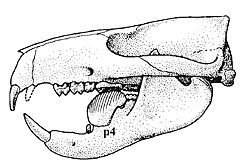
Picture of Allotheria
- Source
- Wikipedia/Commons
- Credit
- Kielan-Jaworowska, 2. & Nessov, L. A.
- Licence
- CC BY-SA 4.0
- Commercial use
- the licence allows it
No 3D scan of Allotheria was found in Sketchfab.
Smithsonian Open Access and MorphoSource were not reached for this taxon, so this list is what the others held rather than everything there is.
The description on this site
- Source
- Wikipedia, “Allotheria”
- Licence
- CC BY-SA 4.0
This is what the site found, which is not the same as what exists.
Keep going
What may have been alongside itMammalia through timeFormations of the Late CretaceousThe world it lived on
Occurrence data from the Paleobiology Database, CC BY 4.0. (Marsh 1880)