Amphibamidae
The Amphibamidae are an ancient family of dissorophoid temnospondyls known from Late Carboniferous-Early Permian strata in the United States.

Nobu Tamura ( http://spinops.blogspot.com ) · CC BY 3.0 · via Wikipedia/Commons. May be a photograph of a specimen, or an artist’s reconstruction — an interpretation of a skeleton, since colour and soft tissue are almost never preserved.
On record
Recorded, not inferred- Sits inside
- AmphibamiformesPBDB
- Diet
- carnivorePBDB, for Temnospondyli
- Life habit
- amphibiousPBDB, for Temnospondyli
- Motility
- actively mobilePBDB, for Temnospondyli
- Environment
- brackish,freshwater,terrestrialPBDB, for Tetrapoda
Time the record covers
At least 55 million years on record.
The record covers at least 307.4 Mya to 251.902 Mya. No occurrence read is dated outside 309.8 Mya to 247 Mya.
26 occurrences of Amphibamidae on record. Bar height is expected occurrences, not a count: each fossil is spread across the span it is dated to, so a tall narrow bar means tight dating and a low wide one means loose.
When
26 occurrences- Carboniferous31%
- Permian19%
- Early Triassic50%
These are dates about fossils, not the animal: the record can only begin after it arose and end before it died out, so either end may reach further. Shares are expected occurrences: a fossil dated to a span is counted partly in each period it straddles. More on what this infers.
Found in
7 formations
- Katberg Formation · Beaufort Group11
- Carbondale Formation · Kewanee Group4
- Eskridge Formation · Council Grove Group2
- Nocona Formation · Wichita Group1
- Normandien Formation · Beaufort Group1
- Kladno Formation1
Loading coastlines…
The named rock units Amphibamidae has been recovered from, largest first. Drawn where the rock is now, not where it formed. 5 occurrences have no formation on record, which is common for older literature.
Found in the same rock
196 taxa- Micropholis stowi12 sites
- Lystrosaurus curvatus3 sites
- Lystrosaurus murrayi3 sites
- Archaeothyris2 sites
- Brachydectes newberryi2 sites
- Captorhinidae2 sites
- Captorhinus2 sites
- Captorhinus aguti2 sites
- Dimetrodon2 sites
- Galesaurus planiceps2 sites
- Lystrosaurus declivis2 sites
- Oestocephalus amphiuminum2 sites
- Phlegethontia longissima2 sites
- Procolophon trigoniceps2 sites
- Prolacerta broomi2 sites
- Temnospondyli2 sites
- Tetracynodon darti2 sites
- Abyssomedon williamsi1 site
- Acheloma cryptatheria1 site
- Acheloma cumminsi1 site
- Acleistorhinidae1 site
- Acroplous vorax1 site
- Actinopterygii1 site
- Adamanterpeton ohioensis1 site
The Paleobiology Database records 19 sites for Amphibamidae, and this reads all of them. The number is how many of those sites it was catalogued from too. The 24 sharing the most are listed.
This is not a list of everything alive at the time. It is only what has come out of the same ground as this animal and been written down.
Entered from
11 references- The amphibamid Micropholis from the Lystrosaurus Assemblage Zone of South Africa11
- Handbook of Paleoherpetology Part 3A2 Temnospondyli I6
- First record of the amphibamiform Micropholis stowi from the lower Fremouw Formation (Lower Triassic) of Antarctica1
- Multiple tooth-rowed captorhinids from the early Permian fissure fills of the Bally Mountain Locality of Oklahoma1
- A new amphibamid (Temnospondyli: Dissorophoidea) from the Early Permian of Texas1
- Plemmyradytes shintoni, gen. et sp. nov., an Early Permian amphibian (Temnospondyli: Dissorophoidea) from the Eskridge Formation, Nebraska1
- An earliest Permian nonmarine vertebrate assemblage from the Eskridge Formation, Nebraska1
- Lissamphibian Origins: Possible Protolissamphibian from the Lower Permian of Oklahoma1
- Micropholis stowi, Huxley, a temnospondylus amphibian from South Africa1
- A contribution to a monograph of the extinct Amphibia of North America. New forms from the Carboniferous1
- On Amphibamus grandiceps, a new Batrachian from the Coal Measures1
Each of the 26 occurrences read was entered from one of these publications, ordered by how many each accounts for. This is not a search for papers mentioning the name. Entries link to doi.org where the Paleobiology Database holds an identifier, and to its own record where it does not. Relayed as the Paleobiology Database holds them, not checked against what they resolve to.
Media and terms
Media content1
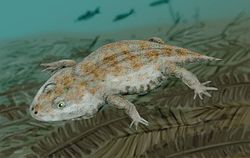
Picture of Amphibamidae
- Source
- Wikipedia/Commons
- Credit
- Nobu Tamura ( http://spinops.blogspot.com )
- Licence
- CC BY 3.0
- Commercial use
- the licence allows it
No 3D scan of Amphibamidae was found in MorphoSource and Sketchfab.
Smithsonian Open Access was not reached for this taxon, so this list is what the others held rather than everything there is.
The description on this site
- Licence
- CC BY-SA 4.0
This is what the site found, which is not the same as what exists.
Keep going
What may have been alongside itAmphibamiformes through timeThe world it lived on
Occurrence data from the Paleobiology Database, CC BY 4.0. Moodie 1912