Anchiornis huxleyi
Anchiornis is a genus of small, four-winged paravian dinosaurs, with only one known species, the type species Anchiornis huxleyi, named for its similarity to modern birds. The Latin name Anchiornis derives from a Greek word meaning "near bird", and huxleyi refers to Thomas Henry Huxley, a contemporary of Charles Darwin. Anchiornis fossils have been found only in the Tiaojishan Formation of Liaoning, China, in rocks dated to the Late Jurassic, about 160 million years ago. It is known from hundreds of specimens, and given the exquisite preservation of some of these fossils, it became the first Mesozoic dinosaur species for which almost the entire life appearance could be determined, and an important source of information on the early evolution of birds.

Jonathan Chen · CC BY-SA 4.0 · via Wikipedia/Commons. May be a photograph of a specimen, or an artist’s reconstruction — an interpretation of a skeleton, since colour and soft tissue are almost never preserved.
On record
Recorded, not inferred- Sits inside
- AnchiornisPBDB
- Diet
- carnivore, omnivorePBDB, for Troodontidae
- Life habit
- ground dwellingPBDB, for Troodontidae
- Motility
- actively mobilePBDB, for Theropoda
- Environment
- terrestrialPBDB, for Troodontidae
Time the record covers
At most 16 million years on record.
Every occurrence read is dated to somewhere between 168.2 Mya and 152.21 Mya, and nothing in the dating separates them, so that window is what the record shows rather than a span.
3 occurrences of Anchiornis huxleyi on record, most of them in the Late Jurassic. Bar height is expected occurrences, not a count: each fossil is spread across the span it is dated to, so a tall narrow bar means tight dating and a low wide one means loose.
When
3 occurrencesThese are dates about fossils, not the animal: the record can only begin after it arose and end before it died out, so either end may reach further. Shares are expected occurrences: a fossil dated to a span is counted partly in each period it straddles. More on what this infers.
Found in
1 formation
Loading coastlines…
The named rock units Anchiornis huxleyi has been recovered from, largest first. Drawn where the rock is now, not where it formed.
Anchiornis huxleyi and its relatives
Late JurassicWhere Anchiornis huxleyi and its relatives were recorded in the Late Jurassic.
Found in the same rock
41 taxa- Euestheria2 sites
- Archaeoistiodactylus linglongtaensis1 site
- Aurornis xui1 site
- Changchengopterus pani1 site
- Chunerpeton tianyiensis1 site
- Coniopteris1 site
- Coniopteris hymenophylloides1 site
- Czekanowskia1 site
- Darwinopterus1 site
- Darwinopterus linglongtaensis1 site
- Darwinopterus modularis1 site
- Darwinopterus robustodens1 site
- Darwinula1 site
- Douzhanopterus zhengi1 site
- Eosinopteryx brevipenna1 site
- Fenghuangopterus lii1 site
- Insecta1 site
- Jianchangnathus robustus1 site
- Jianchangopterus zhaoianus1 site
- Juramaia1 site
- Kunpengopterus antipollicatus1 site
- Kunpengopterus sinensis1 site
- Maiopatagium furculiferum1 site
- Neocalamites1 site
The Paleobiology Database records 3 sites for Anchiornis huxleyi, and this reads all of them. The number is how many of those sites it was catalogued from too. The 24 sharing the most are listed.
This is not a list of everything alive at the time. It is only what has come out of the same ground as this animal and been written down.
Entered from
3 references- Molecular composition and ultrastructure of Jurassic paravian feathers1
- A pre-Archaeopteryx troodontid theropod from China with long feathers on the metatarsus1
- A new feathered maniraptoran dinosaur fossil that fills a morphological gap in avian origin1
Each of the 3 occurrences read was entered from one of these publications, ordered by how many each accounts for. This is not a search for papers mentioning the name. Each entry links to doi.org. Relayed as the Paleobiology Database holds them, not checked against what they resolve to.
Media and terms
Media content2

Picture of Anchiornis huxleyi
- Source
- Wikipedia/Commons
- Credit
- Jonathan Chen
- Licence
- CC BY-SA 4.0
- Commercial use
- the licence allows it
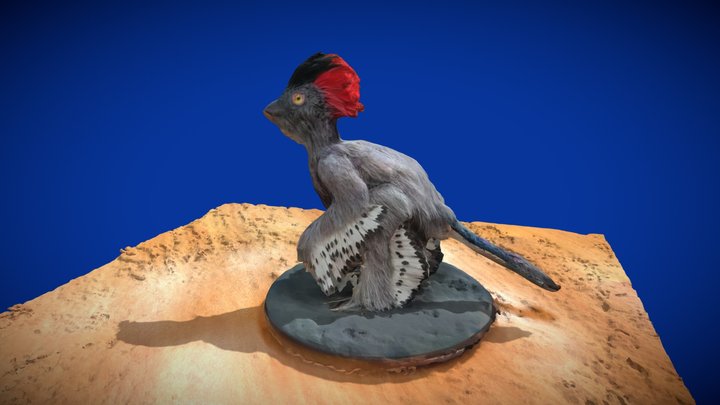
3D model
- Source
- Sketchfab
- Credit
- LATICC-UAQ
- Licence
- CC Attribution
- Commercial use
- cannot be read from the licence given — check the record
Smithsonian Open Access and MorphoSource were not reached for this taxon, so this list is what the others held rather than everything there is.
The description on this site
- Source
- Wikipedia, “Anchiornis”
- Licence
- CC BY-SA 4.0
This is what the site found, which is not the same as what exists.
Keep going
What may have been alongside itAnchiornis through timeFormations of the Late JurassicThe world it lived on
Occurrence data from the Paleobiology Database, CC BY 4.0. Xu et al. 2009