Anisopodidae
The Anisopodidae are a small cosmopolitan family of gnat-like flies known as wood gnats or window-gnats, with 154 described extant species in 15 genera, and several described fossil taxa. Some species are saprophagous or fungivorous. They are mostly small to medium-sized flies, except the genera Olbiogaster and Lobogaster, which are large with spatulated abdomens. Their phylogenetic placement is controversial. They have been proposed to be the sister group to the higher flies, the Brachycera. Some authors consider this group to be four distinct families – Anisopodidae, Mycetobiidae, Olbiogastridae, and Valeseguyidae.

Uncredited · Attribution · via Wikipedia/Commons. May be a photograph of a specimen, or an artist’s reconstruction — an interpretation of a skeleton, since colour and soft tissue are almost never preserved.
On record
Recorded, not inferred- Also called
- wood gnatPBDB
- Sits inside
- AnisopodoideaPBDB
- Motility
- actively mobilePBDB, for Arthropoda
- Environment
- terrestrialPBDB, for Insecta
Time the record covers
At least 232 million years on record.
The record covers at least 245.19 Mya to 12.8 Mya. No occurrence read is dated outside 247 Mya to 11.63 Mya.
104 occurrences of Anisopodidae on record, most of them in the Eocene. The Paleobiology Database records this as a living group, and the chart stops with its fossils rather than at the present. Bar height is expected occurrences, not a count: each fossil is spread across the span it is dated to, so a tall narrow bar means tight dating and a low wide one means loose.
When
104 occurrences- Middle Triassicunder 1%
- Early Jurassic12%
- Middle Jurassic4%
- Late Jurassic16%
- Early Cretaceous14%
- Late Cretaceous5%
- Eocene39%
- Oligocene3%
- Miocene7%
These are dates about fossils, not the animal: the record can only begin after it arose and end before it died out, so either end may reach further. Shares are expected occurrences: a fossil dated to a span is counted partly in each period it straddles. More on what this infers.
Found in
29 formations
- Glushkovo Formation6
- Sharteg Formation5
- Bouldnor Formation · Solent Group4
- Gurvan-Eren Formation3
- Lulworth Formation · Purbeck Group3
- Green River Formation2
Loading coastlines…
The named rock units Anisopodidae has been recovered from, largest first. Drawn where the rock is now, not where it formed. 5 further formations hold fewer occurrences each and are not listed. 51 occurrences have no formation on record, which is common for older literature.
Anisopodidae and its relatives
EoceneWhere Anisopodidae and its relatives were recorded in the Eocene.
Found in the same rock
4,017 taxa- Dicranomyia (Dicranomyia) lobata5 sites
- Mycetophilidae5 sites
- Coleoptera4 sites
- Diptera4 sites
- Macrochile spectrum4 sites
- Mycetophiloidea4 sites
- Palaeopoecilostola longicornis4 sites
- Palaeopoecilostola speciosa4 sites
- Archipsocus puber3 sites
- Blattula dubia3 sites
- Blattula langfeldti3 sites
- Ctenobethylus goepperti3 sites
- Culex protorhinus3 sites
- Dicranomyia (Dicranomyia) graciosa3 sites
- Dolichopodidae3 sites
- Emplastus britannicus3 sites
- Eocamponotus mengei3 sites
- Formica flori3 sites
- Formicidae3 sites
- Gansuplecia triporata3 sites
- Gonomyia (Gonomyia) indecisa3 sites
- Hylobittacus picteti3 sites
- Insecta3 sites
- Lasius schiefferdeckeri3 sites
The Paleobiology Database records 64 sites for Anisopodidae, and this reads all of them. Of that, one read hit the database's own return limit, so every count below is a floor rather than a total. The number is how many of those sites it was catalogued from too. The 24 sharing the most are listed.
This is not a list of everything alive at the time. It is only what has come out of the same ground as this animal and been written down.
Entered from
50 references- Sylvicola Harris, 1780 (Diptera: Anisopodidae) in the Eocene resins10
- Review of Mycetobia Meigen, 1818 (Diptera, Anisopodidae) in the Eocene ambers9
- Diptera, Muscida, in Pozdne-Mezozoyskie Nasekomye Vostochnogo Zabaykal'ya7
- New Tega (Insecta: Diptera: Anisopodidae) from the Jurassic of Eurasia and the systematic position of Oligophrynidae6
- Anisopodidae (Insecta: Diptera) from Upper Cretaceous amber of northern Myanmar4
- True flies (Insecta: Diptera) from the late Eocene insect limestone (Bembridge Marls) of the Isle of Wight, England, UK3
- New Bibionomorpha (Insecta: Diptera) from the Jurassic of Asia3
- Fossil and recent Anisopodomorpha (Diptera, Oligoneura): family Cramptonomyiidae3
- Mycetobiine woodgnats (Diptera: Anisopodidae) from the Oligo-Miocene amber of the Dominican Republic, and old world affinities3
- Bibionomorpha and Asilomorpha, in Nasekomye v rannemelovykh ekosistemakh zapadnoy Mongolii3
- Beitrag zur Fauna der Bibioniden, Simuliden und Rhyphiden des Bernsteins3
- Révision des diptères fossiles types de Loew conservés au Musée Provincial de Koenigsberg3
Each of the 104 occurrences read was entered from one of these publications, ordered by how many each accounts for. This is not a search for papers mentioning the name. 38 further references are not listed. Entries link to doi.org where the Paleobiology Database holds an identifier, and to its own record where it does not. Relayed as the Paleobiology Database holds them, not checked against what they resolve to.
Media and terms
Media content1
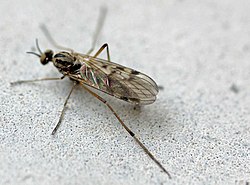
Picture of Anisopodidae
- Source
- Wikipedia/Commons
- Credit
- nobody named on the record
- Licence
- Attribution
- Commercial use
- cannot be read from the licence given — check the record
No 3D scan of Anisopodidae was found in Sketchfab.
Smithsonian Open Access and MorphoSource were not reached for this taxon, so this list is what the others held rather than everything there is.
The description on this site
- Licence
- CC BY-SA 4.0
This is what the site found, which is not the same as what exists.
Keep going
What may have been alongside itAnisopodoidea through timeFormations of the EoceneThe world it lived on
Occurrence data from the Paleobiology Database, CC BY 4.0. Knab 1912