Diptera
A fly is an insect of the order Diptera, named for the single pair of wings. The hindwings have evolved into halteres, organs that sense rotation, giving flies precise control of their flight. Diptera is a large order containing more than 150,000 species, including horse-flies, crane flies, hoverflies, mosquitoes and others.

Uncredited · via Wikipedia/Commons. May be a photograph of a specimen, or an artist’s reconstruction — an interpretation of a skeleton, since colour and soft tissue are almost never preserved.
On record
Recorded, not inferred- Also called
- flyPBDB
- Sits inside
- AntliophoraPBDB
- Motility
- actively mobilePBDB, for Arthropoda
- Environment
- terrestrialPBDB, for Insecta
Time the record covers
At least 387 million years on record.
The record covers at least 387.95 Mya to 11.7 ka. No occurrence read is dated outside 390.5 Mya to 0 Mya.
8,451 occurrences of Diptera on record, most of them in the Eocene. The Paleobiology Database records this as a living group. Bar height is expected occurrences, not a count: each fossil is spread across the span it is dated to, so a tall narrow bar means tight dating and a low wide one means loose.
When
8,451 occurrences- Devonianunder 1%
- Middle Triassicunder 1%
- Late Triassicunder 1%
- Early Jurassic3%
- Middle Jurassic1%
- Late Jurassic8%
- Early Cretaceous11%
- Late Cretaceous8%
- Paleoceneunder 1%
- Eocene41%
- Oligocene10%
- Miocene12%
- Plioceneunder 1%
- Pleistocene1%
- Holocene1%
These are dates about fossils, not the animal: the record can only begin after it arose and end before it died out, so either end may reach further. Shares are expected occurrences: a fossil dated to a span is counted partly in each period it straddles. More on what this infers.
Found in
203 formations
- Florissant Formation322
- Rott Formation313
- Karabastau Formation217
- Niveau du gypse d'Aix Formation178
- Bouldnor Formation · Solent Group162
- Daohugou Formation151
Loading coastlines…
The named rock units Diptera has been recovered from, largest first. Drawn where the rock is now, not where it formed. 179 further formations hold fewer occurrences each and are not listed. 4,437 occurrences have no formation on record, which is common for older literature.
Diptera and its relatives
EoceneWhere Diptera and its relatives were recorded in the Eocene.
Found in the same rock
7,072 taxa- Coleoptera27 sites
- Curculionidae13 sites
- Plecia foersteri11 sites
- Bibionidae10 sites
- Formicidae10 sites
- Plecia10 sites
- Tipula10 sites
- Bibio9 sites
- Mycetophilidae9 sites
- Plecia bucklandi9 sites
- Aphanus pulchellus8 sites
- Brachycera8 sites
- Cydnus brevicollis8 sites
- Plecia pictipennis8 sites
- Anostraca7 sites
- Atriculicoides globosus7 sites
- Blattodea7 sites
- Chironomidae7 sites
- Culicoides filipalpis7 sites
- Distenorrhinus (Distenorrhinus) pallidirostris7 sites
- Insecta7 sites
- Odonata7 sites
- Orthoptera7 sites
- Panorpidium geinitzi7 sites
The Paleobiology Database records at least 394 sites for Diptera, and this reads 240 of them. Of that, one read hit the database's own return limit, so every count below is a floor rather than a total. The number is how many of those sites it was catalogued from too. The 24 sharing the most are listed.
This is not a list of everything alive at the time. It is only what has come out of the same ground as this animal and been written down.
Entered from
1,427 references- Monographie des Cecidomyidae, des Sciaridae, des Mycetophilidae et des Chironomidae de l'ambre de la Baltique269
- Les insectes fossiles des terrains oligocènes de France225
- Biting midges (Diptera, Ceratopogonidae) from Baltic amber224
- Krzemińska et al., 2009109
- A Report on Some Miocene Diptera from Florissant, Colorado100
- Crane-flies of the Baltic Amber (Diptera)94
- Heer, 184991
- Fossil arthropods of California 29. Silicified Miocene pupae of ceratopogonid flies87
- True flies (Insecta: Diptera) from the late Eocene insect limestone (Bembridge Marls) of the Isle of Wight, England, UK84
- Infraorders Psychodomorpha, Tipulomorpha and Culicomorpha74
- Neue Dipteren (Nematocera) aus dem Oberoligocan von Rott. 1. Teil 6. Familie: Tendipedidae (Zuck- oder Schwarmmucken). 2. Teil 7. Familie: Heleidae (Gnitzen) 3. Teil 8. Familie: Lycoriidae (Trauermucken)74
- Biting midges (Diptera: Ceratopogonidae) in Eocene Baltic amber from the Rovno region (Ukraine)71
Each of the 8,451 occurrences read was entered from one of these publications, ordered by how many each accounts for. This is not a search for papers mentioning the name. 1,415 further references are not listed. Entries link to doi.org where the Paleobiology Database holds an identifier, and to its own record where it does not. Relayed as the Paleobiology Database holds them, not checked against what they resolve to.
Media and terms
Media content2
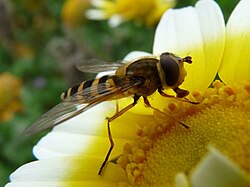
Picture of Diptera
- Source
- Wikipedia/Commons
- Credit
- nobody named on the record
- Licence
- not stated by the source
- Commercial use
- cannot be read from the licence given — check the record
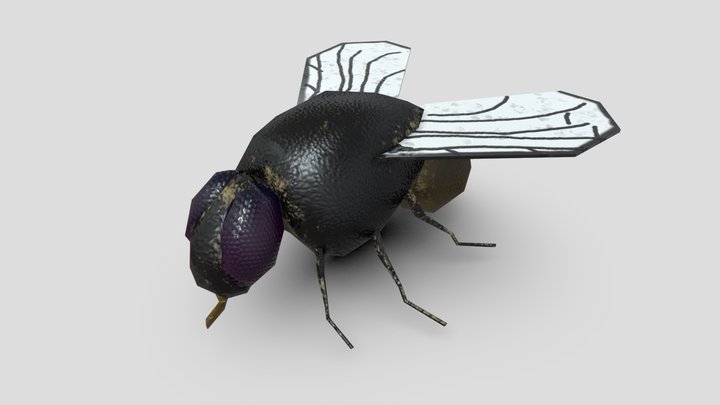
3D model
- Source
- Sketchfab
- Credit
- Glowbox 3D
- Licence
- CC Attribution
- Commercial use
- cannot be read from the licence given — check the record
Smithsonian Open Access and MorphoSource were not reached for this taxon, so this list is what the others held rather than everything there is.
The description on this site
- Source
- Wikipedia, “Fly”
- Licence
- CC BY-SA 4.0
This is what the site found, which is not the same as what exists.
Keep going
What may have been alongside itAntliophora through timeFormations of the EoceneThe world it lived on
Occurrence data from the Paleobiology Database, CC BY 4.0. Linnaeus 1758