Anostraca
Anostraca is one of the four orders of crustaceans in the class Branchiopoda; its members are referred to as fairy shrimp. They live in vernal pools and hypersaline lakes across the world, and they have even been found in deserts, ice-covered mountain lakes, and Antarctic ice. They are usually 6–25 mm (0.24–0.98 in) long. Most species have 20 body segments, bearing 11 pairs of leaf-like phyllopodia, and the body lacks a carapace. They swim "upside-down" and feed by filtering organic particles from the water or by scraping algae from surfaces, with the exception of Branchinecta gigas, or "giant fairy shrimp", which is itself a predator of other species of anostracans. They are an important food for many birds and fish, and some are cultured and harvested for use as fish food. There are 300 species spread across 8 families.

Hans Hillewaert · CC BY-SA 4.0 · via Wikipedia/Commons. May be a photograph of a specimen, or an artist’s reconstruction — an interpretation of a skeleton, since colour and soft tissue are almost never preserved.
On record
Recorded, not inferred- Sits inside
- BranchiopodaPBDB
- Diet
- suspension feeder, detritivorePBDB, for Branchiopoda
- Life habit
- nektobenthicPBDB, for Branchiopoda
- Motility
- slow-movingPBDB, for Branchiopoda
- Vision
- well-developedPBDB, for Branchiopoda
- Environment
- marine,brackish,freshwaterPBDB, for Branchiopoda
Time the record covers
At least 392 million years on record.
The record covers at least 410.62 Mya to 18.5 Mya. No occurrence read is dated outside 413.02 Mya to 16.3 Mya.
26 occurrences of Anostraca on record, most of them in the Miocene. The Paleobiology Database records this as a living group, and the chart stops with its fossils rather than at the present. Bar height is expected occurrences, not a count: each fossil is spread across the span it is dated to, so a tall narrow bar means tight dating and a low wide one means loose.
When
26 occurrencesThese are dates about fossils, not the animal: the record can only begin after it arose and end before it died out, so either end may reach further. Shares are expected occurrences: a fossil dated to a span is counted partly in each period it straddles. More on what this infers.
Found in
4 formations
Loading coastlines…
The named rock units Anostraca has been recovered from, largest first. Drawn where the rock is now, not where it formed. 1 occurrence has no formation on record, which is common for older literature.
Anostraca and its relatives
MioceneWhere Anostraca and its relatives were recorded in the Miocene.
Found in the same rock
166 taxa- Dasyhelea antiqua21 sites
- Schistomerus californense21 sites
- Protoarrenurus convergens11 sites
- Thripidae11 sites
- Calopsectra5 sites
- Culicoides megacanthus4 sites
- Dasyhelea stenoceras4 sites
- Orthemis4 sites
- Anaphothrips (Proscirtothrips) vitreus3 sites
- Argenna fossilis2 sites
- Carpelimus2 sites
- Diplostraca2 sites
- ? Pachytheca sp.1 site
- Acalyptratae1 site
- Acanthodii1 site
- Actinopterygii1 site
- Anthocoridae1 site
- Araneae1 site
- Archaeothrix1 site
- Archaeothrix oscillatoriformis1 site
- Arthropoda1 site
- Asteroxylon1 site
- Atherimorpha festuca1 site
- Aulacidae1 site
The Paleobiology Database records 26 sites for Anostraca, and this reads all of them. The number is how many of those sites it was catalogued from too. The 24 sharing the most are listed.
This is not a list of everything alive at the time. It is only what has come out of the same ground as this animal and been written down.
Entered from
6 references- Miocene arthropods from the Mojave desert, California21
- First decapod crustaceans in a Late Devonian continental ecosystem1
- Paleoecology of an exceptionally preserved arthropod fauna from lake deposits of the Miocene Barstow Formation, Southern California, U.S.A.1
- A Carboniferous insect1
- Lower Cretaceous fleas1
- On a new type of crustacean from the Old Red Sandstone (Rhynie Chert Bed, Aberdenshire) -- Lepidocaris rhyniensis gen. et sp. nov1
Each of the 26 occurrences read was entered from one of these publications, ordered by how many each accounts for. This is not a search for papers mentioning the name. Each entry links to doi.org. Relayed as the Paleobiology Database holds them, not checked against what they resolve to.
Media and terms
Media content1
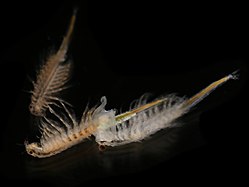
Picture of Anostraca
- Source
- Wikipedia/Commons
- Credit
- Hans Hillewaert
- Licence
- CC BY-SA 4.0
- Commercial use
- the licence allows it
No 3D scan of Anostraca was found in MorphoSource and Sketchfab.
Smithsonian Open Access was not reached for this taxon, so this list is what the others held rather than everything there is.
The description on this site
- Source
- Wikipedia, “Anostraca”
- Licence
- CC BY-SA 4.0
This is what the site found, which is not the same as what exists.
Keep going
What may have been alongside itBranchiopoda through timeFormations of the MioceneThe world it lived on
Occurrence data from the Paleobiology Database, CC BY 4.0. Sars 1867