Osteichthyes
Osteichthyes, also known as osteichthyans or commonly referred to as the bony fish, is a diverse clade of vertebrate animals that have endoskeletons primarily composed of bone tissue, encompassing both the conventional bony fishes and, in a cladistic sense, all tetrapods, including mammals and reptiles. They can be contrasted with the Chondrichthyes and the extinct placoderms and acanthodians, which have endoskeletons primarily composed of cartilage. The vast majority of extant fish are members of Osteichthyes, being an extremely diverse and abundant group consisting of 45 orders, over 435 families and 28,000 species.

Prehistoricplanes · CC BY-SA 4.0 · via Wikipedia/Commons. May be a photograph of a specimen, or an artist’s reconstruction — an interpretation of a skeleton, since colour and soft tissue are almost never preserved.
On record
Recorded, not inferred- Also called
- bony fishPBDB
- Sits inside
- GnathostomataPBDB
- Motility
- actively mobilePBDB
Time the record covers
At least 438 million years on record.
The record covers at least 438.6 Mya to 11.7 ka. No occurrence read is dated outside 443.1 Mya to 0 Mya.
12,000+ occurrences of Osteichthyes on record. The Paleobiology Database records this as a living group. Bar height is expected occurrences, not a count: each fossil is spread across the span it is dated to, so a tall narrow bar means tight dating and a low wide one means loose.
When
12,000 occurrences read- Silurianunder 1%
- Devonianunder 1%
- Carboniferousunder 1%
- Permianunder 1%
- Early Triassicunder 1%
- Middle Triassicunder 1%
- Late Triassicunder 1%
- Early Jurassicunder 1%
- Late Jurassicunder 1%
- Early Cretaceousunder 1%
- Late Cretaceous12%
- Paleocene35%
- Eocene45%
- Oligoceneunder 1%
- Miocene3%
- Plioceneunder 1%
- Pleistoceneunder 1%
- Holoceneunder 1%
These are dates about fossils, not the animal: the record can only begin after it arose and end before it died out, so either end may reach further. Shares are expected occurrences: a fossil dated to a span is counted partly in each period it straddles. The read hit its cap, so every figure above is a floor and the shares are of the occurrences read. More on what this infers.
Found in
at least 286 formations
- Willwood Formation2,702
- Fort Union Formation965
- Wasatch Formation867
- DeBeque Formation744
- Hell Creek Formation · Montana Group633
- Wind River Formation589
Loading coastlines…
The named rock units Osteichthyes has been recovered from, largest first. Drawn where the rock is now, not where it formed. The read hit its cap, so each count is a floor. 262 further formations hold fewer occurrences each and are not listed. 1,573 occurrences have no formation on record, which is common for older literature.
Found in the same rock
2,728 taxa- Nuculana36 sites
- Gastropoda29 sites
- Actinopterygii28 sites
- Bryozoa28 sites
- Bivalvia26 sites
- Myrtaea (Myrtaea) curta25 sites
- Orbiculoidea25 sites
- Eburneopecten scintillatus24 sites
- Lingula24 sites
- Caestocorbula wailesiana23 sites
- Corbula densata23 sites
- Tellinidae23 sites
- Venericardia (Rotundicardia) diversidentata23 sites
- Callista annexa21 sites
- Kapalmerella alveata21 sites
- Nucula (Nucula) sphenopsis21 sites
- Spisula jacksonensis21 sites
- Turritella21 sites
- Dentalium20 sites
- Alveinus minutus19 sites
- Bathytormus flexurus19 sites
- Crassinella pygmaea19 sites
- Nuculopsis19 sites
- Retusa jacksonensis19 sites
The Paleobiology Database records at least 651 sites for Osteichthyes, and this reads 240 of them. The number is how many of those sites it was catalogued from too. The 24 sharing the most are listed.
This is not a list of everything alive at the time. It is only what has come out of the same ground as this animal and been written down.
Entered from
at least 817 references- Synonymies and reidentifications of North American fossil mammals1,492
- Faunal Zonation of the Willwood Formation in the Central Bighorn Basin, Wyoming811
- The Clarkforkian Land-Mammal Age and Mammalian Faunal Composition Across the Paleocene-Eocene Boundary762
- Early Eocene Mammalian Fauna of the Piceance Creek Basin. Northwestern Colorado488
- The Bug Creek problem and the Cretaceous-Tertiary transition at McGuire Creek, Montana277
- Revision of the Wind River faunas, early Eocene of central Wyoming. Part 13. Systematics and phylogenetic pattern of early Eocene Hyopsodus (Mammalia: Condylarthra)225
- Paleocene vertebrate paleontology of the San Juan Basin, New Mexico206
- Distribution and stratigraphic correlation of upper Paleocene and lower Eocene fossil mammal and plant localities of the Fort Union, Willwood, and Tatman formations, southern Bighorn Basin, Wyoming199
- Systematics and Evolution of Early Eocene Hyaenodontidae (Mammalia, Creodonta) in the Clarks Fork Basin, Wyoming182
- Ancestry and Species Definition in Paleontology: A Stratocladistic Analysis of Paleocene-Eocene Viverravidae (Mammalia, Carnivora) from Wyoming179
- Systematics and Evolution of Early Eocene Perissodactyla (Mammalia) in the Clarks Fork Basin, Wyoming164
- Late Cretaceous and Paleocene mammal localities of southern Alberta158
Each of the 12,000 occurrences read was entered from one of these publications, ordered by how many each accounts for. This is not a search for papers mentioning the name. That read hit its cap, so each count is a floor. 805 further references are not listed. Entries link to doi.org where the Paleobiology Database holds an identifier, and to its own record where it does not. Relayed as the Paleobiology Database holds them, not checked against what they resolve to.
Media and terms
Media content2
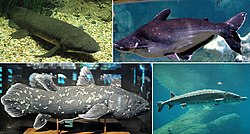
Picture of Osteichthyes
- Source
- Wikipedia/Commons
- Credit
- Prehistoricplanes
- Licence
- CC BY-SA 4.0
- Commercial use
- the licence allows it
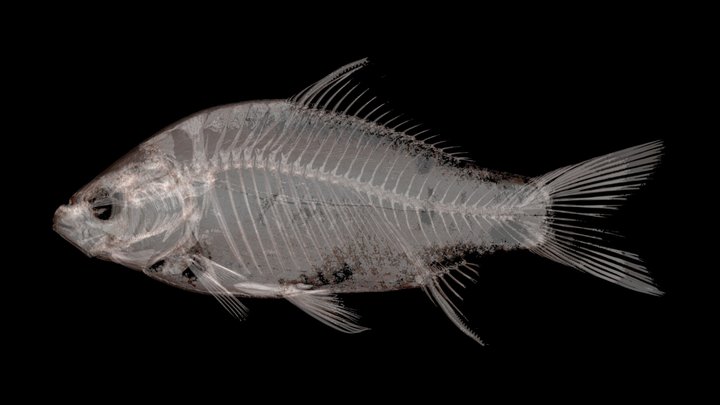
3D model
- Source
- Sketchfab
- Licence
- CC Attribution-NonCommercial-ShareAlike
- Commercial use
- the licence does not allow it
Smithsonian Open Access was not reached for this taxon, so this list is what the others held rather than everything there is.
The description on this site
- Licence
- CC BY-SA 4.0
This is what the site found, which is not the same as what exists.
Keep going
What may have been alongside itGnathostomata through timeThe world it lived on
Occurrence data from the Paleobiology Database, CC BY 4.0. (Huxley 1880)