Arieticeras
Arieticeras is an extinct genus of cephalopod belonging to the Ammonite subclass.

Antonov · CC BY-SA 4.0 · via Wikipedia/Commons. May be a photograph of a specimen, or an artist’s reconstruction — an interpretation of a skeleton, since colour and soft tissue are almost never preserved.
On record
Recorded, not inferred- Sits inside
- ArieticeratinaePBDB
- Diet
- carnivorePBDB, for Ammonoidea
- Life habit
- nektonicPBDB, for Ammonoidea
- Motility
- fast-movingPBDB, for Ammonoidea
- Vision
- well-developedPBDB, for Cephalopoda
- Environment
- marinePBDB, for Cephalopoda
Time the record covers
At least 700 thousand years on record.
The record covers at least 184.2 Mya to 183.5 Mya. No occurrence read is dated outside 201.4 Mya to 168.2 Mya.
206 occurrences of Arieticeras on record, most of them in the Early Jurassic. Bar height is expected occurrences, not a count: each fossil is spread across the span it is dated to, so a tall narrow bar means tight dating and a low wide one means loose.
When
206 occurrences- Early Jurassic100%
- Middle Jurassicunder 1%
These are dates about fossils, not the animal: the record can only begin after it arose and end before it died out, so either end may reach further. Shares are expected occurrences: a fossil dated to a span is counted partly in each period it straddles. More on what this infers.
Found in
26 formations
- Inklin Formation · Laberge Group29
- Spatsizi Formation · Hazelton Group19
- Fannin Formation · Maude Group17
- Staa Formation9
- Bou Gabrine Formation5
- Isztimér Formation5
Loading coastlines…
The named rock units Arieticeras has been recovered from, largest first. Drawn where the rock is now, not where it formed. 2 further formations hold fewer occurrences each and are not listed. 83 occurrences have no formation on record, which is common for older literature.
Arieticeras and its relatives
Early JurassicWhere Arieticeras and its relatives were recorded in the Early Jurassic.
Found in the same rock
274 taxa- Calliphylloceras bicicolae18 sites
- Leptaleoceras accuratum17 sites
- Phylloceras hebertinum17 sites
- Phylloceratoidea14 sites
- Protogrammoceras14 sites
- Amaltheus stokesi12 sites
- Partschiceras striatocostatum12 sites
- Amaltheus margaritatus10 sites
- Juraphyllites10 sites
- Lytoceras9 sites
- Amaltheus8 sites
- Fuciniceras8 sites
- Hantkeniceras hantkeni8 sites
- Fanninoceras (Fanninoceras) fannini7 sites
- Juraphyllites (Harpophylloceras) eximius7 sites
- Juraphyllites (Meneghiniceras) lariense6 sites
- Leptaleoceras6 sites
- Leptaleoceras insigne6 sites
- Linguithyris aspasia6 sites
- Phylloceras6 sites
- Zetoceras zetes6 sites
- Ammonoidea5 sites
- Fanninoceras5 sites
- Fanninoceras (Fanninoceras) carlottense5 sites
The Paleobiology Database records 118 sites for Arieticeras, and this reads all of them. The number is how many of those sites it was catalogued from too. The 24 sharing the most are listed.
This is not a list of everything alive at the time. It is only what has come out of the same ground as this animal and been written down.
Entered from
41 references- Early Jurassic Bivalvia of western Canada. Part I. Subclasses Palaeotaxodonta, Pteriomorpha, and Isofilibranchia22
- Pliensbachian (Lower Jurassic) biostratigraphy and ammonite fauna of the Spatsizi area, north-central British Columbia19
- Pliensbachian (Lower Jurassic) ammonites of the Queen Charlotte Islands, British Columbia17
- Les ammonites du Domérien de la montagne du Bakony (Hongrie)16
- Early Jurassic evolution of the northern Stikinian arc: evidence from the Laberge Group, northwestern British Columbia15
- Provenance Constraints on Early Jurassic Evolution of the Northern Stikinian Arc: Laberge Group, Whitehorse Trough, Northwestern British Columbia14
- Carbon-isotope events during the Pliensbachian (Lower Jurassic) on the African and European margins of the NW Tethyan Realm9
- Les ammonites du jurassique inférieur et moyen de la dorsal tunisienne9
- Ammoniten aus dem Pliensbachium (Carixium und Domerium) von Südamerika6
- Lower to Middle Jurassic Stratigraphy and Ammonite Fauna of the Northern Whitehorse Trough, Yukon, Canada6
- Liassic (Pliensbachian) ammonites from the Lienz Dolomites (Eastern Tyrol, Austria)6
- Biostratigraphy of the Lower and Middle Jurassic deposits of the Far East6
Each of the 206 occurrences read was entered from one of these publications, ordered by how many each accounts for. This is not a search for papers mentioning the name. 29 further references are not listed. Entries link to doi.org where the Paleobiology Database holds an identifier, and to its own record where it does not. Relayed as the Paleobiology Database holds them, not checked against what they resolve to.
Media and terms
Media content2

Picture of Arieticeras
- Source
- Wikipedia/Commons
- Credit
- Antonov
- Licence
- CC BY-SA 4.0
- Commercial use
- the licence allows it
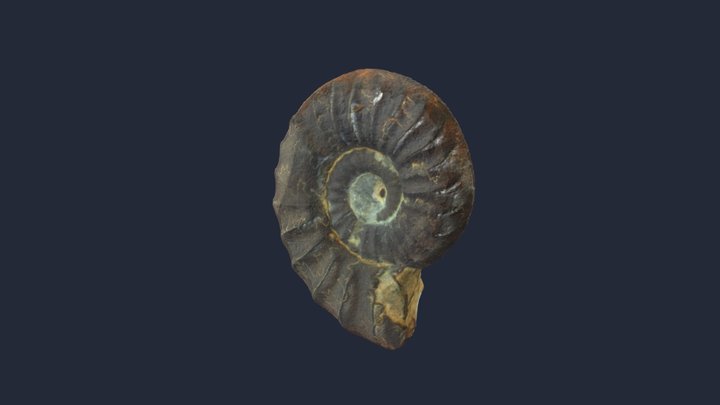
3D model
- Source
- Sketchfab
- Credit
- Shellie Luallin
- Licence
- CC Attribution
- Commercial use
- cannot be read from the licence given — check the record
The description on this site
- Source
- Wikipedia, “Arieticeras”
- Licence
- CC BY-SA 4.0
This is what the site found, which is not the same as what exists.
Keep going
What may have been alongside itArieticeratinae through timeFormations of the Early JurassicThe world it lived on
Occurrence data from the Paleobiology Database, CC BY 4.0. (Seguenza 1885)