Arsinoitherium
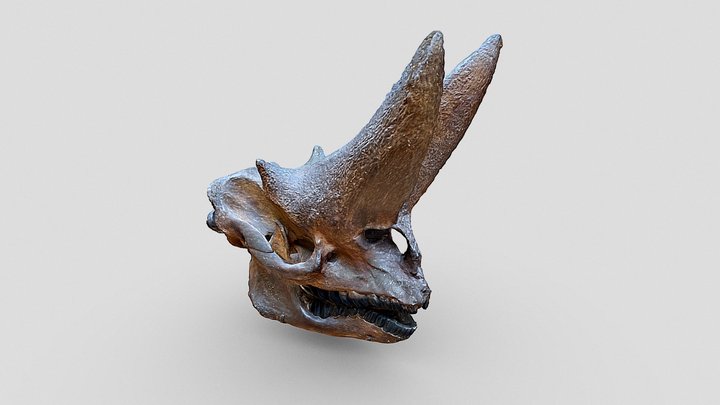
Arsinoitherium is an extinct genus of paenungulate mammals belonging to the extinct order Embrithopoda. It is related to elephants, sirenians, and hyraxes. Arsinoitheres were superficially rhinoceros-like herbivores that lived during the Late Eocene and the Early Oligocene of North Africa from 36 to 30 million years ago, in areas of tropical rainforest and at the margin of mangrove swamps. A species described in 2004, A. giganteum, lived in Ethiopia about 27 million years ago.

Aram Dulyan ( User:Aramgutang ) · CC BY 2.5 · via Wikipedia/Commons. May be a photograph of a specimen, or an artist’s reconstruction — an interpretation of a skeleton, since colour and soft tissue are almost never preserved.
On record
Recorded, not inferred- Sits inside
- ArsinoitheriidaePBDB
- Diet
- insectivorePBDB, for Theria
- Life habit
- scansorialPBDB, for Eutheria
- Motility
- actively mobilePBDB, for Osteichthyes
- Environment
- terrestrialPBDB, for Eutheria
- Length
- 3 mWikidata
Time the record covers
At least 10 million years on record.
The record covers at least 37.71 Mya to 27.3 Mya. No occurrence read is dated outside 41.03 Mya to 23.04 Mya.
14 occurrences of Arsinoitherium on record, most of them in the Oligocene. Bar height is expected occurrences, not a count: each fossil is spread across the span it is dated to, so a tall narrow bar means tight dating and a low wide one means loose.
When
14 occurrencesThese are dates about fossils, not the animal: the record can only begin after it arose and end before it died out, so either end may reach further. Shares are expected occurrences: a fossil dated to a span is counted partly in each period it straddles. More on what this infers.
Found in
8 formations
- Jebel Qatrani Formation3
- Ashawq Formation3
- Idam Unit Formation1
- Aydim Formation · Hardramawt Group1
- Shumaysi Formation1
- Erageleit Formation1
Loading coastlines…
The named rock units Arsinoitherium has been recovered from, largest first. Drawn where the rock is now, not where it formed. 2 occurrences have no formation on record, which is common for older literature.
Arsinoitherium and its relatives
OligoceneWhere Arsinoitherium and its relatives were recorded in the Oligocene.
Found in the same rock
229 taxa- Bunohyrax3 sites
- Megalohyrax eocaenus3 sites
- Talahphiomys lavocati3 sites
- Thyrohyrax meyeri3 sites
- Anomaluridae2 sites
- Arsinotherium2 sites
- Asteroidea2 sites
- Bothriogenys gorringei2 sites
- Bunohyrax fajumensis2 sites
- Creodonta2 sites
- Discorbidae2 sites
- Eremopezus eocaenus2 sites
- Geniohyus2 sites
- Gomphotherium2 sites
- Hemipristis serra2 sites
- Himantura2 sites
- Hyainailouros2 sites
- Metaphiomys2 sites
- Moeritherium trigonodon2 sites
- Nummulites2 sites
- Palaeomastodon2 sites
- Phiomia2 sites
- Phiomia minor2 sites
- Phiomys andrewsi2 sites
The Paleobiology Database records 13 sites for Arsinoitherium, and this reads all of them. The number is how many of those sites it was catalogued from too. The 24 sharing the most are listed.
This is not a list of everything alive at the time. It is only what has come out of the same ground as this animal and been written down.
Entered from
11 references- Large Mammals from the Rupelian of Oman – Recent Finds2
- Oligocene-Miocene terrestrial vertebrates in the southern Arabian peninsula (Sultanate of Oman) and their geodynamic and palaeogeographic settings2
- A Descriptive Catalogue of the Tertiary Vertebrata of Fayum, Egypt2
- Discovery of an embrithopod mammal (Arsinoitherium?) in the late Eocene of Tunisia1
- New Oligocene primate from Saudi Arabia and the divergence of apes and Old World monkeys1
- A Mammalian Fauna from the Late Oligocene of Northwestern Kenya1
- The first described Arsinoitherium from Eocene Aydim Formation of Oman: Biogeographic implications1
- New large−bodied mammals from the late Oligocene site of Chilga, Ethiopia.1
- Ecological diversity and community ecology in the Fayum sequence (Egypt)1
- Premiere découverte d'une faune mammalienne terrestre paleogene d'Afrique sub-saharienne1
- Palaeogene vertebrate fauna and regressive sediments of Dur at Talhah, southern Sirt Basin, Libya1
Each of the 14 occurrences read was entered from one of these publications, ordered by how many each accounts for. This is not a search for papers mentioning the name. Entries link to doi.org where the Paleobiology Database holds an identifier, and to its own record where it does not. Relayed as the Paleobiology Database holds them, not checked against what they resolve to.
Media and terms
Media content2

Picture of Arsinoitherium
- Source
- Wikipedia/Commons
- Credit
- Aram Dulyan ( User:Aramgutang )
- Licence
- CC BY 2.5
- Commercial use
- the licence allows it
Smithsonian Open Access and MorphoSource were not reached for this taxon, so this list is what the others held rather than everything there is.
The description on this site
- Licence
- CC BY-SA 4.0
This is what the site found, which is not the same as what exists.
Keep going
What may have been alongside itArsinoitheriidae through timeFormations of the OligoceneThe world it lived on
Occurrence data from the Paleobiology Database, CC BY 4.0. Beadnell 1902