Arthropleura
Arthropleura, from Ancient Greek ἄρθρον (árthron), meaning "joint", and πλευρά (pleurá), meaning "rib", is an extinct genus of massive myriapod that lived in modern-day Europe and North America around 344 to 292 million years ago, from the Viséan stage of the lower Carboniferous period to the Sakmarian stage of the lower Permian period. It was a millipede, and was capable of reaching at least 2 metres in length, possibly up to over 2.5 metres, making it the largest known land arthropod of all time. Arthropleura is known from body fossils as well as trace fossils, particularly giant trackways up to 50 centimetres (20 in) wide, and potentially also large burrows. It lived in open, sparsely wooded environments near water, and may have been amphibious.

Mickaël Lhéritier, Gregory D. Edgecombe, Russell J. Garwood, Adrien Buisson, Alexis Gerbe, Nicolás Mongiardino Koch,… · CC BY 4.0 · via Wikipedia/Commons. May be a photograph of a specimen, or an artist’s reconstruction — an interpretation of a skeleton, since colour and soft tissue are almost never preserved.
On record
Recorded, not inferred- Sits inside
- ArthropleuridaePBDB
- Motility
- actively mobilePBDB, for Arthropoda
Time the record covers
At least 31 million years on record.
The record covers at least 330.3 Mya to 298.9 Mya. No occurrence read is dated outside 346.7 Mya to 290.1 Mya.
61 occurrences of Arthropleura on record, most of them in the Carboniferous. Bar height is expected occurrences, not a count: each fossil is spread across the span it is dated to, so a tall narrow bar means tight dating and a low wide one means loose.
When
61 occurrences- Carboniferous98%
- Permian2%
These are dates about fossils, not the animal: the record can only begin after it arose and end before it died out, so either end may reach further. Shares are expected occurrences: a fossil dated to a span is counted partly in each period it straddles. More on what this infers.
Found in
21 formations
- Lower Saarbrucker layer Formation6
- Upper Saarbrucker layer Formation5
- Farrington Formation3
- Wettin Formation2
- Foel Formation1
- Luisenthal Formation · Saarbrucken Group1
Loading coastlines…
The named rock units Arthropleura has been recovered from, largest first. Drawn where the rock is now, not where it formed. 28 occurrences have no formation on record, which is common for older literature.
Arthropleura and its relatives
CarboniferousWhere Arthropleura and its relatives were recorded in the Carboniferous.
Found in the same rock
285 taxa- Archimylacridae5 sites
- Lepidostrobophyllum3 sites
- Alanops magnificus2 sites
- Allobuthus pescei2 sites
- Anthracomartus2 sites
- Aphantomartus pustulatus2 sites
- Bornatarbus mayasii2 sites
- Cyperites2 sites
- Dictyoneuridae2 sites
- Dictyoptera2 sites
- Macrogyion cronus2 sites
- Palaeocampa anthrax2 sites
- Palaeocaris secretanae2 sites
- Pecopteris2 sites
- Sigillariostrobus2 sites
- Stigmaria ficoides2 sites
- Trigonotarbida2 sites
- Actinopteri1 site
- Adelophthalmus1 site
- Adelophthalmus mansfieldi1 site
- Alethopteris zeilleri1 site
- Alienus lebachensis1 site
- Althansia sahneri1 site
- Ameticos scolos1 site
The Paleobiology Database records 58 sites for Arthropleura, and this reads all of them. The number is how many of those sites it was catalogued from too. The 24 sharing the most are listed.
This is not a list of everything alive at the time. It is only what has come out of the same ground as this animal and been written down.
Entered from
21 references- Die Arthropoden aus dem Carbon und Perm des Saar-Nahe-Pfalz-Gebietes15
- La faune continentale du terrain houiller de la Belgique13
- Hallazgos de Arthropleura en el Estefaniense de la Península Ibérica5
- Pruvost, 19195
- Arthropleurids from the Westphalian D of Writhlington Geological Nature Reserve, Somerset3
- Remains of Arthropleura, a gigantic myriapod arthropod, from the Pennsylvanian of Ohio and Pennsylvania2
- Arthropodenfunde im Stefan der Halleschen Mulde2
- Sur les débris d’Arthropleura trouvés en France2
- Goldenberg, 18732
- A new record of the myriapod genus Arthropleura Jordan in Jordan et von Meyer, 1854 from the Pennsylvanian of Ukraine1
- Head anatomy and phylogenomics show the Carboniferous giant Arthropleura belonged to a millipede-centipede group1
- The largest arthropod in Earth history: insights from newly discovered Arthropleura remains (Serpukhovian Stainmore Formation, Northumberland, England)1
Each of the 61 occurrences read was entered from one of these publications, ordered by how many each accounts for. This is not a search for papers mentioning the name. 9 further references are not listed. Entries link to doi.org where the Paleobiology Database holds an identifier, and to its own record where it does not. Relayed as the Paleobiology Database holds them, not checked against what they resolve to.
Media and terms
Media content2

Picture of Arthropleura
- Source
- Wikipedia/Commons
- Credit
- Mickaël Lhéritier, Gregory D. Edgecombe, Russell J. Garwood, Adrien Buisson, Alexis Gerbe, Nicolás Mongiardino Koch,…
- Licence
- CC BY 4.0
- Commercial use
- the licence allows it
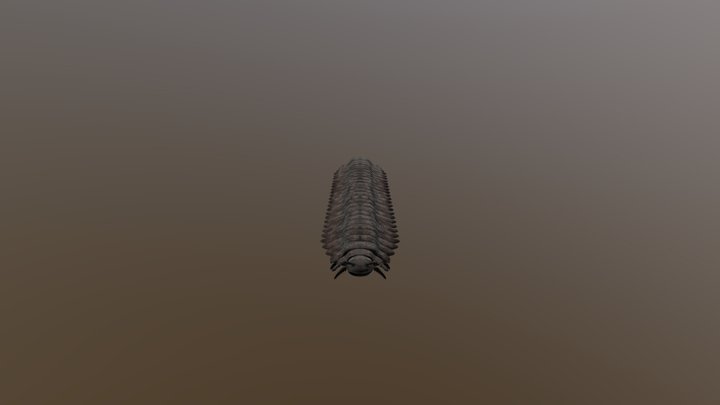
3D model
- Source
- Sketchfab
- Credit
- DeapBluScea
- Licence
- CC Attribution
- Commercial use
- cannot be read from the licence given — check the record
Smithsonian Open Access and MorphoSource were not reached for this taxon, so this list is what the others held rather than everything there is.
The description on this site
- Licence
- CC BY-SA 4.0
This is what the site found, which is not the same as what exists.
Keep going
What may have been alongside itArthropleuridae through timeFormations of the CarboniferousThe world it lived on
Occurrence data from the Paleobiology Database, CC BY 4.0. (Jordan 1854)