Trigonotarbida
The order Trigonotarbida is a group of extinct arachnids whose fossil record extends from the late Silurian to the early Permian. These animals are known from several localities in Europe and North America, as well as a single record from Argentina. Trigonotarbids can be envisaged as spider-like arachnids, but without silk-producing spinnerets. They ranged in size from a few millimetres to a few centimetres in body length and had segmented abdomens (opisthosoma), with the dorsal exoskeleton (tergites) across the backs of the animals' abdomens, which were characteristically divided into three or five separate plates. Probably living as predators on other arthropods, some later trigonotarbid species were quite heavily armoured and protected themselves with spines and tubercles. About seventy species are currently known, with most fossils originating from the Carboniferous coal measures.

Junnn11 · CC BY-SA 4.0 · via Wikipedia/Commons. May be a photograph of a specimen, or an artist’s reconstruction — an interpretation of a skeleton, since colour and soft tissue are almost never preserved.
On record
Recorded, not inferred- Sits inside
- PantetrapulmonataPBDB
- Life habit
- solitaryPBDB, for Arachnida
- Motility
- actively mobilePBDB, for Arachnida
- Environment
- terrestrialPBDB, for Arachnida
Time the record covers
At least 126 million years on record.
The record covers at least 419.62 Mya to 293.52 Mya. No occurrence read is dated outside 422.7 Mya to 283.3 Mya.
182 occurrences of Trigonotarbida on record, most of them in the Carboniferous. Bar height is expected occurrences, not a count: each fossil is spread across the span it is dated to, so a tall narrow bar means tight dating and a low wide one means loose.
When
182 occurrences- Silurianunder 1%
- Devonian20%
- Carboniferous77%
- Permian2%
These are dates about fossils, not the animal: the record can only begin after it arose and end before it died out, so either end may reach further. Shares are expected occurrences: a fossil dated to a span is counted partly in each period it straddles. More on what this infers.
Found in
51 formations
- Kladno Formation18
- Panther Mountain Formation · Hamilton Group14
- Dryden Flags Formation10
- Carbondale Formation · Kewanee Group6
- Zacler Formation3
- Lancaster Formation3
Loading coastlines…
The named rock units Trigonotarbida has been recovered from, largest first. Drawn where the rock is now, not where it formed. 27 further formations hold fewer occurrences each and are not listed. 69 occurrences have no formation on record, which is common for older literature.
Trigonotarbida and its relatives
CarboniferousWhere Trigonotarbida and its relatives were recorded in the Carboniferous.
Found in the same rock
575 taxa- Anthracomartus hindi10 sites
- Aphantomartus pustulatus10 sites
- Anthracomartus priesti9 sites
- Anthracomartus8 sites
- Aphantomartus areolatus8 sites
- Anthracosiro woodwardi7 sites
- Maiocercus celticus7 sites
- Plesiosiro madeleyi6 sites
- Arthropleura armata5 sites
- Compsoscorpius buthiformis5 sites
- Weygoldtina anglica5 sites
- Anthracomartus voelkelianus4 sites
- Anthracosiro fritschii4 sites
- Architarbus rotundatus4 sites
- Arthropoda4 sites
- Goniotarbus tuberculatus4 sites
- Pleurojulus biornatus4 sites
- Trigonotarbus johnsoni4 sites
- Alkenia mirabilis3 sites
- Arachnida3 sites
- Archaeomartus levis3 sites
- Brachypyge carbonis3 sites
- Devonobius delta3 sites
- Eoscorpius carbonarius3 sites
The Paleobiology Database records 117 sites for Trigonotarbida, and this reads all of them. The number is how many of those sites it was catalogued from too. The 24 sharing the most are listed.
This is not a list of everything alive at the time. It is only what has come out of the same ground as this animal and been written down.
Entered from
84 references- A study of the structure classification and relationships of the Palaeozoic Arachnida based on the collections of the British Museum15
- New terrestrial arachnids from the Devonian of Gilboa, New York (Arachnida, Trigonotarbida)14
- Paleozoic and Mesozoic Arachnida of Europe12
- Pocock, 191112
- On some arachnid remains from the Old Red Sandstone (Rhynie Chert Bed, Aberdeenshire)8
- Fritsch, 18997
- A monograph of the terrestrial Palaeozoic Arachnida of North America6
- Les arachnides fossiles du houiller de Belgique4
- Pruvost, 19194
- On some arthropod remains from the Nottinghamshire and Derbyshire coal-field4
- First trigonotarbid arachnids from the Pennsylvanian of Indiana and Oklahoma3
- Trigonotarbid arachnids from the Lower Devonian (Siegenian) of Bürdenbach (Lahrbach Valley, Westerwald area, Rhenish Slate Mountains, Germany)3
Each of the 182 occurrences read was entered from one of these publications, ordered by how many each accounts for. This is not a search for papers mentioning the name. 72 further references are not listed. Entries link to doi.org where the Paleobiology Database holds an identifier, and to its own record where it does not. Relayed as the Paleobiology Database holds them, not checked against what they resolve to.
Media and terms
Media content1
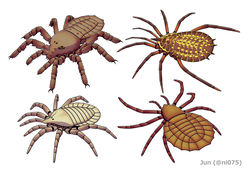
Picture of Trigonotarbida
- Source
- Wikipedia/Commons
- Credit
- Junnn11
- Licence
- CC BY-SA 4.0
- Commercial use
- the licence allows it
No 3D scan of Trigonotarbida was found in Sketchfab.
Smithsonian Open Access and MorphoSource were not reached for this taxon, so this list is what the others held rather than everything there is.
The description on this site
- Licence
- CC BY-SA 4.0
This is what the site found, which is not the same as what exists.
Keep going
What may have been alongside itPantetrapulmonata through timeFormations of the CarboniferousThe world it lived on
Occurrence data from the Paleobiology Database, CC BY 4.0. Petrunkevitch 1949