Australopithecus africanus
Australopithecus africanus is an extinct species of australopithecine which lived between about 3.3 and 2.1 million years ago in the Late Pliocene to Early Pleistocene of South Africa. The species has been recovered from Taung, Sterkfontein, Makapansgat, and Gladysvale. The first specimen, the Taung child, was described by anatomist Raymond Dart in 1924, and was the first early hominin found. However, its closer relations to humans than to other apes would not become widely accepted until the middle of the century because most had believed humans evolved outside of Africa. It is unclear how A. africanus relates to other hominins, being variously placed as ancestral to Homo and Paranthropus, to just Paranthropus, or to just P. robustus. The oldest known South African australopith specimen "Little Foot", representing the most completely preserved early hominin with 90% of the skeleton intact, has been controversially suggested to represent A. africanus, its probable junior synonym A. prometheus, or neither of the two taxa.

Guérin Nicolas ( messages ) · CC BY-SA 3.0 · via Wikipedia/Commons. May be a photograph of a specimen, or an artist’s reconstruction — an interpretation of a skeleton, since colour and soft tissue are almost never preserved.
On record
Recorded, not inferred- Sits inside
- AustralopithecusPBDB
- Diet
- omnivorePBDB, for Hominidae
- Life habit
- ground dwellingPBDB, for Hominidae
- Motility
- actively mobilePBDB, for Osteichthyes
- Environment
- terrestrialPBDB, for Eutheria
Time the record covers
At most 11 million years on record.
Every occurrence read is dated to somewhere between 11.63 Mya and 774 ka, and nothing in the dating separates them, so that window is what the record shows rather than a span.
7 occurrences of Australopithecus africanus on record, most of them in the Pliocene. Bar height is expected occurrences, not a count: each fossil is spread across the span it is dated to, so a tall narrow bar means tight dating and a low wide one means loose.
When
7 occurrences- Miocene17%
- Pliocene77%
- Pleistocene6%
These are dates about fossils, not the animal: the record can only begin after it arose and end before it died out, so either end may reach further. Shares are expected occurrences: a fossil dated to a span is counted partly in each period it straddles. More on what this infers.
Found in
5 formations
- Makapansgat Formation2
- Lothagam 1 Formation · Lothagam Group1
- Nawata and Nachukui Formation1
- USNO Formation · Omo Group1
- Sterkfontein Formation · Transvaal Group1
Loading coastlines…
The named rock units Australopithecus africanus has been recovered from, largest first. Drawn where the rock is now, not where it formed. 1 occurrence has no formation on record, which is common for older literature.
Australopithecus africanus and its relatives
PlioceneWhere Australopithecus africanus and its relatives were recorded in the Pliocene.
Found in the same rock
164 taxa- Bovidae4 sites
- Felidae4 sites
- Gazella4 sites
- Hipparion4 sites
- Parapapio4 sites
- Damaliscus3 sites
- Deinotherium3 sites
- Hyaenidae3 sites
- Megantereon3 sites
- Nyanzachoerus3 sites
- Antilope2 sites
- Ceratotherium simum2 sites
- Cercocebus2 sites
- Crocodylus2 sites
- Crocuta crocuta2 sites
- Diceros bicornis2 sites
- Equus2 sites
- Eurygnathohippus turkanense2 sites
- Euthecodon2 sites
- Giraffa2 sites
- Gomphotheriidae2 sites
- Hexaprotodon2 sites
- Hippotherium primigenium2 sites
- Hominidae2 sites
The Paleobiology Database records 7 sites for Australopithecus africanus, and this reads all of them. The number is how many of those sites it was catalogued from too. The 24 sharing the most are listed.
This is not a list of everything alive at the time. It is only what has come out of the same ground as this animal and been written down.
Entered from
7 references- Lothagam: a record of faunal change in the late Miocene of East Africa1
- Extinct large Colobines from the Plio-Pleistocene of Africa1
- Re-appraisal of lithostratigraphy of Sterkfontein hominid site1
- Elephant Shrews (Macroscelididae) from Olduvai and Makapansgat1
- Geology and Fauna of a New Pliocene Locality in North- western Kenya1
- The fossil suidae of Makapansgat1
- Travertines and Cave Deposits of the Kaap Escarpment of South Africa, and the Type Locality of Australopithecus Africanus Dart1
Each of the 7 occurrences read was entered from one of these publications, ordered by how many each accounts for. This is not a search for papers mentioning the name. Entries link to doi.org where the Paleobiology Database holds an identifier, and to its own record where it does not. Relayed as the Paleobiology Database holds them, not checked against what they resolve to.
Media and terms
Media content3

Picture of Australopithecus africanus
- Source
- Wikipedia/Commons
- Credit
- Guérin Nicolas ( messages )
- Licence
- CC BY-SA 3.0
- Commercial use
- the licence allows it
Laser scan
- Source
- MorphoSource
- Licence
- not stated by the source
- Commercial use
- cannot be read from the licence given — check the record
- Specimen
- Australopithecus africanus · UW:Taung 1
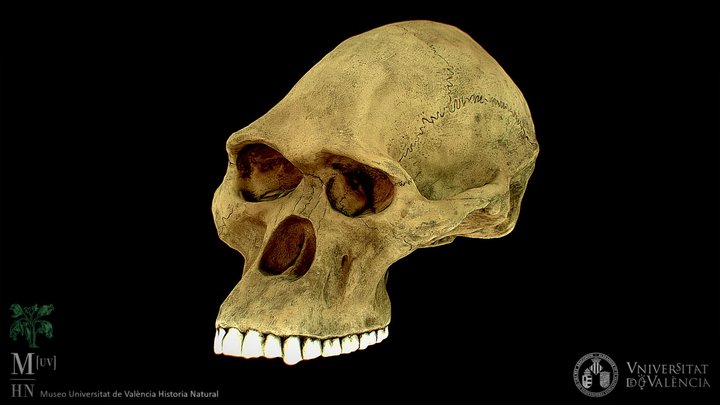
3D model
- Source
- Sketchfab
- Licence
- CC Attribution
- Commercial use
- cannot be read from the licence given — check the record
Smithsonian Open Access was not reached for this taxon, so this list is what the others held rather than everything there is.
The description on this site
- Licence
- CC BY-SA 4.0
This is what the site found, which is not the same as what exists.
Keep going
What may have been alongside itAustralopithecus through timeFormations of the PlioceneThe world it lived on
Occurrence data from the Paleobiology Database, CC BY 4.0. Dart 1925