Axophyllum

via iDigBio · CC BY · via iDigBio. May be a photograph of a specimen, or an artist’s reconstruction — an interpretation of a skeleton, since colour and soft tissue are almost never preserved.
On record
Recorded, not inferred- Sits inside
- AxophyllidaePBDB
- Diet
- suspension feederPBDB, for Rugosa
- Life habit
- epifaunalPBDB, for Rugosa
- Motility
- stationary, attachedPBDB, for Rugosa
- Vision
- blindPBDB, for Anthozoa
- Environment
- marinePBDB, for Rugosa
Time the record covers
At least 63 million years on record.
The record covers at least 339.9 Mya to 276.8 Mya. No occurrence read is dated outside 346.7 Mya to 264.9 Mya.
57 occurrences of Axophyllum on record, most of them in the Carboniferous. Bar height is expected occurrences, not a count: each fossil is spread across the span it is dated to, so a tall narrow bar means tight dating and a low wide one means loose.
When
57 occurrences- Carboniferous91%
- Permian9%
These are dates about fossils, not the animal: the record can only begin after it arose and end before it died out, so either end may reach further. Shares are expected occurrences: a fossil dated to a span is counted partly in each period it straddles. More on what this infers.
Found in
29 formations
- Clogrenan Formation4
- Roque Redonde Formation3
- Idmarrach Formation3
- Zindancik Formation3
- Heshilafu Formation3
- Ardengost Formation2
Loading coastlines…
The named rock units Axophyllum has been recovered from, largest first. Drawn where the rock is now, not where it formed. 5 further formations hold fewer occurrences each and are not listed. 15 occurrences have no formation on record, which is common for older literature.
Axophyllum and its relatives
CarboniferousWhere Axophyllum and its relatives were recorded in the Carboniferous.
Found in the same rock
273 taxa- Siphonodendron pauciradiale11 sites
- Palaeosmilia murchisoni10 sites
- Syringopora8 sites
- Siphonodendron7 sites
- Siphonodendron martini7 sites
- Dibunophyllum6 sites
- Lithostrotion decipiens6 sites
- Siphonodendron irregulare6 sites
- Arachnolasma5 sites
- Dibunophyllum bipartitum5 sites
- Rotiphyllum5 sites
- Bryozoa4 sites
- Clisiophyllum4 sites
- Diphyphyllum4 sites
- Haplolasma4 sites
- Kizilia4 sites
- Lithostrotion4 sites
- Michelinia4 sites
- Palastraea regia4 sites
- Amplexocarinia3 sites
- Amplexus3 sites
- Aphralysia3 sites
- Archaediscus3 sites
- Chaetetidae3 sites
The Paleobiology Database records 30 sites for Axophyllum, and this reads all of them. The number is how many of those sites it was catalogued from too. The 24 sharing the most are listed.
This is not a list of everything alive at the time. It is only what has come out of the same ground as this animal and been written down.
Entered from
26 references- Late Visean to Early Serpukhovian rugose corals from the Yashui Section, Guizhou, South China6
- Comparisons of Rugose corals from the Upper Visean of SW Spain and Ireland: implications for improved resolution in Late Mississippian coral biostratigraphy6
- Stratigraphy and Paleontology of the Uppermost Pennsylvanian and Lowermost Permian Rocks in Kansas5
- Preliminary data on the coral distribution in the Upper Visean (Mississippian) succession from Adarouch area (NE Central Morocco)4
- Corals of the Upper Visean microbial-sponge-bryozoan-coral bioherm and related strata of Kongul Yayla (Taurides, South Turkey)3
- Mississippian coral assemblages from Tabainout mud-mound complex, Khenifra area, central Morocco3
- Rugose corals and associated carbonate microfossils from the Brigantian (Mississippian) of Catelsec (Montagne Noire, southern France)3
- Lower Carboniferous corals from the southwestern margin of the Tarim Basin, NW China3
- The occurrence of a microbial buildup at Poederlee (Campine Basin, Belgium): biostratigraphy, sedimentology, early diagenesis and significance for Early Warnantian paleogeography3
- Serpukhovian coral assemblages from Idmarrach and Tirhela Formations (Adarouch, Morocco)2
- Late Visean rugose coral faunas from South-Eastern Ireland: composition, depositional setting and palaeoecology of Siphonodendron biostromes2
- Rekonstruktion eines nicht mehr existenten Sedimentationsraumes - Die Kalkgerölle im Karbon-Flysch der Malagiden (Betische Kordillere, Südspanien) [Reconstruction of a lost sedimentary realm - the limestone boulders in the Carboniferous of the Malaguides (Betic Cordillera, southern Spain)]2
Each of the 57 occurrences read was entered from one of these publications, ordered by how many each accounts for. This is not a search for papers mentioning the name. 14 further references are not listed. Entries link to doi.org where the Paleobiology Database holds an identifier, and to its own record where it does not. Relayed as the Paleobiology Database holds them, not checked against what they resolve to.
Media and terms
Media content2
Picture of Axophyllum
- Source
- iDigBio
- Credit
- via iDigBio
- Licence
- CC BY
- Commercial use
- the licence allows it
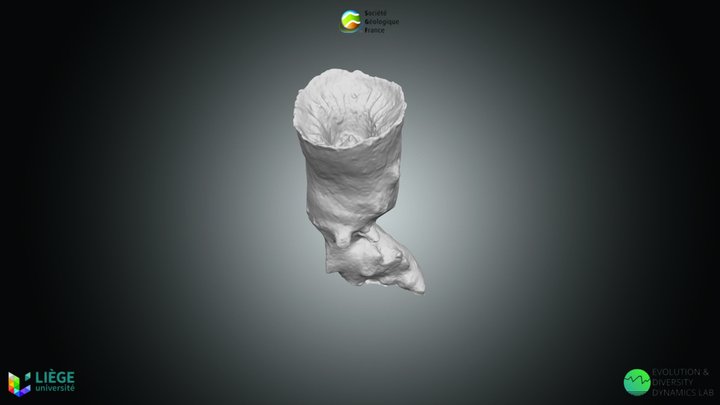
3D model
- Source
- Sketchfab
- Licence
- CC Attribution-NonCommercial-ShareAlike
- Commercial use
- the licence does not allow it
Smithsonian Open Access was not reached for this taxon, so this list is what the others held rather than everything there is.
This is what the site found, which is not the same as what exists.
Keep going
What may have been alongside itAxophyllidae through timeFormations of the CarboniferousThe world it lived on
Occurrence data from the Paleobiology Database, CC BY 4.0. Milne-Edwards and Haime 1850