Bachitherium
Bachitherium is an extinct genus of Paleogene ruminants that lived in Europe from the late Eocene to the late Oligocene. The genus was erected in 1882 by Henri Filhol based on fossil remains found in the Quercy Phosphorites Formation. Bachitherium curtum was defined the type species, and another species called B. insigne; five more species have since been named although one, B. sardus, is currently pending reassessment. The genus name derives from "Bach", the French locality where its first fossils were found, and the Greek θήρ/therium meaning "beast". Bachitherium has historically been assigned to various families within the ruminant infrorder Tragulina, but was reclassified to its own monotypic family Bachitheriidae by Christine Janis in 1987.

Lubman04 · CC BY-SA 4.0 · via Wikipedia/Commons. May be a photograph of a specimen, or an artist’s reconstruction — an interpretation of a skeleton, since colour and soft tissue are almost never preserved.
On record
Recorded, not inferred- Sits inside
- BachitheriidaePBDB
- Diet
- grazer, browserPBDB, for Artiodactyla
- Life habit
- ground dwellingPBDB, for Artiodactyla
- Motility
- actively mobilePBDB, for Osteichthyes
- Environment
- terrestrialPBDB, for Artiodactyla
Time the record covers
At least 6.6 million years on record.
The record covers at least 33.9 Mya to 27.3 Mya. No occurrence read is dated outside 41.03 Mya to 23.04 Mya.
23 occurrences of Bachitherium on record, most of them in the Oligocene. Bar height is expected occurrences, not a count: each fossil is spread across the span it is dated to, so a tall narrow bar means tight dating and a low wide one means loose.
When
23 occurrencesThese are dates about fossils, not the animal: the record can only begin after it arose and end before it died out, so either end may reach further. Shares are expected occurrences: a fossil dated to a span is counted partly in each period it straddles. More on what this infers.
Found in
1 formation
Loading coastlines…
The named rock units Bachitherium has been recovered from, largest first. Drawn where the rock is now, not where it formed. 22 occurrences have no formation on record, which is common for older literature.
Bachitherium and its relatives
OligoceneWhere Bachitherium and its relatives were recorded in the Oligocene.
Found in the same rock
264 taxa- Anguini6 sites
- Amphisbaenidae5 sites
- Coluber cadurci5 sites
- Cordylidae5 sites
- Eomys zitteli5 sites
- Lophiomeryx chalaniati5 sites
- Palaeosciurus goti5 sites
- Stenoplesictis cayluxi5 sites
- Blainvillimys helmeri4 sites
- Dinailurictis bonali4 sites
- Iberomeryx minor4 sites
- Issiodoromys medius4 sites
- Lacertidae4 sites
- Nimravus intermedius4 sites
- Platyspondylia4 sites
- Pseudeumeces cadurcensis4 sites
- Pseudocricetodon montalbanensis4 sites
- Pseudoltinomys major4 sites
- Schizogliravus bruijni4 sites
- Tetracus nanus4 sites
- Anthracotherium monsvialense3 sites
- Ergilemys3 sites
- Glamys priscus3 sites
- Hyaenodon leptorhynchus3 sites
The Paleobiology Database records 20 sites for Bachitherium, and this reads all of them. The number is how many of those sites it was catalogued from too. The 24 sharing the most are listed.
This is not a list of everything alive at the time. It is only what has come out of the same ground as this animal and been written down.
Entered from
12 references- Les ruminants de Pech Desse et de Pech du Fraysse (Quercy; MP28); évolution des ruminants de l'oligocène d'Europe11
- The European Ruminants during the "Microbunodon Event" (MP28, Latest Oligocene): Impact of Climate Changes and Faunal Event on the Ruminant Evolution2
- The first cetacean from the early Oligocene of the SW German Mainz Basin: a probable cheek tooth of a mysticete (Mammalia: Cetacea)1
- Additions to the late Eocene Süngülü mammal fauna in easternmost Anatolia and the Eocene-Oligocene transition at the periphery of Balkanatolia1
- Discovery of the oldest European ruminant in the late Eocene of Bulgaria: Did tectonics influence the diachronic development of the Grande Coupure?1
- New data on the earliest European ruminant (Mammalia, Artiodactyla): A revision of the fossil mandible from Rusce in the Pčinja basin (late Eocene, Southeastern Serbia)1
- Gisements paléontologiques à mammifères ou empreintes de pas de mammifères du Parc naturel régional du Luberon1
- A new early late Oligocene (MP 26) continental vertebrate fauna from Saint-Privat-des-Vieux (Alès Basin, Gard, Southern France)1
- Insect bone-modification and paleoecology of Oligocene mammal-bearing sites in the Doupov Mountains, northwestern Bohemia1
- Découverte d'une faune de vertébrés dans l'Oligocène inférieur de Vayres-sur-Essone (bassin de Paris, France): biodiversité et paléoenvironnement1
- Relations phylétiques de Bachitherium Filhol, ruminant de l'Oligocène d'Europe Occidentale1
- Nouveaux matériels de reptiles du Tertiaire d'Allemagne; 4, Nouveaux matériels des Tortues (Ptychogaster/Ergilemys) de la localité Oligocène moyen de Ronheim (Sud de l'Allemagne). [New finds of Tertiary Reptilia in West Germany; New turtles (Ptychogaster/Ergilemys) of the middle Oligocene in Ronheim, southern Germany.]1
Each of the 23 occurrences read was entered from one of these publications, ordered by how many each accounts for. This is not a search for papers mentioning the name. Entries link to doi.org where the Paleobiology Database holds an identifier, and to its own record where it does not. Relayed as the Paleobiology Database holds them, not checked against what they resolve to.
Media and terms
Media content1
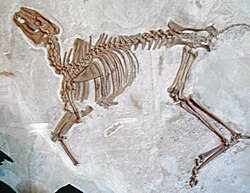
Picture of Bachitherium
- Source
- Wikipedia/Commons
- Credit
- Lubman04
- Licence
- CC BY-SA 4.0
- Commercial use
- the licence allows it
No 3D scan of Bachitherium was found in Sketchfab.
Smithsonian Open Access and MorphoSource were not reached for this taxon, so this list is what the others held rather than everything there is.
The description on this site
- Licence
- CC BY-SA 4.0
This is what the site found, which is not the same as what exists.
Keep going
What may have been alongside itBachitheriidae through timeFormations of the OligoceneThe world it lived on
Occurrence data from the Paleobiology Database, CC BY 4.0. Filhol 1882