Amphisbaenidae
The Amphisbaenidae are a family of amphisbaenians, a group of limbless reptiles. There are 12 genera, containing 183 species.

Diogo B. Provete · CC BY-SA 2.5 · via Wikipedia/Commons. May be a photograph of a specimen, or an artist’s reconstruction — an interpretation of a skeleton, since colour and soft tissue are almost never preserved.
On record
Recorded, not inferred- Also called
- worm lizardPBDB
- Sits inside
- AmphisbaeniformesPBDB
- Diet
- insectivorePBDB
- Life habit
- fossorialPBDB
- Motility
- actively mobilePBDB, for Osteichthyes
- Environment
- terrestrialPBDB, for Amphisbaenia
Time the record covers
At least 72 million years on record.
The record covers at least 72.2 Mya to 11.7 ka. No occurrence read is dated outside 83.6 Mya to 0 Mya.
100 occurrences of Amphisbaenidae on record, most of them in the Miocene. The Paleobiology Database records this as a living group. Bar height is expected occurrences, not a count: each fossil is spread across the span it is dated to, so a tall narrow bar means tight dating and a low wide one means loose.
When
100 occurrences- Late Cretaceous1%
- Paleocene3%
- Eocene25%
- Oligocene17%
- Miocene36%
- Pliocene5%
- Pleistocene12%
- Holocene1%
These are dates about fossils, not the animal: the record can only begin after it arose and end before it died out, so either end may reach further. Shares are expected occurrences: a fossil dated to a span is counted partly in each period it straddles. More on what this infers.
Found in
24 formations
- Córcoles Formation3
- Lignites de Soissonais Formation3
- Maboko Formation2
- Perrière Formation2
- Tienen Formation · Landen Group2
- Laa Formation2
Loading coastlines…
The named rock units Amphisbaenidae has been recovered from, largest first. Drawn where the rock is now, not where it formed. 68 occurrences have no formation on record, which is common for older literature.
Amphisbaenidae and its relatives
MioceneWhere Amphisbaenidae and its relatives were recorded in the Miocene.
Found in the same rock
1,601 taxa- Lacertidae25 sites
- Ophisaurus22 sites
- Anguini19 sites
- Gekkonidae17 sites
- Blanus16 sites
- Vipera14 sites
- Lacerta13 sites
- Colubridae12 sites
- Serpentes12 sites
- Necrosaurus11 sites
- Colubrinae10 sites
- Anguis9 sites
- Anura9 sites
- Aves9 sites
- Blanus cinereus9 sites
- Boidae9 sites
- Bufo bufo9 sites
- Placosaurus9 sites
- Rana9 sites
- Scolecophidia9 sites
- Anguinae8 sites
- Bufo8 sites
- Plesiolacerta lydekkeri8 sites
- Chalcides7 sites
The Paleobiology Database records 81 sites for Amphisbaenidae, and this reads all of them. The number is how many of those sites it was catalogued from too. The 24 sharing the most are listed.
This is not a list of everything alive at the time. It is only what has come out of the same ground as this animal and been written down.
Entered from
54 references- Evolution des lézards du Paléogène en Europe26
- Les nouvelles faunes de vertebres anterieurs a la "Grande Coupure" decouvertes dans les phosphorites du Quercy5
- A fossil record of the Eastern clade of Blanus (Amphisbaenia: Blanidae) from the late Miocene of Ukraine3
- Valbro: A new site of vertebrates from the early Oligocene (MP 22) of France (Quercy). III - Amphibians and squamates3
- Doppelschleichen (Sauria, Amphisbaenia) aus dem Untermiozän von Stubersheim 3 (Süddeutschland)3
- Precisiones sobre la Geologia, Fauna, Cronoestratigrafia y Paleoecologia del yacimiento Mioceno de Corcoles3
- The Early Miocene squamates of Amöneburg (Germany): the first stages of modern squamates in Europe2
- Late middle Miocene amphibians and squamate reptiles from Taut, Romania2
- Catalogue of Spanish Plio-Pleistocene amphibians and squamate reptiles from the Museu de Geologia de Barcelona2
- The Miocene herpetofaunas of Grund (Caudata; Chelonii, Sauria, Serpentes) and Mühlbach am Manhartsberg (Chelonii, Sauria, Amphisbaenia, Serpentes), Lower Austria2
- Lower Vertebrates (Teleostei, Amphibia, Sauria) from the Karpatian of the Korneuburg Basin - Paleoecological, environmental and paleoclimatical implications2
- Les squamates (Reptilia) du Miocène moyen de Sansan2
Each of the 100 occurrences read was entered from one of these publications, ordered by how many each accounts for. This is not a search for papers mentioning the name. 42 further references are not listed. Entries link to doi.org where the Paleobiology Database holds an identifier, and to its own record where it does not. Relayed as the Paleobiology Database holds them, not checked against what they resolve to.
Media and terms
Media content1
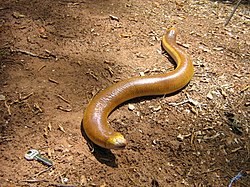
Picture of Amphisbaenidae
- Source
- Wikipedia/Commons
- Credit
- Diogo B. Provete
- Licence
- CC BY-SA 2.5
- Commercial use
- the licence allows it
No 3D scan of Amphisbaenidae was found in Smithsonian Open Access and Sketchfab.
MorphoSource was not reached for this taxon, so this list is what the others held rather than everything there is.
The description on this site
- Licence
- CC BY-SA 4.0
This is what the site found, which is not the same as what exists.
Keep going
What may have been alongside itAmphisbaeniformes through timeFormations of the MioceneThe world it lived on
Occurrence data from the Paleobiology Database, CC BY 4.0. (Gray 1865)