Baculites ovatus

Uncredited · via Wikidata/Commons. May be a photograph of a specimen, or an artist’s reconstruction — an interpretation of a skeleton, since colour and soft tissue are almost never preserved.
On record
Recorded, not inferred- Sits inside
- BaculitesPBDB
- Diet
- carnivorePBDB, for Ammonoidea
- Life habit
- nektonicPBDB, for Ammonoidea
- Motility
- fast-movingPBDB, for Ammonoidea
- Vision
- well-developedPBDB, for Cephalopoda
- Environment
- marinePBDB, for Cephalopoda
Time the record covers
At least 11 million years on record.
The record covers at least 83.6 Mya to 72.2 Mya. No occurrence read is dated outside 143.1 Mya to 66 Mya.
50 occurrences of Baculites ovatus on record, most of them in the Late Cretaceous. Bar height is expected occurrences, not a count: each fossil is spread across the span it is dated to, so a tall narrow bar means tight dating and a low wide one means loose.
When
50 occurrencesThese are dates about fossils, not the animal: the record can only begin after it arose and end before it died out, so either end may reach further. Shares are expected occurrences: a fossil dated to a span is counted partly in each period it straddles. More on what this infers.
Found in
16 formations
- Saratoga Chalk Formation · Navarro Group11
- Pawkowki Formation7
- Wapiabi Formation7
- Dakhla Formation6
- Pierre Formation3
- Aguja Formation2
Loading coastlines…
The named rock units Baculites ovatus has been recovered from, largest first. Drawn where the rock is now, not where it formed. 1 occurrence has no formation on record, which is common for older literature.
Baculites ovatus and its relatives
Late CretaceousWhere Baculites ovatus and its relatives were recorded in the Late Cretaceous.
Found in the same rock
549 taxa- Nostoceras hyatti11 sites
- Nostoceras (Nostoceras) helicinum10 sites
- Inoceramus9 sites
- Nostoceras (Nostoceras) approximans9 sites
- Hoploscaphites pumilus8 sites
- Cirroceras conradi7 sites
- Anchura5 sites
- Anomia5 sites
- Baculites haresi5 sites
- Corbula5 sites
- Cucullaea5 sites
- Cymbophora warrenana5 sites
- Euspira halli5 sites
- Lewyites oronensis5 sites
- Liopistha5 sites
- Placenticeras5 sites
- Tellina5 sites
- Anglonautilus hewaidyi4 sites
- Baculites aquilaensis4 sites
- Baculites compressus4 sites
- Baculites undatus4 sites
- Caprinella4 sites
- Crassatella vadosa4 sites
- Cucullaea vulgaris4 sites
The Paleobiology Database records 49 sites for Baculites ovatus, and this reads all of them. The number is how many of those sites it was catalogued from too. The 24 sharing the most are listed.
This is not a list of everything alive at the time. It is only what has come out of the same ground as this animal and been written down.
Entered from
17 references- Ammonites from the Saratoga Chalk (Upper Cretaceous), Arkansas11
- Geology of the Southern Alberta Plains. Part II. Paleontology of the marine formations of the Montana Group8
- The Cretaceous Alberta Group and equivalent rocks, Rocky Mountain foothills, Alberta7
- Taxonomy and paleobiogeography of the Maastrichtian cephalopods from the Abu Monqar-west Dakhla stretch, Western Desert, Egypt6
- Paleoecology of the Delaware Valley region. Part II: Cretaceous to Quartenary3
- Descriptions of New Species of Fossils, from the Cretaceous Formations of Nebraska, with Observations upon Baculites ovatus and B. compressus, and the Progressive Development of the Septa in Baculites, Ammonites, and Scaphites3
- Paleoecology of the Aguja formation, Brewster County, Texas2
- Campanian-early Eocene cephalopods from Kharga Oasis, Western Desert, Egypt1
- Faunal changes across the Cretaceous-Tertiary (K-T) boundary in the Atlantic coastal plain of New Jersey: restructuring the marine community after the K-T mass-extinction event1
- Additions to the ammonite fauna of the Upper Cretaceous Navesink Formation of New Jersey1
- Upper Campanian (Upper Cretaceous) ammonites from the Marshalltown Formation-Mount Laurel boundary beds in Delaware1
- Upper Campanian ammonites from the Mount Laurel Sand at Biggs Farm, Delaware1
Each of the 50 occurrences read was entered from one of these publications, ordered by how many each accounts for. This is not a search for papers mentioning the name. 5 further references are not listed. Entries link to doi.org where the Paleobiology Database holds an identifier, and to its own record where it does not. Relayed as the Paleobiology Database holds them, not checked against what they resolve to.
Media and terms
Media content2
Picture of Baculites ovatus
- Source
- Wikidata/Commons
- Credit
- nobody named on the record
- Licence
- not stated by the source
- Commercial use
- cannot be read from the licence given — check the record
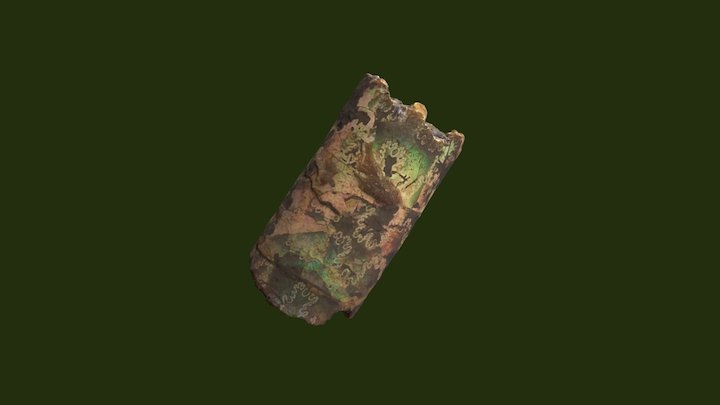
3D model
- Source
- Sketchfab
- Credit
- Shellie Luallin
- Licence
- CC Attribution
- Commercial use
- cannot be read from the licence given — check the record
Smithsonian Open Access and MorphoSource were not reached for this taxon, so this list is what the others held rather than everything there is.
This is what the site found, which is not the same as what exists.
Keep going
What may have been alongside itBaculites through timeFormations of the Late CretaceousThe world it lived on
Occurrence data from the Paleobiology Database, CC BY 4.0. Say 1820