Betula alnoides
Betula alnoides is a species of birch that is native to countries including Bangladesh, Bhutan, Cambodia, China, India, Laos, Myanmar, Nepal, Thailand and Vietnam, at elevations of 300–2,100 m (1,000–7,000 ft) and higher in some cases. It is the southernmost of all known birch species, whose natural range reaches approximately 12° N in Cardamom Mountains, Cambodia.

Uncredited · Public Domain · via Wikipedia/Commons. May be a photograph of a specimen, or an artist’s reconstruction — an interpretation of a skeleton, since colour and soft tissue are almost never preserved.
On record
Recorded, not inferred- Sits inside
- BetulaPBDB
- Diet
- "photoautotroph"PBDB, for Angiospermae
Time the record covers
At most 2.6 million years on record.
Every occurrence read is dated to somewhere between 2.58 Mya and 0 Mya, and nothing in the dating separates them, so that window is what the record shows rather than a span.
3 occurrences of Betula alnoides on record, most of them in the Pleistocene. The Paleobiology Database records this as a living group. Bar height is expected occurrences, not a count: each fossil is spread across the span it is dated to, so a tall narrow bar means tight dating and a low wide one means loose.
When
3 occurrences- Pleistocene100%
- Holoceneunder 1%
These are dates about fossils, not the animal: the record can only begin after it arose and end before it died out, so either end may reach further. Shares are expected occurrences: a fossil dated to a span is counted partly in each period it straddles. More on what this infers.
Betula alnoides and its relatives
PleistoceneWhere Betula alnoides and its relatives were recorded in the Pleistocene.
Found in the same rock
176 taxa- Abies3 sites
- Alnus3 sites
- Apiaceae3 sites
- Asteraceae3 sites
- Betula utilis3 sites
- Carpinus3 sites
- Cyperaceae3 sites
- Ephedra3 sites
- Fabaceae3 sites
- Fraxinus3 sites
- Nymphaea3 sites
- Pinus wallichiana3 sites
- Poaceae3 sites
- Potamogeton3 sites
- Quercus3 sites
- Rhus3 sites
- Rosaceae3 sites
- Salix3 sites
- Ulmus3 sites
- Viburnum3 sites
- Acer2 sites
- Aesculus indica2 sites
- Artemisia2 sites
- Berberis2 sites
The Paleobiology Database records 3 sites for Betula alnoides, and this reads all of them. The number is how many of those sites it was catalogued from too. The 24 sharing the most are listed.
This is not a list of everything alive at the time. It is only what has come out of the same ground as this animal and been written down.
Entered from
2 references- A Catalogue of Fossil Plants from India Part 6: Cenozoic (Quaternary) Palynology and Palaeobotany2
- A Catalogue of Indian Fossil Plants1
Each of the 3 occurrences read was entered from one of these publications, ordered by how many each accounts for. This is not a search for papers mentioning the name. Each entry links to the Paleobiology Database's own record for the work.
Media and terms
Media content1
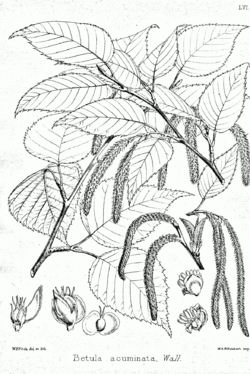
Picture of Betula alnoides
- Source
- Wikipedia/Commons
- Credit
- nobody named on the record
- Licence
- Public Domain
- Commercial use
- the licence allows it
No 3D scan of Betula alnoides was found in MorphoSource and Sketchfab.
Smithsonian Open Access was not reached for this taxon, so this list is what the others held rather than everything there is.
The description on this site
- Licence
- CC BY-SA 4.0
This is what the site found, which is not the same as what exists.
Keep going
What may have been alongside itBetula through timeFormations of the PleistoceneThe world it lived on
Occurrence data from the Paleobiology Database, CC BY 4.0. Buchanan-Hamilton 1825