Bonitasaura
Bonitasaura is a genus of titanosaurian dinosaur hailing from uppermost layers of the Late Cretaceous (Santonian) Bajo de la Carpa Formation, Neuquén Group of the eastern Neuquén Basin, located in Río Negro Province, Northwestern Patagonia, Argentina. The remains, consisting of a partial sub-adult skeleton jumbled in a small area of fluvial sandstone, including a lower jaw with teeth, a partial vertebrae series, and limb bones, were described by Sebastian Apesteguía in 2004.

Pablo A. Gallina and Sebastián Apesteguía · CC BY 2.0 · via Wikipedia/Commons. May be a photograph of a specimen, or an artist’s reconstruction — an interpretation of a skeleton, since colour and soft tissue are almost never preserved.
On record
Recorded, not inferred- Sits inside
- EutitanosauriaPBDB
- Diet
- herbivorePBDB, for Sauropoda
- Life habit
- ground dwelling, gregariousPBDB, for Sauropoda
- Motility
- actively mobilePBDB, for Sauropoda
- Environment
- terrestrialPBDB, for Sauropoda
- Length
- 10 mWikidata
Time the record covers
At most 2.1 million years on record.
Every occurrence read is dated to somewhere between 85.7 Mya and 83.6 Mya, and nothing in the dating separates them, so that window is what the record shows rather than a span.
2 occurrences of Bonitasaura on record, most of them in the Late Cretaceous. Bar height is expected occurrences, not a count: each fossil is spread across the span it is dated to, so a tall narrow bar means tight dating and a low wide one means loose.
When
2 occurrences- Late Cretaceous100%
These are dates about fossils, not the animal: the record can only begin after it arose and end before it died out, so either end may reach further. Shares are expected occurrences: a fossil dated to a span is counted partly in each period it straddles. More on what this infers.
Found in
1 formation
- Bajo de la Carpa Formation · Neuquén Group2
Loading coastlines…
The named rock units Bonitasaura has been recovered from, largest first. Drawn where the rock is now, not where it formed.
Bonitasaura and its relatives
Late CretaceousWhere Bonitasaura and its relatives were recorded in the Late Cretaceous.
Found in the same rock
8 taxa- Abelisauridae1 site
- Crocodylia1 site
- Megaraptoridae1 site
- Neosuchia1 site
- Neuquensaurus1 site
- Podocnemidoidea1 site
- Pterosauria1 site
- Titanosauriformes1 site
The Paleobiology Database records 2 sites for Bonitasaura, and this reads all of them. The number is how many of those sites it was catalogued from too.
This is not a list of everything alive at the time. It is only what has come out of the same ground as this animal and been written down.
Entered from
2 references- Reassessment of Laplatasaurus araukanicus (Sauropoda: Titanosauria) from the Upper Cretaceous of Patagonia, Argentina1
- Bonitasaura salgadoi gen. et sp. nov.: a beaked sauropod from the Late Cretaceous of Patagonia1
Each of the 2 occurrences read was entered from one of these publications, ordered by how many each accounts for. This is not a search for papers mentioning the name. Entries link to doi.org where the Paleobiology Database holds an identifier, and to its own record where it does not. Relayed as the Paleobiology Database holds them, not checked against what they resolve to.
Media and terms
Media content1
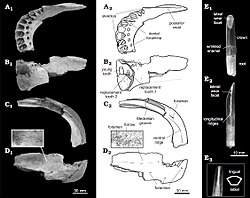
Picture of Bonitasaura
- Source
- Wikipedia/Commons
- Credit
- Pablo A. Gallina and Sebastián Apesteguía
- Licence
- CC BY 2.0
- Commercial use
- the licence allows it
No 3D scan of Bonitasaura was found in MorphoSource and Sketchfab.
Smithsonian Open Access was not reached for this taxon, so this list is what the others held rather than everything there is.
The description on this site
- Source
- Wikipedia, “Bonitasaura”
- Licence
- CC BY-SA 4.0
This is what the site found, which is not the same as what exists.
Keep going
What may have been alongside itEutitanosauria through timeFormations of the Late CretaceousThe world it lived on
Occurrence data from the Paleobiology Database, CC BY 4.0. Apesteguía 2004