Brachycera
The Brachycera are a suborder of the order Diptera. It is a major suborder consisting of around 120 families. Their most distinguishing characteristic is reduced antenna segmentation.

Alvesgaspar · CC BY-SA 3.0 · via Wikipedia/Commons. May be a photograph of a specimen, or an artist’s reconstruction — an interpretation of a skeleton, since colour and soft tissue are almost never preserved.
On record
Recorded, not inferred- Sits inside
- NeodipteraPBDB
- Motility
- actively mobilePBDB, for Arthropoda
- Environment
- terrestrialPBDB, for Insecta
Time the record covers
At least 387 million years on record.
The record covers at least 387.95 Mya to 11.7 ka. No occurrence read is dated outside 390.5 Mya to 0 Mya.
2,130 occurrences of Brachycera on record, most of them in the Eocene. The Paleobiology Database records this as a living group. Bar height is expected occurrences, not a count: each fossil is spread across the span it is dated to, so a tall narrow bar means tight dating and a low wide one means loose.
When
2,130 occurrences- Devonianunder 1%
- Middle Triassicunder 1%
- Late Triassicunder 1%
- Early Jurassicunder 1%
- Middle Jurassic1%
- Late Jurassic7%
- Early Cretaceous11%
- Late Cretaceous10%
- Paleoceneunder 1%
- Eocene47%
- Oligocene7%
- Miocene11%
- Plioceneunder 1%
- Pleistocene1%
- Holocene2%
These are dates about fossils, not the animal: the record can only begin after it arose and end before it died out, so either end may reach further. Shares are expected occurrences: a fossil dated to a span is counted partly in each period it straddles. More on what this infers.
Found in
104 formations
- Florissant Formation161
- Karabastau Formation80
- Rott Formation63
- Daohugou Formation62
- Green River Formation54
- Zaza Formation47
Loading coastlines…
The named rock units Brachycera has been recovered from, largest first. Drawn where the rock is now, not where it formed. 80 further formations hold fewer occurrences each and are not listed. 1,207 occurrences have no formation on record, which is common for older literature.
Brachycera and its relatives
EoceneWhere Brachycera and its relatives were recorded in the Eocene.
Found in the same rock
7,801 taxa- Coleoptera16 sites
- Diptera15 sites
- Prosphyracephala succini15 sites
- Curculionidae14 sites
- Plecia10 sites
- Formicidae9 sites
- Plecia foersteri9 sites
- Bibionidae8 sites
- Gesomyrmex hoernesi8 sites
- Mycetophilidae8 sites
- Protoscelis jurassica8 sites
- Tipula8 sites
- Aphanus pulchellus7 sites
- Archirhyphus asiaticus7 sites
- Atriculicoides globosus7 sites
- Bibio7 sites
- Culicoides filipalpis7 sites
- Entimini7 sites
- Liassothrips crassipes7 sites
- Protoscelis longicornis7 sites
- Aphaenogaster mayri6 sites
- Carabidae6 sites
- Ceratopogonidae6 sites
- Chironomidae6 sites
The Paleobiology Database records at least 499 sites for Brachycera, and this reads 240 of them. Of that, one read hit the database's own return limit, so every count below is a floor rather than a total. The number is how many of those sites it was catalogued from too. The 24 sharing the most are listed.
This is not a list of everything alive at the time. It is only what has come out of the same ground as this animal and been written down.
Entered from
574 references- Monographie des Empidae de l'ambre de la Baltique et catalogue bibliographique complet sur les diptères fossiles de cette résine70
- Neue Dipteren (Brachycera et Cyclorhapha) aus dem Oberoligozän von Rott55
- A revisional study of the fossil Syrphidae54
- Brachyceran Diptera in Cretaceous ambers and Mesozoic diversification of the Eremoneura49
- Die Acalyptratae des Baltischen Bernsteins49
- A Report on Some Miocene Diptera from Florissant, Colorado41
- Monographie der Leptiden und der Phoriden des Bernsteins40
- New taxa of Ironomyiidae (Diptera, Phoromorpha) from the Cretaceous of Siberia and Mongolia32
- Diverse orthorrhaphan flies (Insecta: Diptera: Brachycera) in amber from the Cretaceous of Myanmar: Brachycera in Cretaceous amber, part VII29
- Les insectes fossiles des terrains oligocènes de France26
- Basal Cyclorrhapha in amber from the Cretaceous and Tertiary (Insecta: Diptera), and their relationships: Brachycera in Cretaceous amber part IX24
- New Mesozoic Platypezidae (Diptera) and the main directions of evolution of the family23
Each of the 2,130 occurrences read was entered from one of these publications, ordered by how many each accounts for. This is not a search for papers mentioning the name. 562 further references are not listed. Entries link to doi.org where the Paleobiology Database holds an identifier, and to its own record where it does not. Relayed as the Paleobiology Database holds them, not checked against what they resolve to.
Media and terms
Media content1
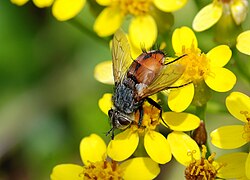
Picture of Brachycera
- Source
- Wikipedia/Commons
- Credit
- Alvesgaspar
- Licence
- CC BY-SA 3.0
- Commercial use
- the licence allows it
No 3D scan of Brachycera was found in Sketchfab.
Smithsonian Open Access and MorphoSource were not reached for this taxon, so this list is what the others held rather than everything there is.
The description on this site
- Source
- Wikipedia, “Brachycera”
- Licence
- CC BY-SA 4.0
This is what the site found, which is not the same as what exists.
Keep going
What may have been alongside itNeodiptera through timeFormations of the EoceneThe world it lived on
Occurrence data from the Paleobiology Database, CC BY 4.0. Zetterstedt 1842