Camelus
A camel is an even-toed ungulate in the genus Camelus that bears distinctive fatty deposits known as "humps" on its back. Camels have long been domesticated and, as livestock, they provide food and textiles. Camels are working animals especially suited to their desert habitat and are a vital means of transport for passengers and cargo. There are three surviving species of camel. The one-humped dromedary makes up 94% of the world's camel population, and the two-humped Bactrian camel makes up 6%. The wild Bactrian camel is a distinct species that is not ancestral to the domestic Bactrian camel, and is now endangered, with around 1,000 individuals and a continuing decline.

Jjron · CC BY-SA 3.0 · via Wikipedia/Commons. May be a photograph of a specimen, or an artist’s reconstruction — an interpretation of a skeleton, since colour and soft tissue are almost never preserved.
On record
Recorded, not inferred- Also called
- camelPBDB
- Sits inside
- CameliniPBDB
- Diet
- browser, grazerPBDB
- Life habit
- ground dwellingPBDB
- Motility
- actively mobilePBDB, for Osteichthyes
- Environment
- terrestrialPBDB, for Artiodactyla
Time the record covers
At least 3.5 million years on record.
The record covers at least 3.6 Mya to 11.7 ka. No occurrence read is dated outside 5.333 Mya to 0 Mya.
47 occurrences of Camelus on record, most of them in the Pleistocene. The Paleobiology Database records this as a living group. Bar height is expected occurrences, not a count: each fossil is spread across the span it is dated to, so a tall narrow bar means tight dating and a low wide one means loose.
When
47 occurrences- Pliocene47%
- Pleistocene51%
- Holocene2%
These are dates about fossils, not the animal: the record can only begin after it arose and end before it died out, so either end may reach further. Shares are expected occurrences: a fossil dated to a span is counted partly in each period it straddles. More on what this infers.
Found in
10 formations
- Shungura Formation · Omo Group6
- Koobi Fora Formation3
- Pinjor Formation · Siwalik Group2
- Chiwondo Formation1
- Nachukui Formation · Omo Group1
- Vogel River Series Formation1
Loading coastlines…
The named rock units Camelus has been recovered from, largest first. Drawn where the rock is now, not where it formed. 29 occurrences have no formation on record, which is common for older literature.
Camelus and its relatives
PleistoceneWhere Camelus and its relatives were recorded in the Pleistocene.
Found in the same rock
525 taxa- Hipparion12 sites
- Equus11 sites
- Palaeoloxodon recki9 sites
- Ceratotherium simum8 sites
- Gazella7 sites
- Anancus arvernensis6 sites
- Cervus6 sites
- Kolpochoerus limnetes6 sites
- Bovidae5 sites
- Canis5 sites
- Kobus5 sites
- Kobus sigmoidalis5 sites
- Libytherium maurusium5 sites
- Mammuthus meridionalis5 sites
- Tragelaphus nakuae5 sites
- Vulpes5 sites
- Adenota recki4 sites
- Aepyceros shungurae4 sites
- Alcelaphini4 sites
- Cercopithecidae4 sites
- Crocodylus4 sites
- Crocuta crocuta4 sites
- Deinotherium bozasi4 sites
- Diceros bicornis4 sites
The Paleobiology Database records 45 sites for Camelus, and this reads all of them. The number is how many of those sites it was catalogued from too. The 24 sharing the most are listed.
This is not a list of everything alive at the time. It is only what has come out of the same ground as this animal and been written down.
Entered from
31 references- Catalogue of Tertiary Fossil Sites of the Land Mammals in the U.S.S.R.8
- La faune de Nadaouiyeh Aïn Askar (Syrie centrale, Pléistocène moyen): aperçu et perspectives3
- Family Camelidae3
- Wendorf and Schild, 19803
- Record of Bovidean fossils from the Pinjor Formation of the Siwalik Group, Solan District, Himachal Pradesh2
- Pleistocene vertebrate faunas of Hungary2
- The Late Cenozoic two-humped (Bactrian) camels of Asia2
- Siwalik mammals of the Jammu Sub-Himalaya, India: an appraisal of their diversity and habitats.1
- Plio-Pleistocene mammalian biostratigraphy of Atlantic Morocco1
- Incidence of four gastrointestinal parasite worms in group of cricetomas,Lukaya-Democratic Republic of Congo1
- Les grands mammiferes du gisement Pleistocene Moyen de Latamne (Vallee de l'Oronte, Syrie)1
- Oldest Homo and Pliocene biogeography of the Malawi Rift1
Each of the 47 occurrences read was entered from one of these publications, ordered by how many each accounts for. This is not a search for papers mentioning the name. 19 further references are not listed. Entries link to doi.org where the Paleobiology Database holds an identifier, and to its own record where it does not. Relayed as the Paleobiology Database holds them, not checked against what they resolve to.
Media and terms
Media content2
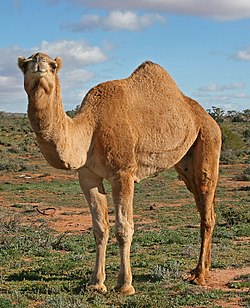
Picture of Camelus
- Source
- Wikipedia/Commons
- Credit
- Jjron
- Licence
- CC BY-SA 3.0
- Commercial use
- the licence allows it
CT scan
- Source
- MorphoSource
- Licence
- not stated by the source
- Commercial use
- cannot be read from the licence given — check the record
- Specimen
- Struthio camelus · l-jz:JZ:48
Smithsonian Open Access was not reached for this taxon, so this list is what the others held rather than everything there is.
The description on this site
- Source
- Wikipedia, “Camel”
- Licence
- CC BY-SA 4.0
This is what the site found, which is not the same as what exists.
Keep going
What may have been alongside itCamelini through timeFormations of the PleistoceneThe world it lived on
Occurrence data from the Paleobiology Database, CC BY 4.0. Linnaeus 1758