Canis
Canis is a genus of the Caninae which includes multiple extant species, such as wolves, dogs, coyotes, and golden jackals. Species of this genus are distinguished by their moderate to large size, their massive, well-developed skulls and dentition, long legs, and comparatively short ears and tails.

Chris Muiden at Dutch Wikipedia No machine-readable author provided. Tobycat assumed (based on copyright claims). Tim… · Public Domain · via Wikipedia/Commons. May be a photograph of a specimen, or an artist’s reconstruction — an interpretation of a skeleton, since colour and soft tissue are almost never preserved.
On record
Recorded, not inferred- Also called
- caninePBDB
- Sits inside
- CaninaePBDB
- Diet
- carnivore, omnivorePBDB, for Canidae
- Life habit
- ground dwellingPBDB, for Canidae
- Motility
- actively mobilePBDB, for Osteichthyes
- Environment
- terrestrialPBDB, for Eutheria
Time the record covers
At least 18 million years on record.
The record covers at least 18.5 Mya to 11.7 ka. No occurrence read is dated outside 29.5 Mya to 0 Mya.
708 occurrences of Canis on record, most of them in the Pleistocene. The Paleobiology Database records this as a living group. Bar height is expected occurrences, not a count: each fossil is spread across the span it is dated to, so a tall narrow bar means tight dating and a low wide one means loose.
When
708 occurrences- Oligoceneunder 1%
- Miocene1%
- Pliocene14%
- Pleistocene71%
- Holocene14%
These are dates about fossils, not the animal: the record can only begin after it arose and end before it died out, so either end may reach further. Shares are expected occurrences: a fossil dated to a span is counted partly in each period it straddles. More on what this infers.
Found in
74 formations
- Palm Spring Formation18
- Glenns Ferry Formation14
- Vogel River Series Formation12
- "unnamed sandstone" Formation5
- Bermont Formation5
- Kromdraai Formation5
Loading coastlines…
The named rock units Canis has been recovered from, largest first. Drawn where the rock is now, not where it formed. 50 further formations hold fewer occurrences each and are not listed. 539 occurrences have no formation on record, which is common for older literature.
Canis and its relatives
PleistoceneWhere Canis and its relatives were recorded in the Pleistocene.
Found in the same rock
2,236 taxa- Equus106 sites
- Bovidae44 sites
- Lepus43 sites
- Microtus35 sites
- Camelops33 sites
- Platygonus32 sites
- Hemiauchenia31 sites
- Odocoileus31 sites
- Sylvilagus28 sites
- Leporidae27 sites
- Mimomys26 sites
- Vulpes26 sites
- Paramylodon harlani25 sites
- Camelops hesternus24 sites
- Neotoma24 sites
- Spermophilus24 sites
- Hemiauchenia macrocephala23 sites
- Odocoileus virginianus23 sites
- Thomomys23 sites
- Cervus22 sites
- Felidae22 sites
- Homotherium22 sites
- Apodemus sylvaticus21 sites
- Rhinocerotidae21 sites
The Paleobiology Database records 617 sites for Canis, and this reads 240 of them. The number is how many of those sites it was catalogued from too. The 24 sharing the most are listed.
This is not a list of everything alive at the time. It is only what has come out of the same ground as this animal and been written down.
Entered from
368 references- Phylogenetic Systematics of the North American Fossil Caninae (Carnivora: Canidae)33
- Polar bear fossil and archaeological records from the Pleistocene and Holocene in relation to sea ice extent and open water polynyas19
- I giacimenti Quaternari di vertebrati fossili nell'Italia Nord-Orientale19
- North American Quaternary Canis17
- Biostratigraphy of Blancan and Irvingtonian mammals in the Fish Creek-Vallecito Creek section, southern California, and a review of the Blancan-Irvingtonian boundary15
- Mittelpleistozane Saugetierfaunen aus Mitteleuropa - der Versuch einer biostratigraphischen Zuordnung14
- The Carnivora of the Hagerman Local Fauna (Late Pliocene) of Southwestern Idaho14
- Pleistocene vertebrate faunas of Hungary13
- Laetoli: a Pliocene Site in Northern Tanzania12
- Synonymies and reidentifications of North American fossil mammals9
- The Villafranchian mammalian faunas and biochronology of Greece8
- Large Ruscinian Mammalia in the Territory of the Former Soviet Union8
Each of the 708 occurrences read was entered from one of these publications, ordered by how many each accounts for. This is not a search for papers mentioning the name. 356 further references are not listed. Entries link to doi.org where the Paleobiology Database holds an identifier, and to its own record where it does not. Relayed as the Paleobiology Database holds them, not checked against what they resolve to.
Media and terms
Media content3
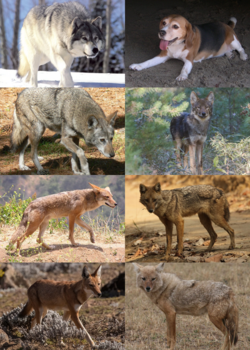
Picture of Canis
- Source
- Wikipedia/Commons
- Credit
- Chris Muiden at Dutch Wikipedia No machine-readable author provided. Tobycat assumed (based on copyright claims). Tim…
- Licence
- Public Domain
- Commercial use
- the licence allows it
CT scan
- Source
- MorphoSource
- Licence
- not stated by the source
- Commercial use
- cannot be read from the licence given — check the record
- Specimen
- Canis lupus · msu:mr:36390
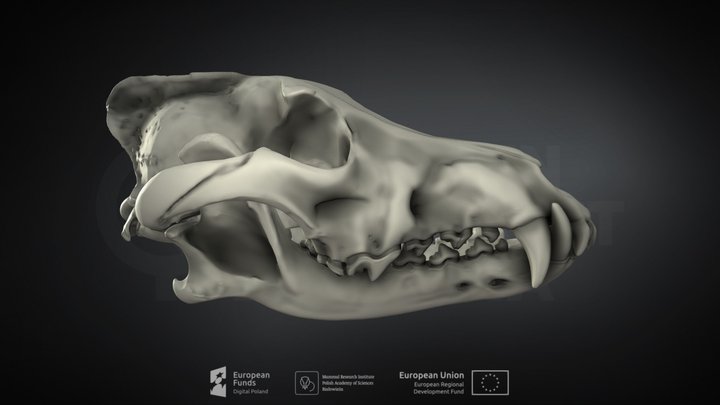
3D model
- Source
- Sketchfab
- Licence
- CC Attribution
- Commercial use
- cannot be read from the licence given — check the record
Smithsonian Open Access was not reached for this taxon, so this list is what the others held rather than everything there is.
The description on this site
- Source
- Wikipedia, “Canis”
- Licence
- CC BY-SA 4.0
This is what the site found, which is not the same as what exists.
Keep going
Everything alive alongside itCaninae through timeFormations of the PleistoceneThe world it lived on
Occurrence data from the Paleobiology Database, CC BY 4.0. Linnaeus 1758