Cataulacus
Cataulacus is a genus of ants in the subfamily Myrmicinae. The genus is distributed in the Paleotropical regions, mainly in the Afrotropics. Most species are found in forests, but a few are known from more open and arid habitats.

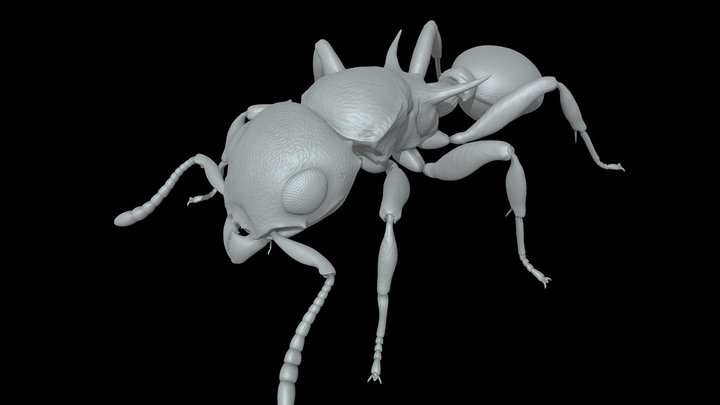
Erin Prado · CC BY 4.0 · via Wikipedia/Commons. May be a photograph of a specimen, or an artist’s reconstruction — an interpretation of a skeleton, since colour and soft tissue are almost never preserved.
On record
Recorded, not inferred- Sits inside
- CrematogastriniPBDB
- Motility
- actively mobilePBDB, for Arthropoda
- Environment
- terrestrialPBDB, for Insecta
Time the record covers
At least 13 million years on record.
The record covers at least 13.82 Mya to 11.7 ka. No occurrence read is dated outside 15.98 Mya to 0 Mya.
6 occurrences of Cataulacus on record, most of them in the Miocene. The Paleobiology Database records this as a living group. Bar height is expected occurrences, not a count: each fossil is spread across the span it is dated to, so a tall narrow bar means tight dating and a low wide one means loose.
When
6 occurrencesThese are dates about fossils, not the animal: the record can only begin after it arose and end before it died out, so either end may reach further. Shares are expected occurrences: a fossil dated to a span is counted partly in each period it straddles. More on what this infers.
Cataulacus and its relatives
MioceneWhere Cataulacus and its relatives were recorded in the Miocene.
Found in the same rock
135 taxa- Tapinoma2 sites
- Acicnemis fossilis1 site
- Acrocyrtus1 site
- Aenictus1 site
- Amphinemura himberii1 site
- Anochetus1 site
- Anomodon1 site
- Anonychomyrma dimorpha1 site
- Aphaenogaster1 site
- Apidae1 site
- Archipsocus palaeosinicus1 site
- Atoposega rosai1 site
- Austroplebeia (Anteplebeina) fujianica1 site
- Belaphotroctes grimaldii1 site
- Brachyponera1 site
- Callyntrura1 site
- Calomyrmex laevissimus1 site
- Camponotus1 site
- Cardiocondyla1 site
- Carebara1 site
- Carebara sophiae1 site
- Cerapachys1 site
- Circulifolium1 site
- Colobopsis1 site
The Paleobiology Database records 5 sites for Cataulacus, and this reads all of them. The number is how many of those sites it was catalogued from too. The 24 sharing the most are listed.
This is not a list of everything alive at the time. It is only what has come out of the same ground as this animal and been written down.
Entered from
5 references- Le formiche dell'ambra Siciliana nel Museo Mineralogico dell'Università di Bologna2
- The mid-Miocene Zhangpu biota reveals an outstandingly rich rainforest biome in East Asia1
- First record of ants from Borneo amber (Hymenoptera, Formicidae)1
- Die fossilen Insekten von Ungarn, mit besonderer Berücksichtigung der Entwicklung der europäischen Insekten-fauna1
- Ameisen aus dem Kopal von Celebes1
Each of the 6 occurrences read was entered from one of these publications, ordered by how many each accounts for. This is not a search for papers mentioning the name. Entries link to doi.org where the Paleobiology Database holds an identifier, and to its own record where it does not. Relayed as the Paleobiology Database holds them, not checked against what they resolve to.
Media and terms
Media content2

Picture of Cataulacus
- Source
- Wikipedia/Commons
- Credit
- Erin Prado
- Licence
- CC BY 4.0
- Commercial use
- the licence allows it
Smithsonian Open Access and MorphoSource were not reached for this taxon, so this list is what the others held rather than everything there is.
The description on this site
- Source
- Wikipedia, “Cataulacus”
- Licence
- CC BY-SA 4.0
This is what the site found, which is not the same as what exists.
Keep going
What may have been alongside itCrematogastrini through timeFormations of the MioceneThe world it lived on
Occurrence data from the Paleobiology Database, CC BY 4.0. Smith 1853