Ceratogaulus
Ceratogaulus is an extinct genus of rodents, a member of the extinct fossorial (burrowing) rodent family Mylagaulidae. Ceratogaulus is one of two rodent genera with horns and is the smallest known horned mammal. Ceratogaulus lived in North America from the late Miocene to the early Pliocene epochs, 16.3 to 5.3 million years ago. Ceratogaulus have sometimes been nicknamed "horned gophers", though they are only distantly related to true gophers.

Ryan Somma · CC BY-SA 2.0 · via Wikipedia/Commons. May be a photograph of a specimen, or an artist’s reconstruction — an interpretation of a skeleton, since colour and soft tissue are almost never preserved.
On record
Recorded, not inferred- Sits inside
- MylagaulinaePBDB
- Diet
- herbivorePBDB, for Rodentia
- Life habit
- ground dwellingPBDB, for Rodentia
- Motility
- actively mobilePBDB, for Osteichthyes
- Environment
- terrestrialPBDB, for Eutheria
- Length
- 30 cmWikidata
Time the record covers
At least 3.1 million years on record.
The record covers at least 12.5 Mya to 9.4 Mya. No occurrence read is dated outside 23.04 Mya to 4.7 Mya.
22 occurrences of Ceratogaulus on record, most of them in the Miocene. Bar height is expected occurrences, not a count: each fossil is spread across the span it is dated to, so a tall narrow bar means tight dating and a low wide one means loose.
When
22 occurrencesThese are dates about fossils, not the animal: the record can only begin after it arose and end before it died out, so either end may reach further. Shares are expected occurrences: a fossil dated to a span is counted partly in each period it straddles. More on what this infers.
Found in
6 formations
- Valentine Formation7
- Ash Hollow Formation · Ogallala Group6
- Goliad Formation3
- Ogallala Formation2
- Tesuque Formation1
- Snake Creek Formation1
Loading coastlines…
The named rock units Ceratogaulus has been recovered from, largest first. Drawn where the rock is now, not where it formed. 2 occurrences have no formation on record, which is common for older literature.
Ceratogaulus and its relatives
MioceneWhere Ceratogaulus and its relatives were recorded in the Miocene.
Found in the same rock
324 taxa- Pliohippus pernix9 sites
- Hippotherium8 sites
- Protohippus supremus7 sites
- Teleoceras major7 sites
- Aelurodon ferox6 sites
- Aepycamelus5 sites
- Calippus regulus5 sites
- Carpocyon webbi5 sites
- Cynarctus voorhiesi5 sites
- Leptocyon vafer5 sites
- Pseudhipparion retrusum5 sites
- Teleoceras medicornutum5 sites
- Aphelops megalodus4 sites
- Calippus martini4 sites
- Copemys4 sites
- Cormohipparion ingenuum4 sites
- Cormohipparion occidentale4 sites
- Cosoryx furcatus4 sites
- Emydidae4 sites
- Gomphotherium4 sites
- Ischyrocyon gidleyi4 sites
- Longirostromeryx wellsi4 sites
- Merychippus coloradense4 sites
- Neohipparion affine4 sites
The Paleobiology Database records 22 sites for Ceratogaulus, and this reads all of them. The number is how many of those sites it was catalogued from too. The 24 sharing the most are listed.
This is not a list of everything alive at the time. It is only what has come out of the same ground as this animal and been written down.
Entered from
9 references- Review of Miocene (Hemingfordian to Clarendonian) mylagaulid rodents (Mammalia) from Nebraska10
- The Lapara Creek Fauna: Early Clarendonian of south Texas, USA3
- The geology and paleontology of Ashfall Fossil Beds, a late Miocene (Clarendonian) mass-death assemblage, Antelope County and adjacent Knox County, Nebraska, USA2
- Systematics and faunal analysis of a Lower Pliocene vertebrate assemblage from Trego County, Kansas2
- A new species of Ceratogaulus from Nebraska and the evolution of nasal horns in Mylagaulidae (Mammalia, Rodentia, Aplodontioidea)1
- Mylagaulid Rodents (Mammalia: Rodentia: Mylagaulidae) from the Middle Miocene (Barstovian) of New Mexico1
- A Late Clarendonian Local Fauna From the Goliad Formation of South Texas1
- Synonymies and reidentifications of North American fossil mammals1
- Vertebrate biostratigraphy of the Ogallala Group in Nebraska1
Each of the 22 occurrences read was entered from one of these publications, ordered by how many each accounts for. This is not a search for papers mentioning the name. Entries link to doi.org where the Paleobiology Database holds an identifier, and to its own record where it does not. Relayed as the Paleobiology Database holds them, not checked against what they resolve to.
Media and terms
Media content2

Picture of Ceratogaulus
- Source
- Wikipedia/Commons
- Credit
- Ryan Somma
- Licence
- CC BY-SA 2.0
- Commercial use
- the licence allows it
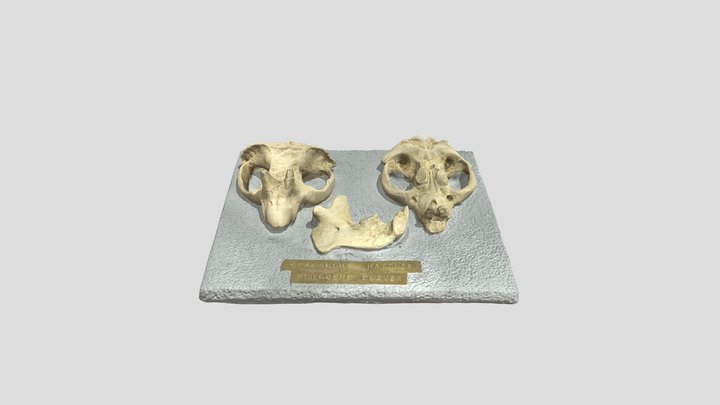
3D model
- Source
- Sketchfab
- Credit
- UIPaleoRepository
- Licence
- CC Attribution
- Commercial use
- cannot be read from the licence given — check the record
Smithsonian Open Access and MorphoSource were not reached for this taxon, so this list is what the others held rather than everything there is.
The description on this site
- Licence
- CC BY-SA 4.0
This is what the site found, which is not the same as what exists.
Keep going
What may have been alongside itMylagaulinae through timeFormations of the MioceneThe world it lived on
Occurrence data from the Paleobiology Database, CC BY 4.0. Matthew 1902