Emydidae
Emydidae is a family of testudines (turtles) that includes close to 50 species in 10 genera. Members of this family are commonly called terrapins, pond turtles, or marsh turtles. Several species of Asian box turtles were formerly classified in the family; however, revised taxonomy has separated them to a different family (Geoemydidae). As currently defined, the Emydidae are entirely a Western Hemisphere family, with the exception of two species of pond turtle.

M. Noth · CC BY 1.0 · via Wikipedia/Commons. May be a photograph of a specimen, or an artist’s reconstruction — an interpretation of a skeleton, since colour and soft tissue are almost never preserved.
On record
Recorded, not inferred- Sits inside
- TestudinoideaPBDB
- Diet
- omnivorePBDB
- Life habit
- aquaticPBDB
- Motility
- actively mobilePBDB, for Osteichthyes
- Environment
- freshwaterPBDB
Time the record covers
At least 201 million years on record.
The record covers at least 201.4 Mya to 11.7 ka. No occurrence read is dated outside 205.7 Mya to 0 Mya.
576 occurrences of Emydidae on record, most of them in the Pleistocene. The Paleobiology Database records this as a living group. Bar height is expected occurrences, not a count: each fossil is spread across the span it is dated to, so a tall narrow bar means tight dating and a low wide one means loose.
When
576 occurrences- Late Triassicunder 1%
- Late Cretaceous1%
- Paleocene5%
- Eocene7%
- Oligocene2%
- Miocene26%
- Pliocene9%
- Pleistocene46%
- Holocene4%
These are dates about fossils, not the animal: the record can only begin after it arose and end before it died out, so either end may reach further. Shares are expected occurrences: a fossil dated to a span is counted partly in each period it straddles. More on what this infers.
Found in
113 formations
- Valentine Formation · Ogallala Group20
- Alachua Formation11
- Xiacaowan Formation7
- Kingsdown Formation6
- Bridger Formation6
- Ogallala Formation6
Loading coastlines…
The named rock units Emydidae has been recovered from, largest first. Drawn where the rock is now, not where it formed. 89 further formations hold fewer occurrences each and are not listed. 347 occurrences have no formation on record, which is common for older literature.
Emydidae and its relatives
PleistoceneWhere Emydidae and its relatives were recorded in the Pleistocene.
Found in the same rock
4,126 taxa- Equus53 sites
- Rana45 sites
- Lepisosteus31 sites
- Odocoileus virginianus30 sites
- Terrapene carolina30 sites
- Trionychidae30 sites
- Emydinae28 sites
- Thamnophis24 sites
- Dasypus bellus23 sites
- Geochelone22 sites
- Ectocion osbornianus21 sites
- Rana pipiens20 sites
- Aenocyon dirus19 sites
- Bufo19 sites
- Mammut americanum19 sites
- Pseudemys19 sites
- Sylvilagus19 sites
- Procyon lotor17 sites
- Alligator mississippiensis16 sites
- Coluber constrictor16 sites
- Holmesina septentrionalis16 sites
- Lynx rufus16 sites
- Mammuthus columbi16 sites
- Neotoma floridana16 sites
The Paleobiology Database records 426 sites for Emydidae, and this reads 240 of them. The number is how many of those sites it was catalogued from too. The 24 sharing the most are listed.
This is not a list of everything alive at the time. It is only what has come out of the same ground as this animal and been written down.
Entered from
282 references- Pleistocene Amphibians and Reptiles in Britain and Europe28
- A transitional Paleocene-Eocene reptile fauna from the Bighorn Basin, Wyoming22
- Synonymies and reidentifications of North American fossil vertebrates and so forth14
- Fossil turtles and crocodiles from the Caenozoic of S-Asia9
- Turtles of the early Pleistocene Santa Fe River 1B locality8
- A Late Pleistocene Hepetofauna from Clark Quarry, Glynn County, Georgia7
- Synonymies, reidentifications, and other arbitrary pronouncements mostly concerning fossil vertebrates7
- The status of Emydoidea hutchisoni Holman, 1995 (Testudines: Emydidae). (Note)7
- A new emydine species from the Medial Miocene (Barstovian) of Nebraska, USA with a new generic arrangement for the species of Clemmys sensu McDowell (1964) (Reptilia: Testudines: Emydidae)7
- The Aragonian vertebrate fauna of Xiacaowan, Jiangsu7
- Miocene and Pliocene Chelonians from the Calvert Cliffs and Nearby Regions6
- Fossil Kinosternidae from the Oligocene and Miocene of Florida, USA6
Each of the 576 occurrences read was entered from one of these publications, ordered by how many each accounts for. This is not a search for papers mentioning the name. 270 further references are not listed. Entries link to doi.org where the Paleobiology Database holds an identifier, and to its own record where it does not. Relayed as the Paleobiology Database holds them, not checked against what they resolve to.
Media and terms
Media content1
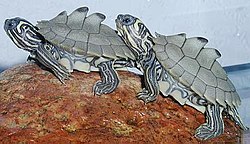
Picture of Emydidae
- Source
- Wikipedia/Commons
- Credit
- M. Noth
- Licence
- CC BY 1.0
- Commercial use
- the licence allows it
No 3D scan of Emydidae was found in Smithsonian Open Access and Sketchfab.
MorphoSource was not reached for this taxon, so this list is what the others held rather than everything there is.
The description on this site
- Source
- Wikipedia, “Emydidae”
- Licence
- CC BY-SA 4.0
This is what the site found, which is not the same as what exists.
Keep going
What may have been alongside itTestudinoidea through timeFormations of the PleistoceneThe world it lived on
Occurrence data from the Paleobiology Database, CC BY 4.0. Rafinesque 1815