Ceresiosaurus
Ceresiosaurus is an extinct aquatic genus of lariosaurine nothosaurid sauropterygian known from the Middle Triassic of Monte San Giorgio, in southern Switzerland and northern Italy. The type species, Ceresiosaurus calcagnii, was named by Bernhard Peyer in 1931. C. calcagnii is known from both the Cava superiore and Cava inferiore beds of the Lower Meride Limestone at Monte San Giorgio, dating to the latest Anisian of the Middle Triassic. Rieppel (1998) suggested that the back then monospecific genus Ceresiosaurus, is a junior synonym of the better known Lariosaurus, yet he kept it type species as a separate species under the new combination L. calcagnii. In 2004, however, this synonymy was objected by Hänni who described and name a second species of Ceresiosaurus, C. lanzi - a separation supported by several other authors since. This species is known only from the stratigraphically younger Cassima beds of Monte San Giorgio, although also from the Lower Meride Limestone, dating to possibly the lowest Ladinian age. The species in a subtropical lagoonal environment with varying open marine influences, and alongside many related but smaller species of nothosaurids and pachypleurosaurids. Ceresiosaurus represents one of the largest vertebrate of up to 3 m (9.8 ft) snout-tail length from the very diversified paleoenvironment of the Middle Triassic Monte San Giorgio.

Ghedoghedo · CC BY-SA 3.0 · via Wikipedia/Commons. May be a photograph of a specimen, or an artist’s reconstruction — an interpretation of a skeleton, since colour and soft tissue are almost never preserved.
On record
Recorded, not inferred- Sits inside
- NothosauridaePBDB
- Motility
- actively mobilePBDB, for Osteichthyes
- Environment
- marinePBDB, for Sauropterygia
Time the record covers
At most 4.5 million years on record.
Every occurrence read is dated to somewhere between 241.464 Mya and 237 Mya, and nothing in the dating separates them, so that window is what the record shows rather than a span.
12 occurrences of Ceresiosaurus on record, most of them in the Middle Triassic. Bar height is expected occurrences, not a count: each fossil is spread across the span it is dated to, so a tall narrow bar means tight dating and a low wide one means loose.
When
12 occurrences- Middle Triassic100%
These are dates about fossils, not the animal: the record can only begin after it arose and end before it died out, so either end may reach further. Shares are expected occurrences: a fossil dated to a span is counted partly in each period it straddles. More on what this infers.
Found in
4 formations
Loading coastlines…
The named rock units Ceresiosaurus has been recovered from, largest first. Drawn where the rock is now, not where it formed. 1 occurrence has no formation on record, which is common for older literature.
Ceresiosaurus and its relatives
Middle TriassicWhere Ceresiosaurus and its relatives were recorded in the Middle Triassic.
Found in the same rock
58 taxa- Saurichthys9 sites
- Ticinolepis longaeva4 sites
- Besania2 sites
- Eosemionotus2 sites
- Neusticosaurus2 sites
- Actinopterygii1 site
- Alcoveria1 site
- Bathysynactites viai1 site
- Boreosomus1 site
- Brevisaurichthys osseus1 site
- Caturus1 site
- Cleithrolepis1 site
- Colobodus1 site
- Colobodus giganteus1 site
- Cosesaurus aviceps1 site
- Cyamodontoidea1 site
- Daonella lommeli1 site
- Enantiostreon1 site
- Entolium discites1 site
- Eoeugnathus1 site
- Eognathus sp.1 site
- Equisetites1 site
- Heterolimulus gadeai1 site
- Hoernesia socialis1 site
The Paleobiology Database records 12 sites for Ceresiosaurus, and this reads all of them. The number is how many of those sites it was catalogued from too. The 24 sharing the most are listed.
This is not a list of everything alive at the time. It is only what has come out of the same ground as this animal and been written down.
Entered from
5 references- New holostean fishes (Actinopterygii: Neopterygii) from the Middle Triassic of the Monte San Giorgio (Canton Ticino, Switzerland)8
- Exceptional preservation of embryos in the actinopterygian Saurichthys from the Middle Triassic of Monte San Giorgio, Switzerland1
- The status of the sauropterygian reptile genera Ceresiosaurus, Lariosaurus, and Silvestrosaurus from the Middle Triassic of Europe1
- Fossil reptiles from the Spanish Muschelkalk (Mont‐Ral and Alcover, Province Tarragona)1
- Les reptiles du Trias moyen du Monte San Giorgio, Tessin [The reptiles from the Middle Triassic of Monte San Giorgio, Tessino]1
Each of the 12 occurrences read was entered from one of these publications, ordered by how many each accounts for. This is not a search for papers mentioning the name. Entries link to doi.org where the Paleobiology Database holds an identifier, and to its own record where it does not. Relayed as the Paleobiology Database holds them, not checked against what they resolve to.
Media and terms
Media content1
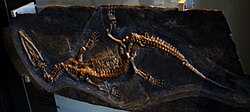
Picture of Ceresiosaurus
- Source
- Wikipedia/Commons
- Credit
- Ghedoghedo
- Licence
- CC BY-SA 3.0
- Commercial use
- the licence allows it
No 3D scan of Ceresiosaurus was found in MorphoSource and Sketchfab.
Smithsonian Open Access was not reached for this taxon, so this list is what the others held rather than everything there is.
The description on this site
- Licence
- CC BY-SA 4.0
This is what the site found, which is not the same as what exists.
Keep going
What may have been alongside itNothosauridae through timeFormations of the Middle TriassicThe world it lived on
Occurrence data from the Paleobiology Database, CC BY 4.0. Peyer 1931