Cicuta
Cicuta, commonly known as water hemlock, is a genus of four species of highly poisonous plants in the family Apiaceae. They are perennial herbaceous plants which grow up to 2.5 meters (8 ft) tall, having distinctive small green or white flowers arranged in an umbrella shape (umbel). Plants in this genus may also be referred to as cowbane or poison parsnip. Cicuta is native to temperate regions of the Northern Hemisphere, mainly North America and Europe, typically growing in wet meadows, along streambanks and other wet and marshy areas. In the United Kingdom it is frequently found along canals. These plants bear a close resemblance to other members in the family Apiaceae and may be confused with a number of edible or poisonous plants. The common name hemlock may also be confused with poison hemlock, or with the Hemlock tree.

Uncredited · via Wikipedia/Commons. May be a photograph of a specimen, or an artist’s reconstruction — an interpretation of a skeleton, since colour and soft tissue are almost never preserved.
On record
Recorded, not inferred- Also called
- cowbanePBDB
- Sits inside
- PlantaePBDB
Time the record covers
At least 13 million years on record.
The record covers at least 13.82 Mya to 129 ka. No occurrence read is dated outside 15.98 Mya to 11.7 ka.
11 occurrences of Cicuta on record, most of them in the Miocene. The Paleobiology Database records this as a living group. Bar height is expected occurrences, not a count: each fossil is spread across the span it is dated to, so a tall narrow bar means tight dating and a low wide one means loose.
When
11 occurrences- Miocene55%
- Pliocene18%
- Pleistocene27%
These are dates about fossils, not the animal: the record can only begin after it arose and end before it died out, so either end may reach further. Shares are expected occurrences: a fossil dated to a span is counted partly in each period it straddles. More on what this infers.
Found in
2 formations
- Calvert Formation · Chesapeake Group2
- Choptank Formation · Chesapeake Group1
Loading coastlines…
The named rock units Cicuta has been recovered from, largest first. Drawn where the rock is now, not where it formed. 8 occurrences have no formation on record, which is common for older literature.
Cicuta and its relatives
MioceneWhere Cicuta and its relatives were recorded in the Miocene.
Found in the same rock
179 taxa- Acer3 sites
- Albula3 sites
- Alnus3 sites
- Carcharhinus3 sites
- Carex3 sites
- Carya3 sites
- Castanea3 sites
- Corylus3 sites
- Cyperaceae3 sites
- Dasyatis3 sites
- Ilex3 sites
- Juglans3 sites
- Lagodon rhomboides3 sites
- Liquidambar3 sites
- Manikara sp.3 sites
- Merluccius3 sites
- Mesocetus siphunculus3 sites
- Mustelus3 sites
- Nyssa3 sites
- Ostrya3 sites
- Otodus megalodon3 sites
- Picea3 sites
- Pinus3 sites
- Protautoga conidens3 sites
The Paleobiology Database records 6 sites for Cicuta, and this reads all of them. The number is how many of those sites it was catalogued from too. The 24 sharing the most are listed.
This is not a list of everything alive at the time. It is only what has come out of the same ground as this animal and been written down.
Entered from
5 references- Geology and biostratigraphy of the Potomac River Cliffs at Stratford Hall, Westmoreland County, Virginia3
- Late Devensian river deposits beneath the floodplain terrace of the River Thames at Abingdon, Berkshire, England3
- Tretichnye Flory Zapadnoi Sibiri3
- Die mittelmiozaenen und obermiozaenen Floren aus der Meuroer und Raunoer Folge in der Lausitz. III. Fundstellen und Palaeobiologie1
- Die pliozaenen Floren von Thueringen, Deutsche Demokratische Republik1
Each of the 11 occurrences read was entered from one of these publications, ordered by how many each accounts for. This is not a search for papers mentioning the name. Entries link to doi.org where the Paleobiology Database holds an identifier, and to its own record where it does not. Relayed as the Paleobiology Database holds them, not checked against what they resolve to.
Media and terms
Media content1
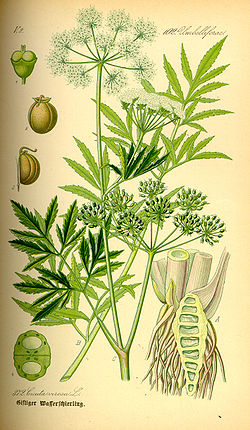
Picture of Cicuta
- Source
- Wikipedia/Commons
- Credit
- nobody named on the record
- Licence
- not stated by the source
- Commercial use
- cannot be read from the licence given — check the record
No 3D scan of Cicuta was found in MorphoSource and Sketchfab.
Smithsonian Open Access was not reached for this taxon, so this list is what the others held rather than everything there is.
The description on this site
- Source
- Wikipedia, “Cicuta”
- Licence
- CC BY-SA 4.0
This is what the site found, which is not the same as what exists.
Keep going
What may have been alongside itPlantae through timeFormations of the MioceneThe world it lived on
Occurrence data from the Paleobiology Database, CC BY 4.0. Linnaeus 1753