Cirripedia
Barnacles are arthropods of the subclass Cirripedia in the subphylum Crustacea. They are related to crabs and lobsters, with similar nauplius larvae. Barnacles are exclusively marine invertebrates; many species live in shallow and tidal waters. Some 2,100 species have been described.

MichaelMaggs · CC BY-SA 3.0 · via Wikipedia/Commons. May be a photograph of a specimen, or an artist’s reconstruction — an interpretation of a skeleton, since colour and soft tissue are almost never preserved.
On record
Recorded, not inferred- Also called
- barnaclePBDB
- Sits inside
- ThecostracaPBDB
- Diet
- suspension feederPBDB
- Life habit
- epifaunalPBDB
- Motility
- stationary, attached, epibiontPBDB
- Vision
- limitedPBDB
Time the record covers
At least 458 million years on record.
The record covers at least 458.2 Mya to 11.7 ka. No occurrence read is dated outside 469.4 Mya to 0 Mya.
1,901 occurrences of Cirripedia on record, most of them in the Late Cretaceous. The Paleobiology Database records this as a living group. Bar height is expected occurrences, not a count: each fossil is spread across the span it is dated to, so a tall narrow bar means tight dating and a low wide one means loose.
When
1,901 occurrences- Ordovicianunder 1%
- Silurianunder 1%
- Devonianunder 1%
- Carboniferousunder 1%
- Permianunder 1%
- Middle Triassicunder 1%
- Early Jurassicunder 1%
- Late Jurassicunder 1%
- Early Cretaceous11%
- Late Cretaceous25%
- Paleoceneunder 1%
- Eocene5%
- Oligocene4%
- Miocene21%
- Pliocene10%
- Pleistocene20%
- Holocene1%
These are dates about fossils, not the animal: the record can only begin after it arose and end before it died out, so either end may reach further. Shares are expected occurrences: a fossil dated to a span is counted partly in each period it straddles. More on what this infers.
Found in
317 formations
- Gault Formation128
- Vaqueros Formation70
- Choptank Formation · Chesapeake Group36
- Ripley Formation · Selma Group35
- Yorktown Formation · Chesapeake Group29
- St Marys Formation · Chesapeake Group24
Loading coastlines…
The named rock units Cirripedia has been recovered from, largest first. Drawn where the rock is now, not where it formed. 293 further formations hold fewer occurrences each and are not listed. 614 occurrences have no formation on record, which is common for older literature.
Cirripedia and its relatives
Late CretaceousWhere Cirripedia and its relatives were recorded in the Late Cretaceous.
Found in the same rock
3,452 taxa- Balanus77 sites
- Ostrea55 sites
- Chlamys38 sites
- Turritella34 sites
- Bryozoa31 sites
- Echinoidea28 sites
- Serpula23 sites
- Cliona20 sites
- Spondylus20 sites
- Gastropoda16 sites
- Nucula (Nucula) proxima16 sites
- Anomia simplex15 sites
- Concavus concavus15 sites
- Conradostrea sculpturata15 sites
- Conus15 sites
- Mulinia lateralis15 sites
- Tellina15 sites
- Dentalium14 sites
- Cardium13 sites
- Cibicides13 sites
- Glycymeris13 sites
- Hiatella arctica13 sites
- Arca12 sites
- Balanus crenatus12 sites
The Paleobiology Database records 1,153 sites for Cirripedia, and this reads 240 of them. The number is how many of those sites it was catalogued from too. The 24 sharing the most are listed.
This is not a list of everything alive at the time. It is only what has come out of the same ground as this animal and been written down.
Entered from
402 references- Recent advances in the knowledge of Gault Cirripedia123
- Usonogie raki (Cirripedia, Thoracica) verkhnego Mela Mangyshlaka82
- The Vaqueros Formation, Lower Miocene of California. I. Paleontology64
- Cirripedes from the Upper Cretaceous of Alabama and Mississippi, Eastern Gulf Region, USA. Part 1. Palaeontology63
- Systematics and biostratigraphy of Miocene Cirripedia of the Chesapeake Group; Maryland, North Carolina, and Virginia48
- A new record of the Late Cretaceous cirripede Eoverruca hewitti (Verrucomorpha, Proverrucidae) from southern Poland42
- Revision of the balanid barnacle genus Concavus Newman, 1982, with the description of a new subfamily, two new genera, and eight new species42
- Die Crustaceen der böhmischen Kreideformation41
- Cirripedes (Thoracica, Crustacea) from the Cretaceous (Albian and Cenomanian) of Texas and Oklahoma, USA34
- Eocene Balanidae of Florida, Including a New Genus and Species with a Unique Plan of "Turtle-Barnacle" Organization31
- Unpublished census data from Atlantic coastal plain and circum-Caribbean Neogene assemblages and taxonomic opinions29
- Origin and phylogeny of the Cretaceous thoracican cirripede family Stramentidae24
Each of the 1,901 occurrences read was entered from one of these publications, ordered by how many each accounts for. This is not a search for papers mentioning the name. 390 further references are not listed. Entries link to doi.org where the Paleobiology Database holds an identifier, and to its own record where it does not. Relayed as the Paleobiology Database holds them, not checked against what they resolve to.
Media and terms
Media content2

Picture of Cirripedia
- Source
- Wikipedia/Commons
- Credit
- MichaelMaggs
- Licence
- CC BY-SA 3.0
- Commercial use
- the licence allows it
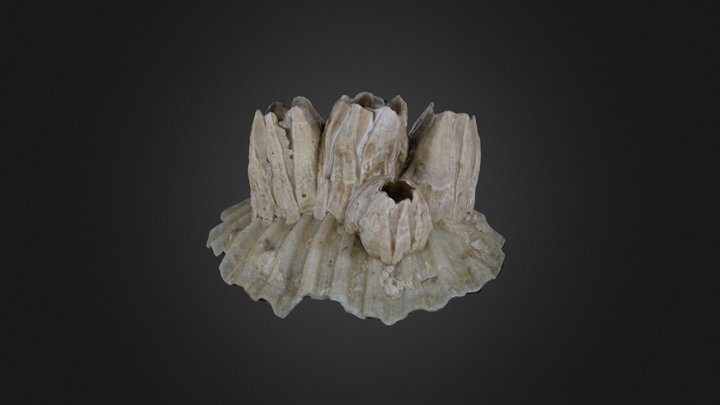
3D model
- Source
- Sketchfab
- Licence
- CC0 Public Domain
- Commercial use
- the licence allows it
Smithsonian Open Access was not reached for this taxon, so this list is what the others held rather than everything there is.
The description on this site
- Source
- Wikipedia, “Barnacle”
- Licence
- CC BY-SA 4.0
This is what the site found, which is not the same as what exists.
Keep going
What may have been alongside itThecostraca through timeFormations of the Late CretaceousThe world it lived on
Occurrence data from the Paleobiology Database, CC BY 4.0. (Rafinesque 1816)