Cleoniceras
Cleoniceras is a rather involute, high-whorled hoplitid from the Lower to basal Middle Albian of Europe, Madagascar, and the Transcaspian region. The shell has a generally small umbilicus, arched to acute venter, and typically at some growth stage, falcoid ribs that spring in pairs from umbilical tubercles, usually disappearing on the outer whorls.

Antonov · Public Domain · via Wikipedia/Commons. May be a photograph of a specimen, or an artist’s reconstruction — an interpretation of a skeleton, since colour and soft tissue are almost never preserved.
On record
Recorded, not inferred- Sits inside
- CleoniceratidaePBDB
- Diet
- carnivorePBDB, for Ammonoidea
- Life habit
- nektonicPBDB, for Ammonoidea
- Motility
- fast-movingPBDB, for Ammonoidea
- Vision
- well-developedPBDB, for Cephalopoda
- Environment
- marinePBDB, for Cephalopoda
Time the record covers
At least 9.6 million years on record.
The record covers at least 110.1 Mya to 100.5 Mya. No occurrence read is dated outside 113.2 Mya to 66 Mya.
45 occurrences of Cleoniceras on record, most of them in the Early Cretaceous. Bar height is expected occurrences, not a count: each fossil is spread across the span it is dated to, so a tall narrow bar means tight dating and a low wide one means loose.
When
45 occurrencesThese are dates about fossils, not the animal: the record can only begin after it arose and end before it died out, so either end may reach further. Shares are expected occurrences: a fossil dated to a span is counted partly in each period it straddles. More on what this infers.
Found in
10 formations
- Folkestone Formation · Lower Greensand Group21
- Monk’s Bay Sandstone Formation · Lower Greensand Group1
- Peace River Formation1
- Haida Formation1
- Kamiji Formation · Lower Yezo Group1
- Ambarimaninga Formation1
Loading coastlines…
The named rock units Cleoniceras has been recovered from, largest first. Drawn where the rock is now, not where it formed. 15 occurrences have no formation on record, which is common for older literature.
Cleoniceras and its relatives
Early CretaceousWhere Cleoniceras and its relatives were recorded in the Early Cretaceous.
Found in the same rock
220 taxa- Sonneratia10 sites
- Douvilleiceras mammillatum8 sites
- Douvilleiceras inaequinodum6 sites
- Protanisoceras6 sites
- Pseudosonneratia6 sites
- Inoceramus (Actinoceramus) salomoni5 sites
- Otohoplites5 sites
- Protanisoceras acteon5 sites
- Protohoplites5 sites
- Roberticeras newtoni5 sites
- Douvilleiceras4 sites
- Entolium orbiculare4 sites
- Exogyra4 sites
- Grantziceras affine4 sites
- Neithea quinquecostata4 sites
- Anadesmoceras3 sites
- Brewericeras hulenense3 sites
- Cucullaea glabra3 sites
- Desmoceras (Desmoceras) latidorsatum3 sites
- Grantziceras glabrum3 sites
- Grycia3 sites
- Gryphaeostrea canaliculata3 sites
- Hamites praegibbosus3 sites
- Otohoplites raulinianus3 sites
The Paleobiology Database records 29 sites for Cleoniceras, and this reads all of them. The number is how many of those sites it was catalogued from too. The 24 sharing the most are listed.
This is not a list of everything alive at the time. It is only what has come out of the same ground as this animal and been written down.
Entered from
15 references- The stratigraphical palaeontology of the Lower Greensand22
- New or formerly poorly known, biochronologically and paleobiogeographically important gastroplitinid and cleoniceratinid (Ammonitida) taxa from Middle Albian rocks of mid-western and Arctic Canada8
- Geologie de Madagascar I. Les Terrains Sedimentaires3
- Parahoplitid ammonites and narrowing down the Aptian/Albian boundary interval in northern Iran1
- First dinosaur (Ornithopoda) from Early Cretaceous (Albian) of Oregon, U.S.A.1
- An Early Albian Arctic-type ammonite Arcthoplites from Hokkaido, northern Japan, and its paleobiogeographic and paleoclimatological implications1
- Desmoceratidae, Silesitidae and Kossmaticeratidae (Ammonitida) from the Upper Aptian-Albian of Patagonia (Argentina)1
- Ammonite faunas and biostratigraphy of the Albian to Middle Cenomanian (Cretaceous) in western Korjak-Kamchatka, NE Russia1
- Stratigraphic investigations of the Cretaceous Queen Chartlotte Group, Queen Charlotte Islands, British Columbia1
- The Ammonoidea of the Lower Greensand, part IX1
- Illustration of canadian fossils. Lower Cretaceous marine index fossils of the sedimentary basins of western and Arctic Canada1
- Early Cretaceous (Albian) ammonites from the Chitna Valley and Talkeetna Mountains, Alaska1
Each of the 45 occurrences read was entered from one of these publications, ordered by how many each accounts for. This is not a search for papers mentioning the name. 3 further references are not listed. Entries link to doi.org where the Paleobiology Database holds an identifier, and to its own record where it does not. Relayed as the Paleobiology Database holds them, not checked against what they resolve to.
Media and terms
Media content2

Picture of Cleoniceras
- Source
- Wikipedia/Commons
- Credit
- Antonov
- Licence
- Public Domain
- Commercial use
- the licence allows it
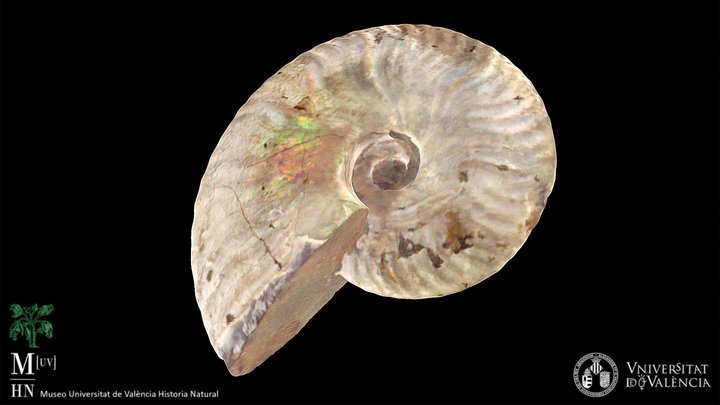
3D model
- Source
- Sketchfab
- Licence
- CC Attribution
- Commercial use
- cannot be read from the licence given — check the record
The description on this site
- Source
- Wikipedia, “Cleoniceras”
- Licence
- CC BY-SA 4.0
This is what the site found, which is not the same as what exists.
Keep going
What may have been alongside itCleoniceratidae through timeFormations of the Early CretaceousThe world it lived on
Occurrence data from the Paleobiology Database, CC BY 4.0. Parona and Bonarelli 1897