Douvilleiceras
Douvilleiceras is a genus of ammonites from the Middle to Late Cretaceous. Its fossils have been found worldwide, in Africa, Asia, Europe, and North and South America.

Hectonichus · CC BY-SA 3.0 · via Wikipedia/Commons. May be a photograph of a specimen, or an artist’s reconstruction — an interpretation of a skeleton, since colour and soft tissue are almost never preserved.
On record
Recorded, not inferred- Sits inside
- DouvilleiceratinaePBDB
- Diet
- carnivorePBDB, for Ammonoidea
- Life habit
- nektonicPBDB, for Ammonoidea
- Motility
- fast-movingPBDB, for Ammonoidea
- Vision
- well-developedPBDB, for Cephalopoda
- Environment
- marinePBDB, for Cephalopoda
Time the record covers
At least 27 million years on record.
The record covers at least 121.4 Mya to 93.9 Mya. No occurrence read is dated outside 143.1 Mya to 89.8 Mya.
202 occurrences of Douvilleiceras on record, most of them in the Early Cretaceous. Bar height is expected occurrences, not a count: each fossil is spread across the span it is dated to, so a tall narrow bar means tight dating and a low wide one means loose.
When
202 occurrencesThese are dates about fossils, not the animal: the record can only begin after it arose and end before it died out, so either end may reach further. Shares are expected occurrences: a fossil dated to a span is counted partly in each period it straddles. More on what this infers.
Found in
28 formations
- Folkestone Formation · Lower Greensand Group26
- Haida Formation20
- Grès verts helvétiques Formation17
- Mzinene Formation13
- Budden Canyon Formation · Pacheco Group13
- Glen Rose Limestone Formation · Trinity Group8
Loading coastlines…
The named rock units Douvilleiceras has been recovered from, largest first. Drawn where the rock is now, not where it formed. 4 further formations hold fewer occurrences each and are not listed. 51 occurrences have no formation on record, which is common for older literature.
Douvilleiceras and its relatives
Early CretaceousWhere Douvilleiceras and its relatives were recorded in the Early Cretaceous.
Found in the same rock
582 taxa- Desmoceras (Desmoceras) latidorsatum23 sites
- Protanisoceras21 sites
- Beudanticeras16 sites
- Brewericeras hulenense14 sites
- Leymeriella13 sites
- Puzosia13 sites
- Gastropoda12 sites
- Hoplites12 sites
- Neithea quinquecostata12 sites
- Roberticeras newtoni12 sites
- Hamites10 sites
- Holaster10 sites
- Lyelliceras10 sites
- Birostrina9 sites
- Cleoniceras9 sites
- Entolium orbiculare9 sites
- Hemiaster9 sites
- Otohoplites9 sites
- Sonneratia9 sites
- Anagaudryceras sacya8 sites
- Bivalvia8 sites
- Hypacanthoplites8 sites
- Leymeriella tardefurcata8 sites
- Panopea8 sites
The Paleobiology Database records 142 sites for Douvilleiceras, and this reads all of them. The number is how many of those sites it was catalogued from too. The 24 sharing the most are listed.
This is not a list of everything alive at the time. It is only what has come out of the same ground as this animal and been written down.
Entered from
39 references- Geologie de Madagascar I. Les Terrains Sedimentaires31
- The stratigraphical palaeontology of the Lower Greensand31
- Les grès verts helvétiques (Aptien moyen-Albien supérieur) de Haute-Savoie, Valais et Vaud (Alpes occidentales franco-suisses)24
- Cretaceous faunas from Zululand and Natal, South Africa. The Albian ammonite genus Douvilleiceras de Grossouvre, 189413
- Early Albian (Early Cretaceous) douvilleiceratid ammonites from Haida Gwaii, British Columbia, Canada12
- The Cretaceous and Tertiary of southern Texas and northern Mexico10
- Lower Albian and Aptian (Cretaceous) ammonites of Texas8
- Ammonoids of the lower Cretaceous sandstone member of the Haida Formation, Skidgate Inlet, Queen Charlotte Islands, western British Columbia8
- Lower Cretaceous stratigraphic units of Northern California8
- Texas Cretaceous ammonites and nautiloids6
- Albian ammonite faunas from Peru: The genus Neodeshaesites Casey, 19645
- Nouvelles données sur l'Albien de la Chartreuse et du Vercors5
Each of the 202 occurrences read was entered from one of these publications, ordered by how many each accounts for. This is not a search for papers mentioning the name. 27 further references are not listed. Entries link to doi.org where the Paleobiology Database holds an identifier, and to its own record where it does not. Relayed as the Paleobiology Database holds them, not checked against what they resolve to.
Media and terms
Media content2

Picture of Douvilleiceras
- Source
- Wikipedia/Commons
- Credit
- Hectonichus
- Licence
- CC BY-SA 3.0
- Commercial use
- the licence allows it
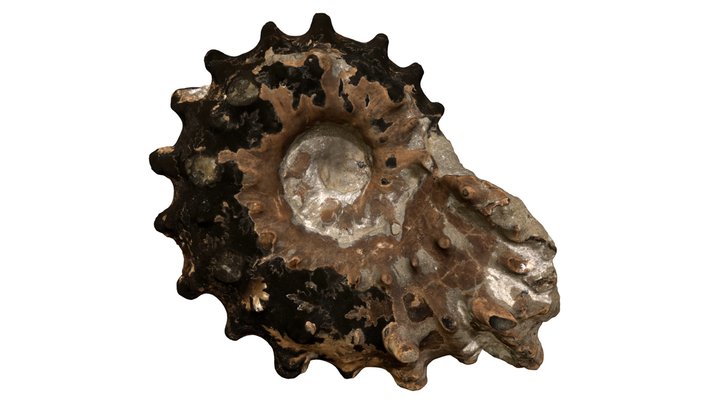
3D model
- Source
- Sketchfab
- Licence
- CC Attribution
- Commercial use
- cannot be read from the licence given — check the record
The description on this site
- Licence
- CC BY-SA 4.0
This is what the site found, which is not the same as what exists.
Keep going
What may have been alongside itDouvilleiceratinae through timeFormations of the Early CretaceousThe world it lived on
Occurrence data from the Paleobiology Database, CC BY 4.0. Grossouvre 1894