Conepatus
The hog-nosed skunks belong to the genus Conepatus and are members of the family Mephitidae (skunks). They are native to the Americas. They have white backs and tails and black underparts.

Inao Vásquez payayita Louis Agassiz Fuertes Washington L. S. Vieira · CC BY-SA 4.0 · via Wikipedia/Commons. May be a photograph of a specimen, or an artist’s reconstruction — an interpretation of a skeleton, since colour and soft tissue are almost never preserved.
On record
Recorded, not inferred- Also called
- hog-nosed skunkPBDB
- Sits inside
- MephitidaePBDB
- Diet
- carnivore, omnivorePBDB, for Carnivora
- Life habit
- scansorialPBDB
- Motility
- actively mobilePBDB, for Osteichthyes
- Environment
- terrestrialPBDB, for Eutheria
Time the record covers
At least 4.6 million years on record.
The record covers at least 4.7 Mya to 11.7 ka. No occurrence read is dated outside 9.4 Mya to 0 Mya.
29 occurrences of Conepatus on record, most of them in the Pleistocene. The Paleobiology Database records this as a living group. Bar height is expected occurrences, not a count: each fossil is spread across the span it is dated to, so a tall narrow bar means tight dating and a low wide one means loose.
When
29 occurrences- Miocene9%
- Pliocene1%
- Pleistocene72%
- Holocene18%
These are dates about fossils, not the animal: the record can only begin after it arose and end before it died out, so either end may reach further. Shares are expected occurrences: a fossil dated to a span is counted partly in each period it straddles. More on what this infers.
Found in
2 formations
Loading coastlines…
The named rock units Conepatus has been recovered from, largest first. Drawn where the rock is now, not where it formed. 26 occurrences have no formation on record, which is common for older literature.
Conepatus and its relatives
PleistoceneWhere Conepatus and its relatives were recorded in the Pleistocene.
Found in the same rock
525 taxa- Odocoileus virginianus9 sites
- Puma concolor8 sites
- Dasypus bellus7 sites
- Equus7 sites
- Panthera onca7 sites
- Sylvilagus floridanus6 sites
- Geomys pinetis5 sites
- Lynx rufus5 sites
- Sigmodon hispidus5 sites
- Spilogale putorius5 sites
- Tremarctos floridanus5 sites
- Cryptotis parva4 sites
- Hemiauchenia macrocephala4 sites
- Lagidium peruanum4 sites
- Leopardus pardalis4 sites
- Megalonyx4 sites
- Mephitis mephitis4 sites
- Neofiber alleni4 sites
- Oryzomys palustris4 sites
- Platygonus compressus4 sites
- Scalopus aquaticus4 sites
- Smilodon populator4 sites
- Sylvilagus brasiliensis4 sites
- Tapirus (Helicotapirus) veroensis4 sites
The Paleobiology Database records 25 sites for Conepatus, and this reads all of them. The number is how many of those sites it was catalogued from too. The 24 sharing the most are listed.
This is not a list of everything alive at the time. It is only what has come out of the same ground as this animal and been written down.
Entered from
18 references- Faunal remains4
- Late Quaternary caviomorph rodents (Rodentia: Hystricognathi) from the Serra da Capivara, northeastern Brazil, with description of a new taxon2
- New Pleistocene Cave Faunas of the Andes of Central Perú: Radiocarbon Ages and the Survival of Low Latitude, Pleistocene DNA2
- Earliest hog-nosed skunk, Conepatus (Mephitidae, Carnivora), from the early Pliocene of Guanajuato, Mexico and origin of South American skunks2
- A systematic reassessment and paleogeographic review of fossil Xenarthra from Peru2
- Novos achados de mamiferos carnivoros do Pleistoceno final-Holoceno em grutas calcarias do Estado da Bahia2
- Historical Biogeography of Florida Pleistocene Mammals2
- A new Late Pleistocene Conepatus and associated vertebrate fauna from Florida2
- Chronology of Florida Pleistocene mammals2
- The Early-Late Hemphillian (Hh2) Faunal Assemblage From Juchipila Basin, State of Zacatecas, Mexico, and Its Biochronologic Correlation with Other Hemphillian Faunas in Central Mexico1
- A new extinct primate among the Pleistocene megafauna of Bahia, Brazil1
- Reassesment of the Pliocene-Pleistocene continental time scale of Southern South America. Correlation of the type Chapadmalalan with Bolivian sections1
Each of the 29 occurrences read was entered from one of these publications, ordered by how many each accounts for. This is not a search for papers mentioning the name. 6 further references are not listed. Entries link to doi.org where the Paleobiology Database holds an identifier, and to its own record where it does not. Relayed as the Paleobiology Database holds them, not checked against what they resolve to.
Media and terms
Media content2

Picture of Conepatus
- Source
- Wikipedia/Commons
- Credit
- Inao Vásquez payayita Louis Agassiz Fuertes Washington L. S. Vieira
- Licence
- CC BY-SA 4.0
- Commercial use
- the licence allows it
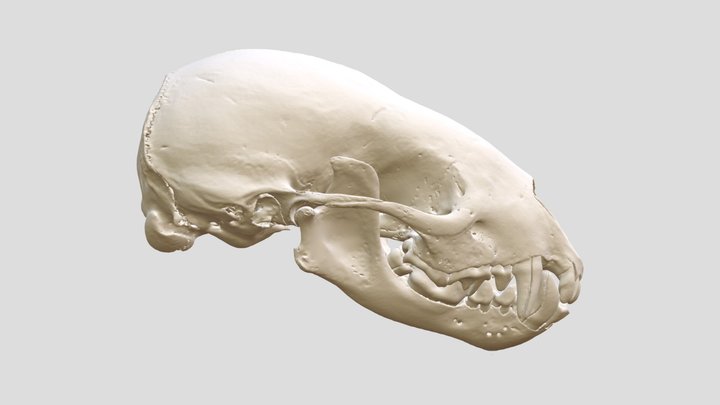
3D model
- Source
- Sketchfab
- Credit
- Biodiversity
- Licence
- CC Attribution
- Commercial use
- cannot be read from the licence given — check the record
Smithsonian Open Access and MorphoSource were not reached for this taxon, so this list is what the others held rather than everything there is.
The description on this site
- Licence
- CC BY-SA 4.0
This is what the site found, which is not the same as what exists.
Keep going
What may have been alongside itMephitidae through timeFormations of the PleistoceneThe world it lived on
Occurrence data from the Paleobiology Database, CC BY 4.0. Gray 1837