Sylvilagus floridanus
The eastern cottontail is a species of rabbit in the family Leporidae. It is the most widespread and abundant rabbit species in North America, inhabiting a wide range that extends from southern Canada throughout most of the United States and into parts of Mexico, Central America, and the northern regions of South America. Known for its distinctive fluffy white tail, which resembles a cotton ball and gives the species its common name, the eastern cottontail typically inhabits open fields, meadows, and brushy areas where it can easily find cover and food. It is a primarily herbivorous, crepuscular mammal that feeds on grasses, herbs, twigs, and bark, and plays an important role in the ecosystem as prey for a variety of predators including foxes, hawks, and owls. Due to its adaptability to human-altered landscapes such as suburban and agricultural areas, the eastern cottontail has maintained stable population levels and is not considered threatened. It is also well known for its high reproductive rate, with females capable of producing multiple large litters annually, which contributes to its widespread presence.

StBlueD · CC BY-SA 4.0 · via Wikipedia/Commons. May be a photograph of a specimen, or an artist’s reconstruction — an interpretation of a skeleton, since colour and soft tissue are almost never preserved.
On record
Recorded, not inferred- Also called
- eastern cottontailPBDB
- Sits inside
- SylvilagusPBDB
- Diet
- grazer, browserPBDB, for Leporidae
- Life habit
- ground dwellingPBDB, for Leporidae
- Motility
- actively mobilePBDB, for Osteichthyes
- Environment
- terrestrialPBDB, for Eutheria
- Mass
- 1.13 kgWikidata
Time the record covers
At least 762 thousand years on record.
The record covers at least 774 ka to 11.7 ka. No occurrence read is dated outside 2.58 Mya to 0 Mya.
56 occurrences of Sylvilagus floridanus on record, most of them in the Pleistocene. The Paleobiology Database records this as a living group. Bar height is expected occurrences, not a count: each fossil is spread across the span it is dated to, so a tall narrow bar means tight dating and a low wide one means loose.
When
56 occurrences- Pleistocene94%
- Holocene6%
These are dates about fossils, not the animal: the record can only begin after it arose and end before it died out, so either end may reach further. Shares are expected occurrences: a fossil dated to a span is counted partly in each period it straddles. More on what this infers.
Found in
5 formations
Loading coastlines…
The named rock units Sylvilagus floridanus has been recovered from, largest first. Drawn where the rock is now, not where it formed. 50 occurrences have no formation on record, which is common for older literature.
Sylvilagus floridanus and its relatives
PleistoceneWhere Sylvilagus floridanus and its relatives were recorded in the Pleistocene.
Found in the same rock
874 taxa- Odocoileus virginianus33 sites
- Equus29 sites
- Dasypus bellus23 sites
- Procyon lotor20 sites
- Lynx rufus19 sites
- Scalopus aquaticus19 sites
- Didelphis virginiana18 sites
- Geomys pinetis17 sites
- Holmesina septentrionalis17 sites
- Mephitis mephitis17 sites
- Sigmodon hispidus17 sites
- Neofiber alleni16 sites
- Mammut americanum15 sites
- Hemiauchenia macrocephala14 sites
- Neotoma floridana14 sites
- Oryzomys palustris14 sites
- Peromyscus14 sites
- Ursus americanus14 sites
- Castor canadensis13 sites
- Cryptotis parva13 sites
- Paramylodon harlani13 sites
- Palaeolama mirifica12 sites
- Sciurus carolinensis12 sites
- Aenocyon dirus11 sites
The Paleobiology Database records 56 sites for Sylvilagus floridanus, and this reads all of them. The number is how many of those sites it was catalogued from too. The 24 sharing the most are listed.
This is not a list of everything alive at the time. It is only what has come out of the same ground as this animal and been written down.
Entered from
36 references- Chronology of Florida Pleistocene mammals13
- Sabertooth cat, Smilodon floridanus (Leidy), and associated fauna from a Tennessee Cave (40 Dv 40), the First American Bank site4
- Quaternary vertebrate localities of Virginia and their avian and mammalian fauna3
- Overview of the geology and vertebrate biochronology of the Leisey Shell Pit Local Fauna, Hillsborough County, Florida2
- Early Pleistocene (Irvingtonian) mammals from the Seymour Formation, Knox and Baylor Counties, Texas, exclusive of Camelidae2
- The Pleistocene vertebrate fauna from Cumberland Cave, Maryland2
- Biostratigraphy of Blancan and Irvingtonian mammals in the Fish Creek-Vallecito Creek section, southern California, and a review of the Blancan-Irvingtonian boundary1
- Pleistocene (Rancholabrean) vertebrate faunas from coastal Georgia1
- Small mammals (Insectivora, Lagomorpha, and Rodentia) from the early Pleistocene (early Irvingtonian) Leisey Shell Pit Local Fauna, Hillsborough County, Florida1
- Arvicolid Rodents of the Early Pleistocene Java Local Fauna from North-Central South Dakota1
- Descubrimiento de Mamiferos Fosiles de Edad Lujanense (Pleistoceno Tardio) en el "Desierto" de la Tatacoa (Huila, Colombia)1
- Faunal correlation of Pleistocene deposits in Western Canada1
Each of the 56 occurrences read was entered from one of these publications, ordered by how many each accounts for. This is not a search for papers mentioning the name. 24 further references are not listed. Entries link to doi.org where the Paleobiology Database holds an identifier, and to its own record where it does not. Relayed as the Paleobiology Database holds them, not checked against what they resolve to.
Media and terms
Media content3

Picture of Sylvilagus floridanus
- Source
- Wikipedia/Commons
- Credit
- StBlueD
- Licence
- CC BY-SA 4.0
- Commercial use
- the licence allows it
CT scan
- Source
- MorphoSource
- Credit
- AMNH Mammal Collections
- Licence
- not stated by the source
- Commercial use
- cannot be read from the licence given — check the record
- Specimen
- Sylvilagus floridanus · AMNH:Mammals:M-254438
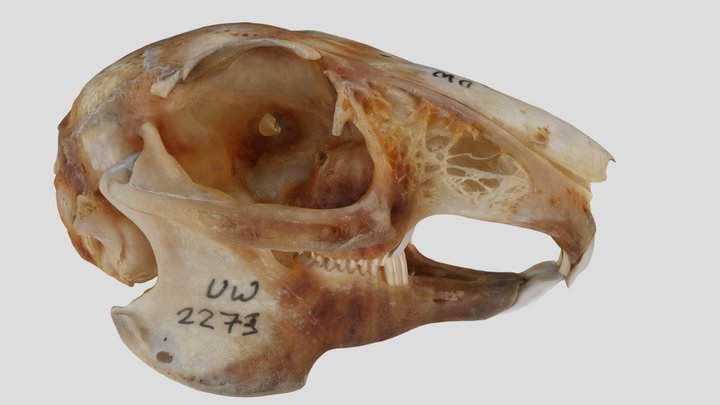
3D model
- Source
- Sketchfab
- Licence
- CC Attribution
- Commercial use
- cannot be read from the licence given — check the record
Smithsonian Open Access was not reached for this taxon, so this list is what the others held rather than everything there is.
The description on this site
- Licence
- CC BY-SA 4.0
This is what the site found, which is not the same as what exists.
Keep going
What may have been alongside itSylvilagus through timeFormations of the PleistoceneThe world it lived on
Occurrence data from the Paleobiology Database, CC BY 4.0. (Allen 1890)