Conger
Conger is a genus of marine congrid eels. It includes some of the largest types of eels, ranging up to two metres or more in length, in the case of the European conger. Large congers have often been observed by divers during the day in parts of the Mediterranean Sea, and both European and American congers are sometimes caught by fishermen along the European and North American Atlantic coasts.

SEFSC Pascagoula Laboratory; Collection of Brandi Noble, NOAA/NMFS/SEFSC · Public Domain · via Wikipedia/Commons. May be a photograph of a specimen, or an artist’s reconstruction — an interpretation of a skeleton, since colour and soft tissue are almost never preserved.
On record
Recorded, not inferred- Sits inside
- CongridaePBDB
- Diet
- carnivorePBDB, for Anguilliformes
- Life habit
- nektobenthicPBDB, for Anguilliformes
- Motility
- actively mobilePBDB, for Anguilliformes
Time the record covers
At least 59 million years on record.
The record covers at least 59.24 Mya to 129 ka. No occurrence read is dated outside 61.66 Mya to 0 Mya.
65 occurrences of Conger on record, most of them in the Eocene. The Paleobiology Database records this as a living group. Bar height is expected occurrences, not a count: each fossil is spread across the span it is dated to, so a tall narrow bar means tight dating and a low wide one means loose.
When
65 occurrencesThese are dates about fossils, not the animal: the record can only begin after it arose and end before it died out, so either end may reach further. Shares are expected occurrences: a fossil dated to a span is counted partly in each period it straddles. More on what this infers.
Found in
26 formations
- Selsey Formation · Bracklesham Group7
- Miretrain Marl Formation4
- Elmore Formation · Bracklesham Group3
- Bashi Formation3
- Yazoo Formation · Jackson Group2
- Moodys Branch Formation · Jackson Group2
Loading coastlines…
The named rock units Conger has been recovered from, largest first. Drawn where the rock is now, not where it formed. 2 further formations hold fewer occurrences each and are not listed. 22 occurrences have no formation on record, which is common for older literature.
Conger and its relatives
EoceneWhere Conger and its relatives were recorded in the Eocene.
Found in the same rock
1,373 taxa- Diaphus12 sites
- Bregmaceros11 sites
- Neobythites10 sites
- Pterothrissus umbonatus10 sites
- Trachinus10 sites
- Epigonus9 sites
- Glyptophidium9 sites
- Apogon8 sites
- Centroberyx8 sites
- Cylindracanthus rectus8 sites
- Isurus praecursor8 sites
- Paraconger8 sites
- Pristis lathami8 sites
- Allomorone burlesonis7 sites
- Brachycarcharias lerichei7 sites
- Haemulon7 sites
- Lactarius amplus7 sites
- Myripristis7 sites
- Preophidion7 sites
- Scyliorhinus7 sites
- Aetobatus irregularis6 sites
- Aetomylaeus dixoni6 sites
- Aetomylaeus striatus6 sites
- Aves6 sites
The Paleobiology Database records 56 sites for Conger, and this reads all of them. The number is how many of those sites it was catalogued from too. The 24 sharing the most are listed.
This is not a list of everything alive at the time. It is only what has come out of the same ground as this animal and been written down.
Entered from
21 references- Reconstruction of the fossil marine bony fish fauna (Teleostei) from the Eocene to Pleistocene of New Zealand by means of otoliths. With studies of Recent congroid, morid and trachinoid otoliths10
- 541. Some Pleistocene fish-otoliths from the Boso and Miura peninsulas10
- The Selsey Division (Bracklesham Group) at Lee-on-the-Solent, Gosport, (Hants)9
- Early Eocene fish otoliths from the eastern and southern USA6
- Middle and late Eocene fish otoliths from the eastern and southern USA5
- Fish otoliths from the Lutetian of the Aquitaine Basin (SW France), a breakthrough in the knowledge of the European Eocene ichthyofauna5
- Otolithes de poissons du paléocanyon de saubrigues (chattien à langhien), aquitaine méridionale, France3
- Distinctive "congrid type" fish otoliths from the lower Tertiary of the Gulf Coast (Pisces: Anguilliformes)3
- Fish otoliths from the Paleocene of Denmark2
- Fish otolith record reveals possible tropical-subtropical fish community in temperate Japan during the exceptionally warm Last Interglacial period1
- Fossil fish otoliths from the Chibanian Miyata Formation, Kanagawa Prefecture, Japan, with comments on the paleoenvironment1
- Giant-toothed White Sharks and Wide-toothed Mako (Lamnidae) from the Venezuela Neogene: Their Role in the Caribbean, Shallow-water Fish Assemblage1
Each of the 65 occurrences read was entered from one of these publications, ordered by how many each accounts for. This is not a search for papers mentioning the name. 9 further references are not listed. Entries link to doi.org where the Paleobiology Database holds an identifier, and to its own record where it does not. Relayed as the Paleobiology Database holds them, not checked against what they resolve to.
Media and terms
Media content3

Picture of Conger
- Source
- Wikipedia/Commons
- Credit
- SEFSC Pascagoula Laboratory; Collection of Brandi Noble, NOAA/NMFS/SEFSC
- Licence
- Public Domain
- Commercial use
- the licence allows it
Synchrotron Imaging scan
- Source
- MorphoSource
- Licence
- not stated by the source
- Commercial use
- cannot be read from the licence given — check the record
- Specimen
- Conger conger · mnhn:ic:OS.PB-SP-24
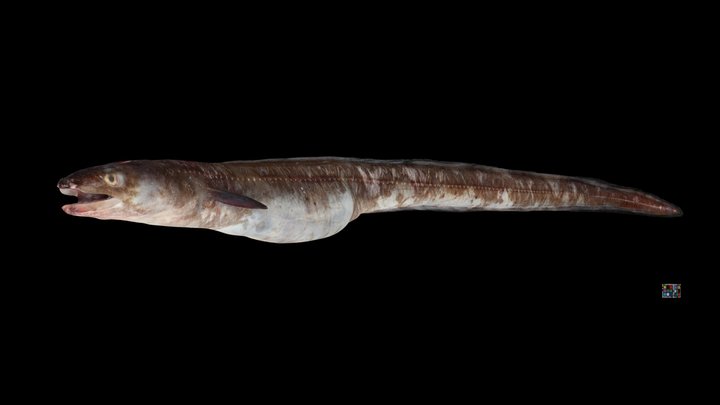
3D model
- Source
- Sketchfab
- Licence
- CC0 Public Domain
- Commercial use
- the licence allows it
Smithsonian Open Access was not reached for this taxon, so this list is what the others held rather than everything there is.
The description on this site
- Source
- Wikipedia, “Conger”
- Licence
- CC BY-SA 4.0
This is what the site found, which is not the same as what exists.
Keep going
What may have been alongside itCongridae through timeFormations of the EoceneThe world it lived on
Occurrence data from the Paleobiology Database, CC BY 4.0. Schaeffer 1760