Haemulon
Haemulon is a genus of fish in the grunt family known as the scaled-fin grunts. Most are found in the western Atlantic Ocean, with a few species known from the eastern Pacific Ocean. This genus is considered to be one of the most important fish groups of the coral reefs of Brazil due to its commercial value and crucial ecological role.

Brian Gratwicke · CC BY 2.0 · via Wikipedia/Commons. May be a photograph of a specimen, or an artist’s reconstruction — an interpretation of a skeleton, since colour and soft tissue are almost never preserved.
On record
Recorded, not inferred- Sits inside
- HaemulinaePBDB
- Motility
- actively mobilePBDB, for Osteichthyes
Time the record covers
At least 48 million years on record.
The record covers at least 48.07 Mya to 11.7 ka. No occurrence read is dated outside 56 Mya to 0 Mya.
32 occurrences of Haemulon on record, most of them in the Eocene. The Paleobiology Database records this as a living group. Bar height is expected occurrences, not a count: each fossil is spread across the span it is dated to, so a tall narrow bar means tight dating and a low wide one means loose.
When
32 occurrences- Eocene50%
- Miocene19%
- Pliocene9%
- Pleistocene3%
- Holocene19%
These are dates about fossils, not the animal: the record can only begin after it arose and end before it died out, so either end may reach further. Shares are expected occurrences: a fossil dated to a span is counted partly in each period it straddles. More on what this infers.
Found in
16 formations
- Gatun Formation2
- Cantaure Formation2
- Donzacq Marl Formation2
- Nanjemoy Formation2
- Moodys Branch Formation2
- Bashi Formation2
Loading coastlines…
The named rock units Haemulon has been recovered from, largest first. Drawn where the rock is now, not where it formed. 10 occurrences have no formation on record, which is common for older literature.
Haemulon and its relatives
EoceneWhere Haemulon and its relatives were recorded in the Eocene.
Found in the same rock
522 taxa- Paraconger10 sites
- Allomorone burlesonis9 sites
- Conger9 sites
- Pythonichthys9 sites
- Sciaena9 sites
- Preophidion8 sites
- Pterothrissus umbonatus8 sites
- Symmetrosulcus8 sites
- Apogon7 sites
- Lactarius amplus7 sites
- Myripristis7 sites
- Sparus elegantulus7 sites
- Trachinus7 sites
- Bregmaceros6 sites
- Diaphus6 sites
- Protanago nonsector6 sites
- Pseudophichthys6 sites
- Albula5 sites
- Bauzaia5 sites
- Blennius5 sites
- Brazosiella kokeni5 sites
- Bregmaceros troelli5 sites
- Caproidarum serratus5 sites
- Citharus5 sites
The Paleobiology Database records 22 sites for Haemulon, and this reads all of them. The number is how many of those sites it was catalogued from too. The 24 sharing the most are listed.
This is not a list of everything alive at the time. It is only what has come out of the same ground as this animal and been written down.
Entered from
12 references- Middle and late Eocene fish otoliths from the eastern and southern USA8
- Late Prehistoric Lucayan occupation and subsistence on Middle Caicos Island, northern West Indies6
- Early Eocene fish otoliths from the eastern and southern USA5
- Fish otoliths from the Lutetian of the Aquitaine Basin (SW France), a breakthrough in the knowledge of the European Eocene ichthyofauna3
- Giant-toothed White Sharks and Wide-toothed Mako (Lamnidae) from the Venezuela Neogene: Their Role in the Caribbean, Shallow-water Fish Assemblage3
- Tortonian teleost otoliths from northern Italy: taxonomic synthesis and stratigraphic significance1
- Taphonomic and paleoecological analyses (mollusks and fishes) of the Súa Member condensed shelled, upper Onzole Formation (Early Pliocene, Ecuador)1
- Bathymetric distribution of Miocene to Pleistocene Caribbean teleostean fishes from the coast of Panama and Costa Rica1
- Otolith-based fishes form the Bowden Shell Bed (Pliocene) of Jamaica: Systematics and Palaeoecology1
- Integrated taphonomy of an avian death assemblage in marine sediments from the late Pliocene of Florida1
- Late Pleistocene-early Holocene teleostean otoliths from a Mississippi River mudlump1
- A marine ichthyofauna from the Miocene of Panama, and the Tertiary Caribbean faunal province1
Each of the 32 occurrences read was entered from one of these publications, ordered by how many each accounts for. This is not a search for papers mentioning the name. Entries link to doi.org where the Paleobiology Database holds an identifier, and to its own record where it does not. Relayed as the Paleobiology Database holds them, not checked against what they resolve to.
Media and terms
Media content1
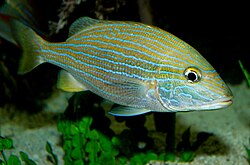
Picture of Haemulon
- Source
- Wikipedia/Commons
- Credit
- Brian Gratwicke
- Licence
- CC BY 2.0
- Commercial use
- the licence allows it
No 3D scan of Haemulon was found in Sketchfab.
Smithsonian Open Access and MorphoSource were not reached for this taxon, so this list is what the others held rather than everything there is.
The description on this site
- Source
- Wikipedia, “Haemulon”
- Licence
- CC BY-SA 4.0
This is what the site found, which is not the same as what exists.
Keep going
What may have been alongside itHaemulinae through timeFormations of the EoceneThe world it lived on
Occurrence data from the Paleobiology Database, CC BY 4.0. Cuvier 1829