Corbiculidae
Cyrenidae is a family of clams in the order Venerida.

USGS · Public Domain · via Wikipedia/Commons. May be a photograph of a specimen, or an artist’s reconstruction — an interpretation of a skeleton, since colour and soft tissue are almost never preserved.
On record
Recorded, not inferred- Sits inside
- CorbiculoideaPBDB
- Diet
- suspension feederPBDB
- Life habit
- infaunalPBDB
- Motility
- facultatively mobilePBDB
- Vision
- blindPBDB, for Bivalvia
- Environment
- brackish,freshwaterPBDB
Time the record covers
At least 205 million years on record.
The record covers at least 205.7 Mya to 11.7 ka. No occurrence read is dated outside 237 Mya to 0 Mya.
567 occurrences of Corbiculidae on record, most of them in the Late Cretaceous. The Paleobiology Database records this as a living group. Bar height is expected occurrences, not a count: each fossil is spread across the span it is dated to, so a tall narrow bar means tight dating and a low wide one means loose.
When
567 occurrences- Late Triassicunder 1%
- Early Jurassicunder 1%
- Middle Jurassic7%
- Late Jurassic7%
- Early Cretaceous8%
- Late Cretaceous23%
- Paleocene9%
- Eocene18%
- Oligocene13%
- Miocene6%
- Pliocene4%
- Pleistocene4%
- Holoceneunder 1%
These are dates about fossils, not the animal: the record can only begin after it arose and end before it died out, so either end may reach further. Shares are expected occurrences: a fossil dated to a span is counted partly in each period it straddles. More on what this infers.
Found in
174 formations
- Woodbine Formation41
- Jalama Formation28
- Tataouine Formation23
- Lefipán Formation23
- Enokuchi Formation · Goshoura Group12
- Itsuki Formation · Tetori Group9
Loading coastlines…
The named rock units Corbiculidae has been recovered from, largest first. Drawn where the rock is now, not where it formed. 150 further formations hold fewer occurrences each and are not listed. 76 occurrences have no formation on record, which is common for older literature.
Corbiculidae and its relatives
Late CretaceousWhere Corbiculidae and its relatives were recorded in the Late Cretaceous.
Found in the same rock
2,848 taxa- Corbicula60 sites
- Brachidontes34 sites
- Anomia31 sites
- Corbicula astartoides30 sites
- Ostrea30 sites
- Caryocorbula29 sites
- Fulpia27 sites
- Anomia jalama23 sites
- Corbula23 sites
- Sanoarca grandis23 sites
- Voysa23 sites
- Protarca22 sites
- Crassostrea21 sites
- Cuspidaria21 sites
- Glycymeris20 sites
- Ursirivus19 sites
- Calva (Calva) varians18 sites
- Euspira18 sites
- Lucina18 sites
- Ostrea soleniscus18 sites
- Tetoria18 sites
- Glycymerita veatchii17 sites
- Ampullina concipio16 sites
- Parvilucina16 sites
The Paleobiology Database records 327 sites for Corbiculidae, and this reads 240 of them. The number is how many of those sites it was catalogued from too. The 24 sharing the most are listed.
This is not a list of everything alive at the time. It is only what has come out of the same ground as this animal and been written down.
Entered from
138 references- Larger invertebrate fossils of the Woodbine formation (Cenomanian) of Texas42
- Mollusca from the upper Cretaceous Jalama Formation, Santa Barbara County, California28
- Neogene and Paleogene Molluscan (Bivalvia) Cenozones of the Russian Northeast.25
- Palökologie benthischer Faunengemeinschaften und Taxonomie der Bivalven im Jura von Südtunesien24
- Molluscs at the K/Pg boundary in Argentina: Extinction and recovery patterns. unpublished Ph.D. thesis23
- A systematic survey of the Mesozoic Bivalvia from Japan23
- Stratigraphy and fossil bivalve assemblages of the mid-Cretaceous Goshoura Group, southwest Japan22
- Tertiary faunal horizons of western Washington17
- Summary of the Paleogene molluscan faunas in North Japan16
- Biostratigraphie et paleoecologie des gisements types du Stampian de la region d''Etampes (Essonne)15
- Paleogene molluscan faunas from the Kushiro Coal Field, Eastern Hokkaido13
- On the Tertiary fluvio-marine formation of the Isle of Wight12
Each of the 567 occurrences read was entered from one of these publications, ordered by how many each accounts for. This is not a search for papers mentioning the name. 126 further references are not listed. Entries link to doi.org where the Paleobiology Database holds an identifier, and to its own record where it does not. Relayed as the Paleobiology Database holds them, not checked against what they resolve to.
Media and terms
Media content1
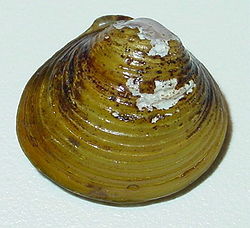
Picture of Corbiculidae
- Source
- Wikipedia/Commons
- Credit
- USGS
- Licence
- Public Domain
- Commercial use
- the licence allows it
No 3D scan of Corbiculidae was found in Sketchfab.
Smithsonian Open Access and MorphoSource were not reached for this taxon, so this list is what the others held rather than everything there is.
The description on this site
- Source
- Wikipedia, “Cyrenidae”
- Licence
- CC BY-SA 4.0
This is what the site found, which is not the same as what exists.
Keep going
What may have been alongside itCorbiculoidea through timeFormations of the Late CretaceousThe world it lived on
Occurrence data from the Paleobiology Database, CC BY 4.0. Gray 1847