Craspedostoma
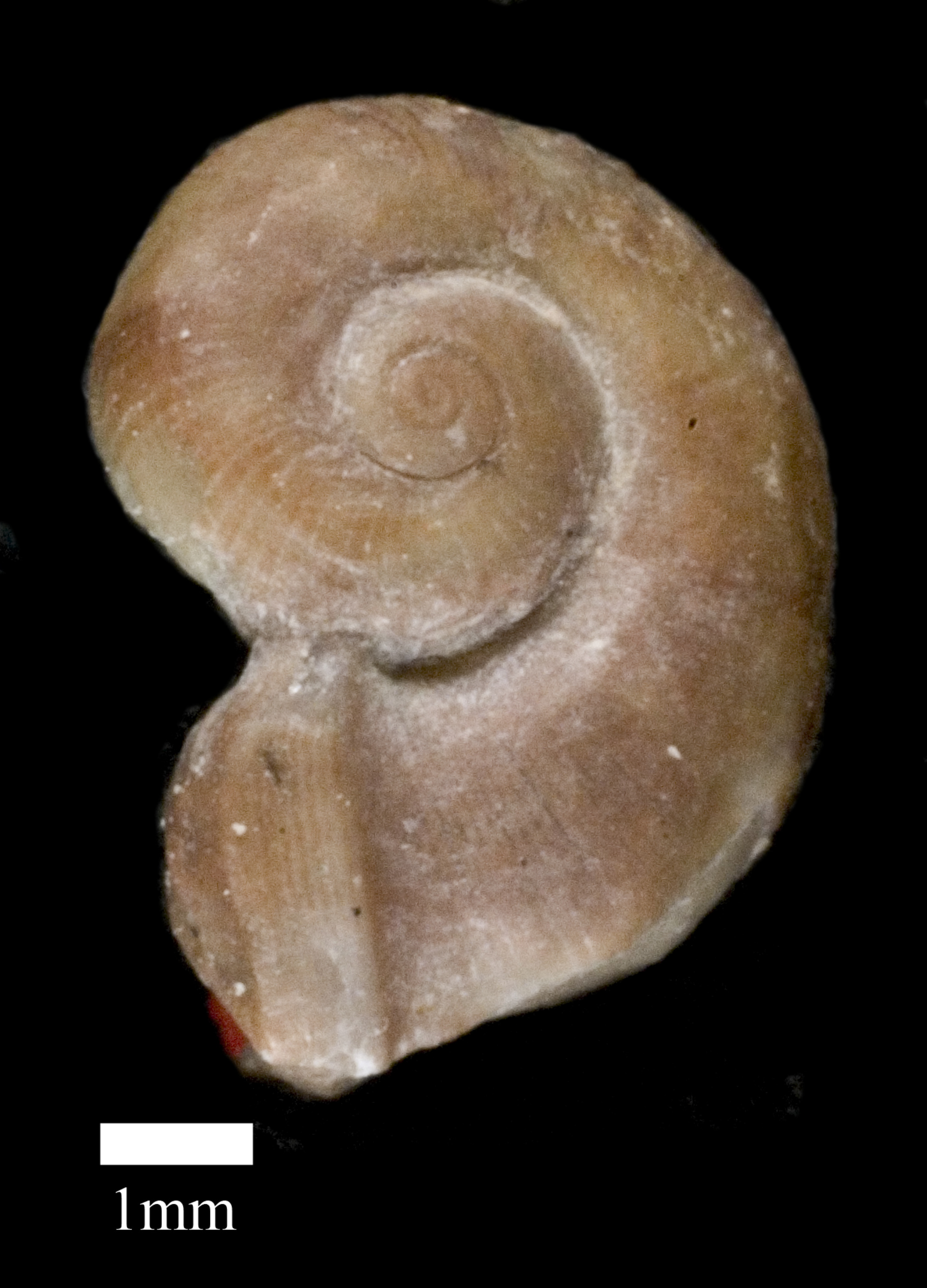
via iDigBio · via iDigBio. May be a photograph of a specimen, or an artist’s reconstruction — an interpretation of a skeleton, since colour and soft tissue are almost never preserved.
On record
Recorded, not inferred- Sits inside
- CraspedostomatinaePBDB
- Diet
- parasite, carnivorePBDB, for Platyceratoidea
- Life habit
- epifaunalPBDB, for Platyceratoidea
- Motility
- facultatively mobilePBDB, for Platyceratoidea
- Vision
- limitedPBDB, for Gastropoda
Time the record covers
At least 24 million years on record.
The record covers at least 449.9 Mya to 425 Mya. No occurrence read is dated outside 452.8 Mya to 422.7 Mya.
10 occurrences of Craspedostoma on record, most of them in the Silurian. Bar height is expected occurrences, not a count: each fossil is spread across the span it is dated to, so a tall narrow bar means tight dating and a low wide one means loose.
When
10 occurrences- Ordovician10%
- Silurian90%
These are dates about fossils, not the animal: the record can only begin after it arose and end before it died out, so either end may reach further. Shares are expected occurrences: a fossil dated to a span is counted partly in each period it straddles. More on what this infers.
Found in
6 formations
- Slite Beds Formation4
- Hemse Beds Formation2
- Halla Beds Formation1
- Kopanina Formation1
- Hamra Formation1
- Gorayivskaya Formation1
Loading coastlines…
The named rock units Craspedostoma has been recovered from, largest first. Drawn where the rock is now, not where it formed.
Craspedostoma and its relatives
SilurianWhere Craspedostoma and its relatives were recorded in the Silurian.
Found in the same rock
287 taxa- Platyostoma cornutum4 sites
- Acervularia3 sites
- Algae3 sites
- Anthozoa3 sites
- Atrypa reticularis3 sites
- Aulopora3 sites
- Brachiopoda3 sites
- Bryozoa3 sites
- Bumastus3 sites
- Calymene3 sites
- Coenites3 sites
- Cornulites3 sites
- Crinoidea3 sites
- Cypricardinia3 sites
- Delthyris (Delthyris) elevata3 sites
- Eospirifer3 sites
- Favosites3 sites
- Favosites gothlandicus3 sites
- Fistulipora3 sites
- Gypidula galeata3 sites
- Halysites catenularius3 sites
- Heliolites3 sites
- Leptaena rhomboidalis3 sites
- Loxoplocus gothlandicus3 sites
The Paleobiology Database records 6 sites for Craspedostoma, and this reads all of them. The number is how many of those sites it was catalogued from too. The 24 sharing the most are listed.
This is not a list of everything alive at the time. It is only what has come out of the same ground as this animal and been written down.
Entered from
4 references- Silurian Reefs of Gotland5
- The Silurian Gastropoda and Pteropoda of Gotland3
- Стратиграфія ордовику Придністров’я (Ordovic Stratigraphy of Transnistria) (= Ordovic Stratigraphy of Transdniestria)1
- Perner, 19031
Each of the 10 occurrences read was entered from one of these publications, ordered by how many each accounts for. This is not a search for papers mentioning the name. Entries link to doi.org where the Paleobiology Database holds an identifier, and to its own record where it does not. Relayed as the Paleobiology Database holds them, not checked against what they resolve to.
Media and terms
Media content1
Picture of Craspedostoma
- Source
- iDigBio
- Credit
- via iDigBio
- Licence
- not stated by the source
- Commercial use
- cannot be read from the licence given — check the record
No 3D scan of Craspedostoma was found in Sketchfab.
Smithsonian Open Access and MorphoSource were not reached for this taxon, so this list is what the others held rather than everything there is.
This is what the site found, which is not the same as what exists.
Keep going
What may have been alongside itCraspedostomatinae through timeFormations of the SilurianThe world it lived on
Occurrence data from the Paleobiology Database, CC BY 4.0. Lindström 1884