Crocodylus porosus
The saltwater crocodile is a crocodilian native to saltwater habitats, brackish wetlands and freshwater rivers from India's east coast across Southeast Asia and the Sundaland to northern Australia and Micronesia. It has been listed as Least Concern on the IUCN Red List since 1996. It was hunted for its skin throughout its range up to the 1970s, and is threatened by illegal killing and habitat loss. It is regarded as dangerous to humans.

Obtained from Molly Ebersold of the St. Augustine Alligator Farm · Public Domain · via Wikipedia/Commons. May be a photograph of a specimen, or an artist’s reconstruction — an interpretation of a skeleton, since colour and soft tissue are almost never preserved.
On record
Recorded, not inferred- Also called
- saltwater crocodilePBDB
- Sits inside
- CrocodylusPBDB
- Diet
- carnivorePBDB, for Crocodylia
- Motility
- actively mobilePBDB, for Osteichthyes
- Environment
- marinePBDB, for Mesoeucrocodylia
Time the record covers
At least 3.5 million years on record.
The record covers at least 3.6 Mya to 11.7 ka. No occurrence read is dated outside 5.333 Mya to 0 Mya.
9 occurrences of Crocodylus porosus on record, most of them in the Pleistocene. The Paleobiology Database records this as a living group. Bar height is expected occurrences, not a count: each fossil is spread across the span it is dated to, so a tall narrow bar means tight dating and a low wide one means loose.
When
9 occurrences- Pliocene33%
- Pleistocene44%
- Holocene22%
These are dates about fossils, not the animal: the record can only begin after it arose and end before it died out, so either end may reach further. Shares are expected occurrences: a fossil dated to a span is counted partly in each period it straddles. More on what this infers.
Found in
2 formations
Loading coastlines…
The named rock units Crocodylus porosus has been recovered from, largest first. Drawn where the rock is now, not where it formed. 7 occurrences have no formation on record, which is common for older literature.
Crocodylus porosus and its relatives
PleistoceneWhere Crocodylus porosus and its relatives were recorded in the Pleistocene.
Found in the same rock
97 taxa- Crocodyloidea5 sites
- Protemnodon4 sites
- Crocodylidae3 sites
- Macropus3 sites
- Macropus (Notamacropus)3 sites
- Varanus prisca3 sites
- Diprotodon optatum2 sites
- Dromaius novaehollandiae2 sites
- Quinkana2 sites
- Sedophascolomys medius2 sites
- Varanus2 sites
- Aepyprymnus rufescens1 site
- Anhinga malagurala1 site
- Antechinus flavipes1 site
- Antechinus stuartii1 site
- Arthropoda1 site
- Bettongia penicillata1 site
- Bos (Bibos)1 site
- Bovinae1 site
- Caretta caretta1 site
- Carphodactylus1 site
- Casuarius1 site
- Cercartetus caudatus1 site
- Cervus1 site
The Paleobiology Database records 9 sites for Crocodylus porosus, and this reads all of them. The number is how many of those sites it was catalogued from too. The 24 sharing the most are listed.
This is not a list of everything alive at the time. It is only what has come out of the same ground as this animal and been written down.
Entered from
6 references- Extinction of eastern Sahul megafauna coincides with sustained environmental deterioration3
- Pallimnarchus and other Cenozoic crocodiles of Queensland2
- The faunal remains and worked bone1
- Tropical Rainforests of North Queensland: Their Conservation Significance1
- New K/Ar age determinations of the Awe Fauna Gangue, Papua New Guinea: consequences for Papuaustralian late Cenozoic biostratigraphy1
- Crocodylus porosus from the Pliocene Allingham Formation of North Queensland Australia. Results of the Ray E. Lemley expeditions, Part 51
Each of the 9 occurrences read was entered from one of these publications, ordered by how many each accounts for. This is not a search for papers mentioning the name. Entries link to doi.org where the Paleobiology Database holds an identifier, and to its own record where it does not. Relayed as the Paleobiology Database holds them, not checked against what they resolve to.
Media and terms
Media content2

Picture of Crocodylus porosus
- Source
- Wikipedia/Commons
- Credit
- Obtained from Molly Ebersold of the St. Augustine Alligator Farm
- Licence
- Public Domain
- Commercial use
- the licence allows it
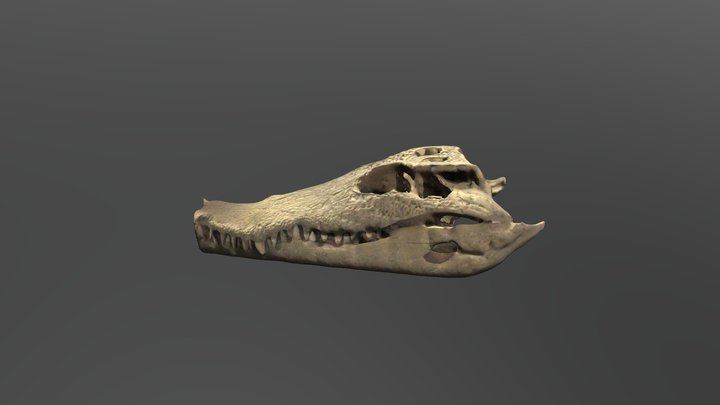
3D model
- Source
- Sketchfab
- Credit
- charlottee_neve
- Licence
- CC Attribution-NoDerivs
- Commercial use
- the licence does not allow it
Smithsonian Open Access and MorphoSource were not reached for this taxon, so this list is what the others held rather than everything there is.
The description on this site
- Licence
- CC BY-SA 4.0
This is what the site found, which is not the same as what exists.
Keep going
What may have been alongside itCrocodylus through timeFormations of the PleistoceneThe world it lived on
Occurrence data from the Paleobiology Database, CC BY 4.0. Schneider 1801