Cucujidae
The Cucujidae, or flat bark beetles, are a family of distinctively flat beetles found worldwide under the bark of dead trees. The family has received considerable taxonomic attention in recent years and now consists of 70 species distributed in five genera. It was indicated Cucujus species are scavengers, only feeding on pupae and larvae of other insects and on other subcortical beetles such as their own. Since the Cucujidae prey on larvae of potentially tree damaging beetles that spread fungal diseases, they are considered to be beneficial to the health of living trees.

Alpsdake · CC BY-SA 4.0 · via Wikipedia/Commons. May be a photograph of a specimen, or an artist’s reconstruction — an interpretation of a skeleton, since colour and soft tissue are almost never preserved.
On record
Recorded, not inferred- Sits inside
- CucujoideaPBDB
- Motility
- actively mobilePBDB, for Arthropoda
- Environment
- terrestrialPBDB, for Insecta
Time the record covers
At least 113 million years on record.
The record covers at least 113.2 Mya to 129 ka. No occurrence read is dated outside 119.57 Mya to 11.7 ka.
6 occurrences of Cucujidae on record, most of them in the Early Cretaceous. The Paleobiology Database records this as a living group. Bar height is expected occurrences, not a count: each fossil is spread across the span it is dated to, so a tall narrow bar means tight dating and a low wide one means loose.
When
6 occurrences- Early Cretaceous33%
- Eocene33%
- Pliocene17%
- Pleistocene17%
These are dates about fossils, not the animal: the record can only begin after it arose and end before it died out, so either end may reach further. Shares are expected occurrences: a fossil dated to a span is counted partly in each period it straddles. More on what this infers.
Found in
4 formations
- Escucha Formation1
- Florissant Formation1
- Crato Formation · Santana Group1
- La Huitrera Formation1
Loading coastlines…
The named rock units Cucujidae has been recovered from, largest first. Drawn where the rock is now, not where it formed. 2 occurrences have no formation on record, which is common for older literature.
Cucujidae and its relatives
Early CretaceousWhere Cucujidae and its relatives were recorded in the Early Cretaceous.
Found in the same rock
372 taxa- Aleocharinae2 sites
- Buprestidae2 sites
- Chrysomelidae2 sites
- Curculionidae2 sites
- Elateridae2 sites
- Scarabaeidae2 sites
- Abia1 site
- Acanthocinus schmidti1 site
- Acidota quadrata1 site
- Adelges1 site
- Aegialia1 site
- Aegialia (Psammoporus) terminalis1 site
- Aegialia lacustris1 site
- Aeshnidae1 site
- Agathidium1 site
- Alavaromma orchamum1 site
- Allopliosilpha inclavata1 site
- Ametroproctus valeriae1 site
- Ampulicidae1 site
- Anthribidae1 site
- Aphelocheirus (Aphelocheirus) affinis1 site
- Aphididae1 site
- Aphodius rufipes1 site
- Apticax solidus1 site
The Paleobiology Database records 5 sites for Cucujidae, and this reads all of them. The number is how many of those sites it was catalogued from too. The 24 sharing the most are listed.
This is not a list of everything alive at the time. It is only what has come out of the same ground as this animal and been written down.
Entered from
6 references- First fossil record of parasitic flat-bark beetle (Coleoptera: Passandridae) from the Eocene of Patagonia, Argentina1
- Coleoptera: beetles1
- Early Cretaceous spider web with its prey1
- The fossil Coleoptera of the Two Creeks Forest Bed, Wisconsin1
- Käfer (Coleoptera) aus dem Jungtertiär Norddeutschlands1
- Adephagous and clavicorn Coleoptera from the Tertiary deposits at Florissant, Colorado with descriptions of a few other forms and a systematic list of the non-rhynchophorus Tertiary Coleoptera of North America1
Each of the 6 occurrences read was entered from one of these publications, ordered by how many each accounts for. This is not a search for papers mentioning the name. Entries link to doi.org where the Paleobiology Database holds an identifier, and to its own record where it does not. Relayed as the Paleobiology Database holds them, not checked against what they resolve to.
Media and terms
Media content1
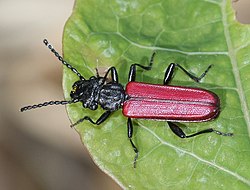
Picture of Cucujidae
- Source
- Wikipedia/Commons
- Credit
- Alpsdake
- Licence
- CC BY-SA 4.0
- Commercial use
- the licence allows it
No 3D scan of Cucujidae was found in Sketchfab.
Smithsonian Open Access and MorphoSource were not reached for this taxon, so this list is what the others held rather than everything there is.
The description on this site
- Source
- Wikipedia, “Cucujidae”
- Licence
- CC BY-SA 4.0
This is what the site found, which is not the same as what exists.
Keep going
What may have been alongside itCucujoidea through timeFormations of the Early CretaceousThe world it lived on
Occurrence data from the Paleobiology Database, CC BY 4.0. Latreille 1802