Cupressaceae
Cupressaceae, the cypress family, is a family of conifers. The family includes 27–30 genera, which include the cypresses, junipers, and redwoods, with about 130–140 species in total. They are monoecious, subdioecious or (rarely) dioecious trees and shrubs up to 116 m (381 ft) tall. The bark of mature trees is commonly orange- to red-brown and of stringy texture, often flaking or peeling in vertical strips, but smooth, scaly or hard and square-cracked in some species. The family reached its peak of diversity during the Mesozoic era.

Uncredited · CC BY-SA 3.0 · via Wikipedia/Commons. May be a photograph of a specimen, or an artist’s reconstruction — an interpretation of a skeleton, since colour and soft tissue are almost never preserved.
On record
Recorded, not inferred- Also called
- cypressPBDB
- Sits inside
- ConiferalesPBDB
- Diet
- "photoautotroph"PBDB, for Streptophyta
Time the record covers
At least 201 million years on record.
The record covers at least 201.4 Mya to 11.7 ka. No occurrence read is dated outside 205.7 Mya to 0 Mya.
1,635 occurrences of Cupressaceae on record, most of them in the Miocene. The Paleobiology Database records this as a living group. Bar height is expected occurrences, not a count: each fossil is spread across the span it is dated to, so a tall narrow bar means tight dating and a low wide one means loose.
When
1,635 occurrences- Late Triassicunder 1%
- Early Jurassicunder 1%
- Middle Jurassicunder 1%
- Late Jurassicunder 1%
- Early Cretaceous2%
- Late Cretaceous10%
- Paleocene16%
- Eocene19%
- Oligocene13%
- Miocene29%
- Pliocene3%
- Pleistocene6%
- Holoceneunder 1%
These are dates about fossils, not the animal: the record can only begin after it arose and end before it died out, so either end may reach further. Shares are expected occurrences: a fossil dated to a span is counted partly in each period it straddles. More on what this infers.
Found in
162 formations
- Fort Union Formation194
- Willwood Formation64
- Hell Creek Formation · Montana Group53
- Golden Valley Formation22
- Okinoyama Formation · Ube Group21
- Chloropagus Formation19
Loading coastlines…
The named rock units Cupressaceae has been recovered from, largest first. Drawn where the rock is now, not where it formed. 138 further formations hold fewer occurrences each and are not listed. 778 occurrences have no formation on record, which is common for older literature.
Cupressaceae and its relatives
MioceneWhere Cupressaceae and its relatives were recorded in the Miocene.
Found in the same rock
1,199 taxa- Metasequoia occidentalis102 sites
- Glyptostrobus europaeus89 sites
- Alnus66 sites
- Cercidiphyllum genetrix53 sites
- Dicotyledoneae50 sites
- Averrhoites affinis33 sites
- Equisetum33 sites
- Platanus raynoldsii31 sites
- Acer29 sites
- Hicoria antiquora29 sites
- Salix29 sites
- Ampelopsis acerifolia28 sites
- Populus28 sites
- Allantoidiopsis erosa25 sites
- Zingiberopsis isonervosa25 sites
- Hamamelidaceae24 sites
- Platycarya23 sites
- Cladrastis21 sites
- Menispermites parvareolatus21 sites
- Quercus21 sites
- Ulmus21 sites
- Lygodium kaulfussi20 sites
- Dombeya novimundi19 sites
- Persites argutus18 sites
The Paleobiology Database records 754 sites for Cupressaceae, and this reads 240 of them. The number is how many of those sites it was catalogued from too. The 24 sharing the most are listed.
This is not a list of everything alive at the time. It is only what has come out of the same ground as this animal and been written down.
Entered from
223 references- Die mittelmiozaenen und obermiozaenen Floren aus der Meuroer und Raunoer Folge in der Lausitz. III. Fundstellen und Palaeobiologie195
- Plant and mammal diversity in the Paleocene to Early Eocene of the Bighorn Basin116
- Megaflora of the Hell Creek and lower Fort Union Formations in the western Dakotas: Vegetational response to climate change, the Cretaceous-Tertiary boundary event, and rapid marine transgression80
- Paleocene flora of the Rocky Mountains and Great Plains78
- Late Paleocene-early Eocene climate changes in southwestern Wyoming: Paleobotanical analysis61
- Miocene floras in the lower Rhenish basin and their ecological interpretation59
- Tretichnye Flory Zapadnoi Sibiri53
- A catalogue of Cenozoic megafossil plants in China52
- Distribution of pollen and spores in a subsurface marine Wilcox (Paleocene-Eocene) section in southwest Louisiana50
- Die oberoligozanen Floren am Nordrand der Sachsischen Lausitz44
- Die Floren des Haselbacher Serie im Weisselster-Becken (Bezirk Leipzig, DDR)44
- Late Miocene and Pliocene Floras in Central Honshu, Japan41
Each of the 1,635 occurrences read was entered from one of these publications, ordered by how many each accounts for. This is not a search for papers mentioning the name. 211 further references are not listed. Entries link to doi.org where the Paleobiology Database holds an identifier, and to its own record where it does not. Relayed as the Paleobiology Database holds them, not checked against what they resolve to.
Media and terms
Media content1
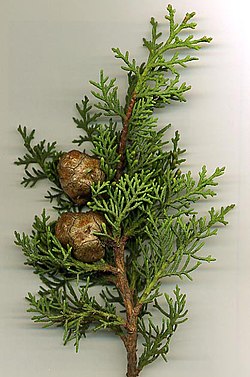
Picture of Cupressaceae
- Source
- Wikipedia/Commons
- Credit
- nobody named on the record
- Licence
- CC BY-SA 3.0
- Commercial use
- the licence allows it
No 3D scan of Cupressaceae was found in MorphoSource and Sketchfab.
Smithsonian Open Access was not reached for this taxon, so this list is what the others held rather than everything there is.
The description on this site
- Licence
- CC BY-SA 4.0
This is what the site found, which is not the same as what exists.
Keep going
What may have been alongside itConiferales through timeFormations of the MioceneThe world it lived on
Occurrence data from the Paleobiology Database, CC BY 4.0. Gray 1822