Cyanoramphus auriceps
The yellow-crowned parakeet also known as the yellow-fronted parakeet is a species of parakeet endemic to the islands of New Zealand. The species is found across the main three islands of New Zealand, North Island, South Island and Stewart Island/Rakiura, as well as on the subantarctic Auckland Islands. It has declined due to predation from introduced species such as stoats, although unlike the red-crowned parakeet, it has not been extirpated from the mainland of New Zealand. Its Māori name is kākāriki.

Nrg800 · CC BY-SA 3.0 · via Wikipedia/Commons. May be a photograph of a specimen, or an artist’s reconstruction — an interpretation of a skeleton, since colour and soft tissue are almost never preserved.
On record
Recorded, not inferred- Also called
- yellow-crowned parakeetPBDB
- Sits inside
- CyanoramphusPBDB
- Diet
- carnivorePBDB, for Coelurosauria
- Life habit
- ground dwelling, solitaryPBDB, for Theropoda
- Motility
- actively mobilePBDB, for Theropoda
- Environment
- terrestrialPBDB, for Theropoda
- Mass
- 40.7 gWikidata
Time the record covers
At most 12 thousand years on record.
The one occurrence read is dated to somewhere between 11.7 ka and 0 Mya, which is a dating window rather than a span.
1 occurrence of Cyanoramphus auriceps on record, most of them in the Holocene. The Paleobiology Database records this as a living group. Bar height is expected occurrences, not a count: each fossil is spread across the span it is dated to, so a tall narrow bar means tight dating and a low wide one means loose.
When
1 occurrences- Holocene100%
These are dates about fossils, not the animal: the record can only begin after it arose and end before it died out, so either end may reach further. Shares are expected occurrences: a fossil dated to a span is counted partly in each period it straddles. More on what this infers.
Cyanoramphus auriceps and its relatives
HoloceneWhere Cyanoramphus auriceps and its relatives were recorded in the Holocene.
Found in the same rock
30 taxa- Anas1 site
- Anas chathamica1 site
- Anthornis melanura1 site
- Anthus novaeseelandiae1 site
- Coenocorypha chathamica1 site
- Cyanoramphus novaezelandiae1 site
- Diaphorapteryx hawkinsi1 site
- Eudyptula minor1 site
- Falco novaeseelandiae1 site
- Fulica chathamensis1 site
- Gallirallus dieffenbachii1 site
- Gallirallus modestus1 site
- Gerygone albofrontata1 site
- Hemiphaga chathamensis1 site
- Larus dominicanus1 site
- Megalurus rufescens1 site
- Mergus milleneri1 site
- Nestor chathamensis1 site
- Pachyptila crassirostris1 site
- Pachyptila turtur1 site
- Pelagodroma marina1 site
- Pelecanoides urinatrix1 site
- Petroica traversi1 site
- Prosthemadera novaeseelandiae1 site
The Paleobiology Database records 1 site for Cyanoramphus auriceps, and this reads all of them. The number is how many of those sites it was catalogued from too. The 24 sharing the most are listed.
This is not a list of everything alive at the time. It is only what has come out of the same ground as this animal and been written down.
Entered from
1 referenceEach of the 1 occurrence read was entered from one of these publications, ordered by how many each accounts for. This is not a search for papers mentioning the name. Each entry links to the Paleobiology Database's own record for the work.
Media and terms
Media content3

Picture of Cyanoramphus auriceps
- Source
- Wikipedia/Commons
- Credit
- Nrg800
- Licence
- CC BY-SA 3.0
- Commercial use
- the licence allows it
Photogrammetry
- Source
- MorphoSource
- Credit
- Moore Lab of Zoology
- Licence
- not stated by the source
- Commercial use
- cannot be read from the licence given — check the record
- Specimen
- Cyanoramphus auriceps · MLZ:Bird:MLZ:Bird:65830
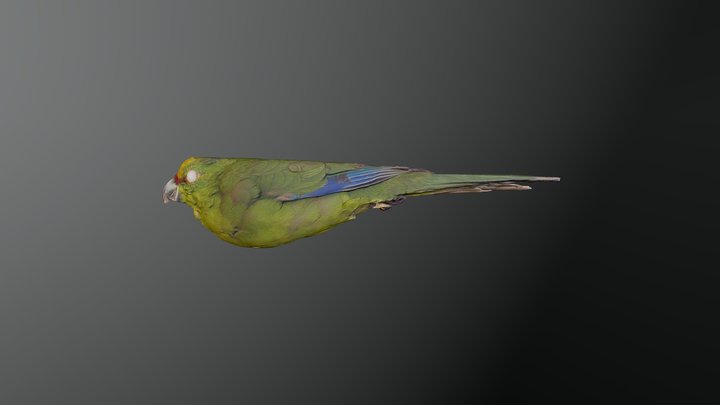
Smithsonian Open Access was not reached for this taxon, so this list is what the others held rather than everything there is.
The description on this site
- Licence
- CC BY-SA 4.0
This is what the site found, which is not the same as what exists.
Keep going
What may have been alongside itCyanoramphus through timeFormations of the HoloceneThe world it lived on
Occurrence data from the Paleobiology Database, CC BY 4.0. (Kuhl 1820)