Cyathoclisia
No picture of Cyathoclisia was found. Wikipedia, Wikidata and iDigBio were searched and had none. Smithsonian Open Access did not answer, so this is what the others held rather than everything there is. GBIF was asked, and what came back is not recorded: nothing, or a picture this site could not tie to Cyathoclisia, or no answer at all. This entry cannot say which.
On record
Recorded, not inferred- Sits inside
- ClisiophyllinaePBDB
- Diet
- suspension feederPBDB, for Rugosa
- Life habit
- epifaunalPBDB, for Rugosa
- Motility
- stationary, attachedPBDB, for Rugosa
- Vision
- blindPBDB, for Anthozoa
- Environment
- marinePBDB, for Rugosa
Time the record covers
At least 12 million years on record.
The record covers at least 358.86 Mya to 346.7 Mya. No occurrence read is dated outside 372.15 Mya to 339.9 Mya.
26 occurrences of Cyathoclisia on record, most of them in the Carboniferous. Bar height is expected occurrences, not a count: each fossil is spread across the span it is dated to, so a tall narrow bar means tight dating and a low wide one means loose.
When
26 occurrencesThese are dates about fossils, not the animal: the record can only begin after it arose and end before it died out, so either end may reach further. Shares are expected occurrences: a fossil dated to a span is counted partly in each period it straddles. More on what this infers.
Found in
6 formations
- Black Rock Limestone Formation11
- Black Rock Formation4
- Kizelov Formation3
- Percha Shale Formation1
- Sablé Formation1
- Volnovakha Formation1
Loading coastlines…
The named rock units Cyathoclisia has been recovered from, largest first. Drawn where the rock is now, not where it formed. 5 occurrences have no formation on record, which is common for older literature.
Cyathoclisia and its relatives
CarboniferousWhere Cyathoclisia and its relatives were recorded in the Carboniferous.
Found in the same rock
70 taxa- Fasciculophyllum15 sites
- Caninia cornucopiae14 sites
- Polygnathus11 sites
- Hindeodus9 sites
- Gnathodus8 sites
- Pseudopolygnathus8 sites
- Syringopora8 sites
- Michelinia7 sites
- Sychnoelasma konincki konincki7 sites
- Polygnathus communis communis6 sites
- Spathognathodus6 sites
- Allotropiophyllum5 sites
- Chonetes5 sites
- Amplexus4 sites
- Caninia4 sites
- Caninophyllum4 sites
- Caninophyllum patulum patulum4 sites
- Leptagonia analoga4 sites
- Cyathaxonia cornu3 sites
- Siphonophyllia3 sites
- Spirifer3 sites
- Spiriferidina3 sites
- Acanthopecten2 sites
- Apatognathus2 sites
The Paleobiology Database records 22 sites for Cyathoclisia, and this reads all of them. The number is how many of those sites it was catalogued from too. The 24 sharing the most are listed.
This is not a list of everything alive at the time. It is only what has come out of the same ground as this animal and been written down.
Entered from
11 references- The distribution of platform conodonts, corals, and foraminifera from the Black Rock Limestone (late Tournaisian and early Visean) of Tears Point, Gower, south Wales11
- Geology of the Country around Wells and Cheddar (Explanation of One-inch Geological Sheet 280, New Series)4
- Rol korallov v biostratigrafii nizhnekamennougolnykh otlozheniy Tatarii [The biostratigraphic significance of corals from the Lower Carboniferous of Tatar]3
- Taxonomy, Biostratigraphy and Palaeobiogeography of the Late Tournaisian rugose corals of north-western Turkey1
- Carboniferous buildups in the Donets Basin (Ukraine)1
- New data on the Carboniferous corals of the Donets Basin1
- Korallen aus dem Obertournai und Untervisé der Inseln Hiddensee und Rügen [Upper Tournaisian and Lower Visean corals from Hiddensee and Rügen islands]1
- Late Devonian (Famennian) rugose coral fauna of the Percha Shale of southwestern New Mexico1
- Delepinella anastomosa nov. gen., nov. sp., Rugosa (Tetracoralliaire) du Tournaisien superieur du Massif Armoricain (France)1
- Fatsialnaya priurochennost korallov v rannekamennougolnykh moryakh vostochnogo sklona yuzhnogo Urala [Ecologic relationships of corals in Early Carboniferous seas of the eastern slope of the southern Urals]1
- Invertebrate fossils from the Lower Carboniferous of New South Wales1
Each of the 26 occurrences read was entered from one of these publications, ordered by how many each accounts for. This is not a search for papers mentioning the name. Entries link to doi.org where the Paleobiology Database holds an identifier, and to its own record where it does not. Relayed as the Paleobiology Database holds them, not checked against what they resolve to.
Media and terms
Media content1
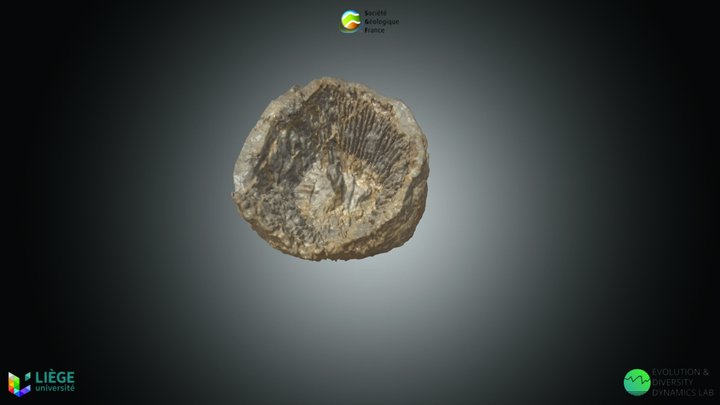
3D model
- Source
- Sketchfab
- Licence
- CC Attribution-NonCommercial-ShareAlike
- Commercial use
- the licence does not allow it
No picture of Cyathoclisia was found. Wikipedia, Wikidata and iDigBio were searched and had none.
Smithsonian Open Access did not answer, so this is what the others held rather than everything there is.
GBIF was asked, and what came back is not recorded: nothing, or a picture this site could not tie to Cyathoclisia, or no answer at all. This entry cannot say which.
Smithsonian Open Access was not reached for this taxon, so this list is what the others held rather than everything there is.
This is what the site found, which is not the same as what exists.
Keep going
What may have been alongside itClisiophyllinae through timeFormations of the CarboniferousThe world it lived on
Occurrence data from the Paleobiology Database, CC BY 4.0. Dingwall 1926