Dasyprocta
The agouti or common agouti is any of several rodent species of the genus Dasyprocta, from Ancient Greek δασύς (dasús), meaning "hair", and πρωκτός (prōktós), meaning "anus". They are native to Central America, northern and central South America, and the southern Lesser Antilles. Some species have also been introduced elsewhere in the West Indies and in west Africa (Bénin). They are related to guinea pigs and look quite similar, but they are larger and have longer legs. The species vary considerably in colour, being brown, reddish, dull orange, greyish, or blackish, but typically with lighter underparts. Their bodies are covered with coarse hair, which is raised when alarmed.

Chuck Homler, Focus On Wildlife · CC BY-SA 4.0 · via Wikipedia/Commons. May be a photograph of a specimen, or an artist’s reconstruction — an interpretation of a skeleton, since colour and soft tissue are almost never preserved.
On record
Recorded, not inferred- Also called
- agoutiPBDB
- Sits inside
- DasyproctidaePBDB
- Diet
- herbivorePBDB, for Dasyproctidae
- Life habit
- ground dwellingPBDB, for Dasyproctidae
- Motility
- actively mobilePBDB, for Osteichthyes
- Environment
- terrestrialPBDB, for Eutheria
Time the record covers
At most 2.6 million years on record.
Every occurrence read is dated to somewhere between 2.58 Mya and 0 Mya, and nothing in the dating separates them, so that window is what the record shows rather than a span.
15 occurrences of Dasyprocta on record, most of them in the Pleistocene. The Paleobiology Database records this as a living group. Bar height is expected occurrences, not a count: each fossil is spread across the span it is dated to, so a tall narrow bar means tight dating and a low wide one means loose.
When
15 occurrences- Pleistocene60%
- Holocene40%
These are dates about fossils, not the animal: the record can only begin after it arose and end before it died out, so either end may reach further. Shares are expected occurrences: a fossil dated to a span is counted partly in each period it straddles. More on what this infers.
Dasyprocta and its relatives
PleistoceneWhere Dasyprocta and its relatives were recorded in the Pleistocene.
Found in the same rock
226 taxa- Cuniculus paca9 sites
- Dasypus (Dasypus) novemcinctus7 sites
- Oryzomys6 sites
- Pecari tajacu6 sites
- Proechimys6 sites
- Thrichomys6 sites
- Hydrochoerus hydrochaeris5 sites
- Nasua nasua5 sites
- Tayassu pecari5 sites
- Coendou prehensilis4 sites
- Didelphis marsupialis4 sites
- Eira barbara4 sites
- Leopardus pardalis4 sites
- Mazama americana4 sites
- Panthera onca4 sites
- Puma concolor4 sites
- Puma yagouaroundi4 sites
- Sciurus4 sites
- Alouatta seniculus3 sites
- Cyclopes3 sites
- Dasypodinae3 sites
- Dasypus3 sites
- Kerodon rupestris3 sites
- Mazama3 sites
The Paleobiology Database records 13 sites for Dasyprocta, and this reads all of them. The number is how many of those sites it was catalogued from too. The 24 sharing the most are listed.
This is not a list of everything alive at the time. It is only what has come out of the same ground as this animal and been written down.
Entered from
9 references- Imigrantes em um continente perdido: O registro fossilífero de roedores Caviomorpha (Mammalia: Rodentia: Ctenohystrica) do Cenozoico do Brasil4
- Late Quaternary caviomorph rodents (Rodentia: Hystricognathi) from the Serra da Capivara, northeastern Brazil, with description of a new taxon3
- Fauna de mamíferos do Quaternário de Serra da Mesa (Goiás, Brasil)2
- Barro Colorado Island and Tropical Biology1
- Central Amazonian Forests and the Minimum Crtical Size of Ecosystems Project1
- An Overview of Research at Cocha Cashu Biological Station1
- Piacaguera: Um Sambaqui do Litoral do Estado de Sao Paulo, Brasil1
- Density, Productivity, and Distribution of Mammals in Two Venezuelan Habitats1
- Mamiferos Fosseis do Pleistoceno do Espirito Santo1
Each of the 15 occurrences read was entered from one of these publications, ordered by how many each accounts for. This is not a search for papers mentioning the name. Entries link to doi.org where the Paleobiology Database holds an identifier, and to its own record where it does not. Relayed as the Paleobiology Database holds them, not checked against what they resolve to.
Media and terms
Media content3

Picture of Dasyprocta
- Source
- Wikipedia/Commons
- Credit
- Chuck Homler, Focus On Wildlife
- Licence
- CC BY-SA 4.0
- Commercial use
- the licence allows it

CT scan
- Source
- MorphoSource
- Credit
- Cleveland Metroparks Zoo
- Licence
- In Copyright
- Commercial use
- cannot be read from the licence given — check the record
- Specimen
- Dasyprocta leporina · cmz:100640
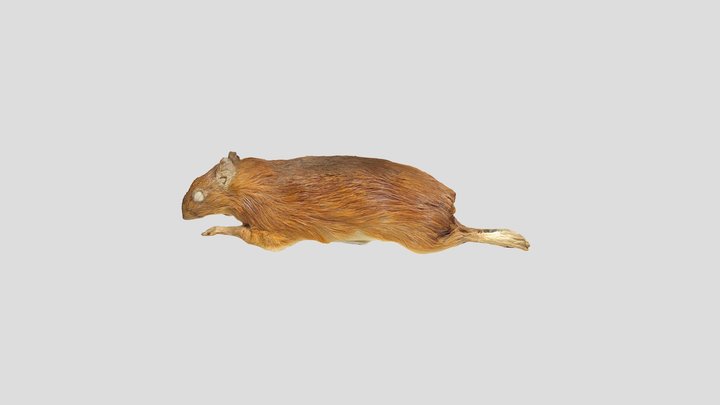
3D model
- Source
- Sketchfab
- Credit
- Do real ao digital
- Licence
- CC Attribution
- Commercial use
- cannot be read from the licence given — check the record
The description on this site
- Source
- Wikipedia, “Agouti”
- Licence
- CC BY-SA 4.0
This is what the site found, which is not the same as what exists.
Keep going
What may have been alongside itDasyproctidae through timeFormations of the PleistoceneThe world it lived on
Occurrence data from the Paleobiology Database, CC BY 4.0. Illiger 1811