Didelphis marsupialis
The common opossum, also called the northern black-eared opossum, is a species of marsupial living from the northeast of Mexico to Bolivia, including Trinidad and Tobago as well as the Windward Islands in the Caribbean, where it is referred to as the manicou. The common opossum prefers forests, but can also be found in fields and cities.

Rabipelao.jpg : Juan Tello derivative work: WolfmanSF ( talk ) · CC BY 2.0 · via Wikipedia/Commons. May be a photograph of a specimen, or an artist’s reconstruction — an interpretation of a skeleton, since colour and soft tissue are almost never preserved.
On record
Recorded, not inferred- Also called
- common opossumPBDB
- Sits inside
- DidelphisPBDB
- Diet
- omnivore, carnivorePBDB, for Didelphidae
- Life habit
- scansorialPBDB, for Didelphidae
- Motility
- actively mobilePBDB, for Osteichthyes
- Environment
- terrestrialPBDB, for Didelphidae
Time the record covers
At least 198 thousand years on record.
The record covers at least 210 ka to 11.7 ka. No occurrence read is dated outside 2.58 Mya to 0 Mya.
11 occurrences of Didelphis marsupialis on record, most of them in the Pleistocene. The Paleobiology Database records this as a living group. Bar height is expected occurrences, not a count: each fossil is spread across the span it is dated to, so a tall narrow bar means tight dating and a low wide one means loose.
When
11 occurrences- Pleistocene64%
- Holocene36%
These are dates about fossils, not the animal: the record can only begin after it arose and end before it died out, so either end may reach further. Shares are expected occurrences: a fossil dated to a span is counted partly in each period it straddles. More on what this infers.
Found in
4 formations
Loading coastlines…
The named rock units Didelphis marsupialis has been recovered from, largest first. Drawn where the rock is now, not where it formed. 7 occurrences have no formation on record, which is common for older literature.
Didelphis marsupialis and its relatives
PleistoceneWhere Didelphis marsupialis and its relatives were recorded in the Pleistocene.
Found in the same rock
383 taxa- Panthera onca8 sites
- Odocoileus virginianus6 sites
- Procyon lotor6 sites
- Canis latrans5 sites
- Holmesina septentrionalis5 sites
- Puma concolor5 sites
- Sigmodon hispidus5 sites
- Cuniculus paca4 sites
- Dasypus (Dasypus) novemcinctus4 sites
- Eira barbara4 sites
- Equus4 sites
- Lontra canadensis4 sites
- Lynx rufus4 sites
- Mammut americanum4 sites
- Mammuthus columbi4 sites
- Oryzomys4 sites
- Pecari tajacu4 sites
- Sciurus4 sites
- Smilodon fatalis4 sites
- Sylvilagus floridanus4 sites
- Aenocyon dirus3 sites
- Alouatta seniculus3 sites
- Camelops hesternus3 sites
- Canis lupus3 sites
The Paleobiology Database records 11 sites for Didelphis marsupialis, and this reads all of them. The number is how many of those sites it was catalogued from too. The 24 sharing the most are listed.
This is not a list of everything alive at the time. It is only what has come out of the same ground as this animal and been written down.
Entered from
11 references- First fossil manatees in Texas, USA: Trichechus manatus bakerorum from Pleistocene beach deposits along the Gulf of Mexico1
- Barro Colorado Island and Tropical Biology1
- Central Amazonian Forests and the Minimum Crtical Size of Ecosystems Project1
- An Overview of Research at Cocha Cashu Biological Station1
- Density, Productivity, and Distribution of Mammals in Two Venezuelan Habitats1
- Distribution of Cenozoic vertebrate faunas in Middle America and problems of migration between North and South America1
- Pleistocene mammals from Aguascalientes, central Mexico1
- Late Pleistocene mammals from a cave in Tamaulipas, Mexico1
- Pleistocene mammals from Ladds, Bartow County, Georgia1
- The Moore Pit local fauna; Pleistocene of Texas1
- Additions to the Pleistocene mammalian fauna from Melbourne, Florida1
Each of the 11 occurrences read was entered from one of these publications, ordered by how many each accounts for. This is not a search for papers mentioning the name. Entries link to doi.org where the Paleobiology Database holds an identifier, and to its own record where it does not. Relayed as the Paleobiology Database holds them, not checked against what they resolve to.
Media and terms
Media content1
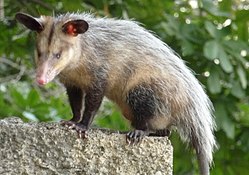
Picture of Didelphis marsupialis
- Source
- Wikipedia/Commons
- Credit
- Rabipelao.jpg : Juan Tello derivative work: WolfmanSF ( talk )
- Licence
- CC BY 2.0
- Commercial use
- the licence allows it
No 3D scan of Didelphis marsupialis was found in Smithsonian Open Access and Sketchfab.
MorphoSource was not reached for this taxon, so this list is what the others held rather than everything there is.
The description on this site
- Licence
- CC BY-SA 4.0
This is what the site found, which is not the same as what exists.
Keep going
What may have been alongside itDidelphis through timeFormations of the PleistoceneThe world it lived on
Occurrence data from the Paleobiology Database, CC BY 4.0. Linnaeus 1758