Degamella
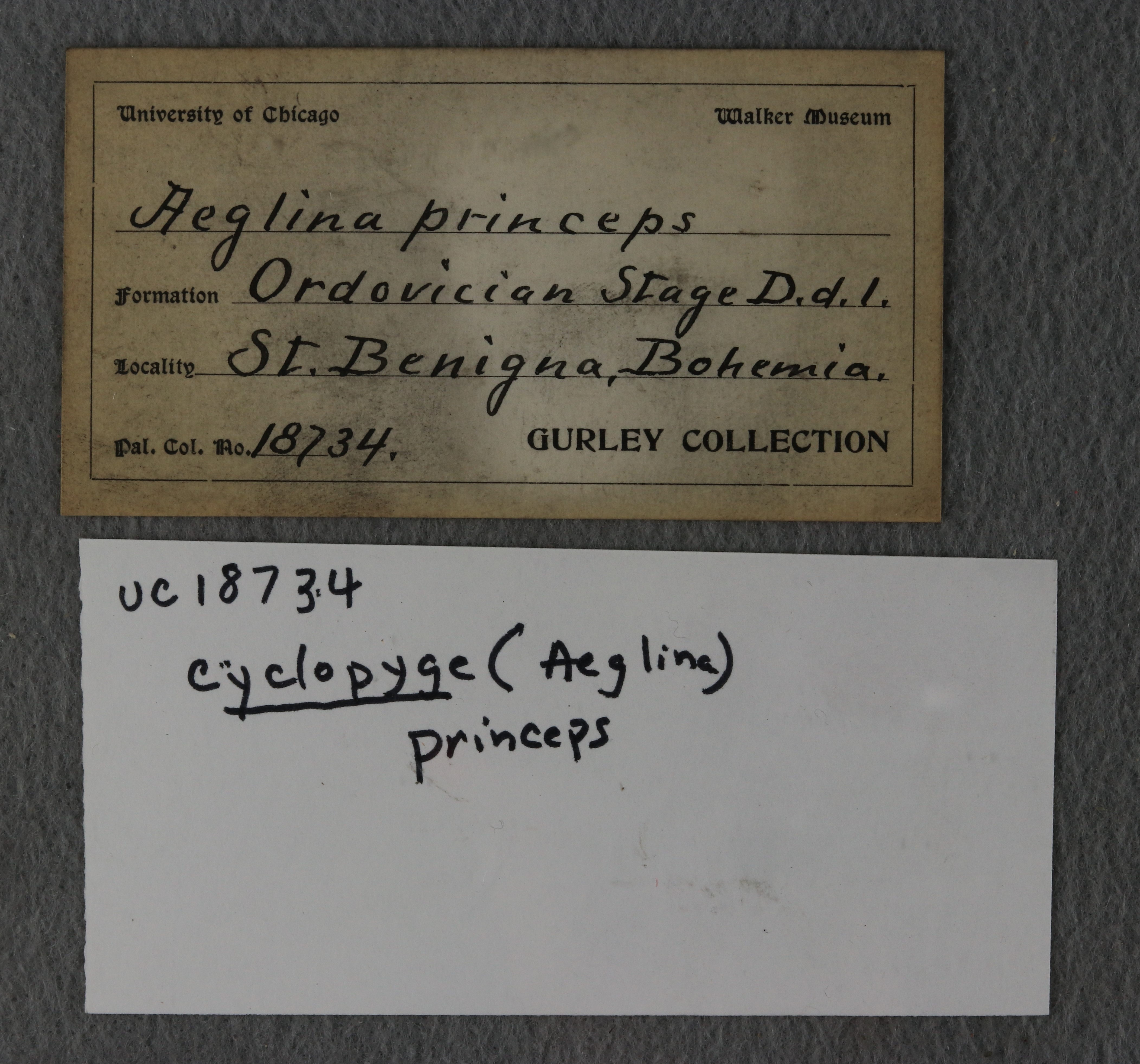
via iDigBio · via iDigBio. May be a photograph of a specimen, or an artist’s reconstruction — an interpretation of a skeleton, since colour and soft tissue are almost never preserved.
On record
Recorded, not inferred- Sits inside
- CyclopygidaePBDB
- Diet
- microcarnivorePBDB
- Life habit
- nektonicPBDB
- Motility
- actively mobilePBDB, for Cyclopygidae
- Vision
- well-developedPBDB, for Cyclopygidae
- Environment
- marinePBDB, for Trilobita
Time the record covers
At least 28 million years on record.
The record covers at least 477.1 Mya to 448.8 Mya. No occurrence read is dated outside 486.4 Mya to 445.2 Mya.
10 occurrences of Degamella on record, most of them in the Ordovician. Bar height is expected occurrences, not a count: each fossil is spread across the span it is dated to, so a tall narrow bar means tight dating and a low wide one means loose.
When
10 occurrences- Ordovician100%
These are dates about fossils, not the animal: the record can only begin after it arose and end before it died out, so either end may reach further. Shares are expected occurrences: a fossil dated to a span is counted partly in each period it straddles. More on what this infers.
Found in
6 formations
- Sarka Formation3
- Pontyfenni Formation1
- Cyffredm Shale Formation1
- Llanfallteg Formation1
- Volcancito Formation1
- Dobrotivá Formation1
Loading coastlines…
The named rock units Degamella has been recovered from, largest first. Drawn where the rock is now, not where it formed. 2 occurrences have no formation on record, which is common for older literature.
Degamella and its relatives
OrdovicianWhere Degamella and its relatives were recorded in the Ordovician.
Found in the same rock
138 taxa- Ectillaenus6 sites
- Colpocoryphe4 sites
- Pricyclopyge4 sites
- Cyclopyge3 sites
- Girvanopyge3 sites
- Microparia3 sites
- Ormathops3 sites
- Selenopeltis3 sites
- Ampyx2 sites
- Anatifopsis bohemica2 sites
- Archinacella2 sites
- Balanocystites2 sites
- Bohemilla2 sites
- Cnemidopyge tenuis2 sites
- Corrugatagnostus2 sites
- Dionide2 sites
- Ellipsotaphrus2 sites
- Illaenopsis2 sites
- Mitrocystella2 sites
- Nobiliasaphus2 sites
- Prospectatrix2 sites
- Psilacella2 sites
- Raphiophorus2 sites
- Sagavia2 sites
The Paleobiology Database records 10 sites for Degamella, and this reads all of them. The number is how many of those sites it was catalogued from too. The 24 sharing the most are listed.
This is not a list of everything alive at the time. It is only what has come out of the same ground as this animal and been written down.
Entered from
8 references- New deeper - water trilobites in the Ordovician of the Prague Basin (Czech Republic)2
- Ordovician (Llanvirn) Trilobites from SW Wales2
- Complementary description of the Middle Ordovician trilobite associations1
- Chlupáč et al., 19981
- Los primeros trilobites ciclopigidos en el Ordovicico de Argentina (Formation Volcancito, Sistema de Famatina) [First Ordovician cyclopygid trilobites from Argentina (Volcancito Formation, Famatina System)]1
- The ecological significance of variation in the genesis composition of Rawtheyan (Late Ordovician) trilobite faunas from North Wales, U.K1
- Early Ordovician (Arenig) stratigraphy and faunas of the Carmarthen District, southwest Wales1
- L'ordovicien au Maroc; essai de synthese stratigraphique1
Each of the 10 occurrences read was entered from one of these publications, ordered by how many each accounts for. This is not a search for papers mentioning the name. Entries link to doi.org where the Paleobiology Database holds an identifier, and to its own record where it does not. Relayed as the Paleobiology Database holds them, not checked against what they resolve to.
Media and terms
Media content1
Picture of Degamella
- Source
- iDigBio
- Credit
- via iDigBio
- Licence
- not stated by the source
- Commercial use
- cannot be read from the licence given — check the record
No 3D scan was found. Smithsonian Open Access, MorphoSource and Sketchfab were all searched.
This is what the site found, which is not the same as what exists.
Keep going
What may have been alongside itCyclopygidae through timeFormations of the OrdovicianThe world it lived on
Occurrence data from the Paleobiology Database, CC BY 4.0. Marek 1961