Selenopeltis
Selenopeltis is an extinct genus of odontopleurid trilobites in the family Odontopleuridae.

Hectonichus · CC BY-SA 3.0 · via Wikipedia/Commons. May be a photograph of a specimen, or an artist’s reconstruction — an interpretation of a skeleton, since colour and soft tissue are almost never preserved.
On record
Recorded, not inferred- Sits inside
- OdontopleuridaePBDB
- Diet
- carnivorePBDB, for Odontopleuridae
- Life habit
- low-level epifaunalPBDB, for Trilobita
- Motility
- fast-movingPBDB, for Trilobita
- Vision
- well-developedPBDB, for Odontopleuridae
- Environment
- marinePBDB, for Trilobita
Time the record covers
At least 36 million years on record.
The record covers at least 477.1 Mya to 440.5 Mya. No occurrence read is dated outside 486.85 Mya to 438.6 Mya.
75 occurrences of Selenopeltis on record, most of them in the Ordovician. Bar height is expected occurrences, not a count: each fossil is spread across the span it is dated to, so a tall narrow bar means tight dating and a low wide one means loose.
When
75 occurrences- Ordovician99%
- Silurian1%
These are dates about fossils, not the animal: the record can only begin after it arose and end before it died out, so either end may reach further. Shares are expected occurrences: a fossil dated to a span is counted partly in each period it straddles. More on what this infers.
Found in
37 formations
- Liben Formation10
- Llanfallteg Formation8
- Navas de Estena Formation5
- Vinice Formation3
- Bohdalec Formation3
- Upper Ktaoua Formation · Ktaoua Group3
Loading coastlines…
The named rock units Selenopeltis has been recovered from, largest first. Drawn where the rock is now, not where it formed. 13 further formations hold fewer occurrences each and are not listed. 1 occurrence has no formation on record, which is common for older literature.
Selenopeltis and its relatives
OrdovicianWhere Selenopeltis and its relatives were recorded in the Ordovician.
Found in the same rock
856 taxa- Ectillaenus25 sites
- Nobiliasaphus21 sites
- Prionocheilus20 sites
- Ormathops16 sites
- Stenopareia16 sites
- Colpocoryphe15 sites
- Dalmanitina15 sites
- Placoparia15 sites
- Sinuitopsis neglecta13 sites
- Dionide12 sites
- Phacopidina12 sites
- Zeliszkella12 sites
- Colpocoryphe grandis11 sites
- Monobolina11 sites
- Mucronaspis11 sites
- Neseuretus11 sites
- Redonia11 sites
- Calymenella9 sites
- Crinoidea9 sites
- Cyclopyge9 sites
- Deceptrix9 sites
- Didymograptus9 sites
- Eccoptochile9 sites
- Heterorthina9 sites
The Paleobiology Database records 73 sites for Selenopeltis, and this reads all of them. The number is how many of those sites it was catalogued from too. The 24 sharing the most are listed.
This is not a list of everything alive at the time. It is only what has come out of the same ground as this animal and been written down.
Entered from
38 references- The biostratigraphy of the Ordovician of Bohemia11
- Trilobiti drabovskych a letenskych vrstev ceskeho ordoviku7
- Ordovician (Llanvirn) Trilobites from SW Wales6
- Estudio bioestratigrafico del Llanvirn y Llandeilo (Dobrotiviense) en la parte meridional de la zona Centroiberica (España)4
- Early Ordovician (Arenig) stratigraphy and faunas of the Carmarthen District, southwest Wales4
- Les mollusques bivalves et rostroconches Ordoviciens de l’Anti-Atlas marocain: Intérêt paléogéographique de leur inventaire3
- Selenopeltis (Trilobita) from Brittany and its distribution in the Ordovician3
- Ordovician trilobites from the Tafilalt Lagerstätte: new data and reappraisal of the Bou Nemrou assemblage2
- The Ordovician succession from the western Iberian Ranges (NE Spain): a review with new data2
- Ordovician [Dobrotivian (Llandeillian stage) to Ashgill] crinoids (Phylum Echinodermata) from the Montes de Toledo and Sierra Morena Spain2
- Ordovician Invertebrate communities in black-shale lithofacies (Prague Basin, Czechoslovakia)2
- The stratigraphy of the Upper Ordovician of central Portugal2
Each of the 75 occurrences read was entered from one of these publications, ordered by how many each accounts for. This is not a search for papers mentioning the name. 26 further references are not listed. Entries link to doi.org where the Paleobiology Database holds an identifier, and to its own record where it does not. Relayed as the Paleobiology Database holds them, not checked against what they resolve to.
Media and terms
Media content2

Picture of Selenopeltis
- Source
- Wikipedia/Commons
- Credit
- Hectonichus
- Licence
- CC BY-SA 3.0
- Commercial use
- the licence allows it
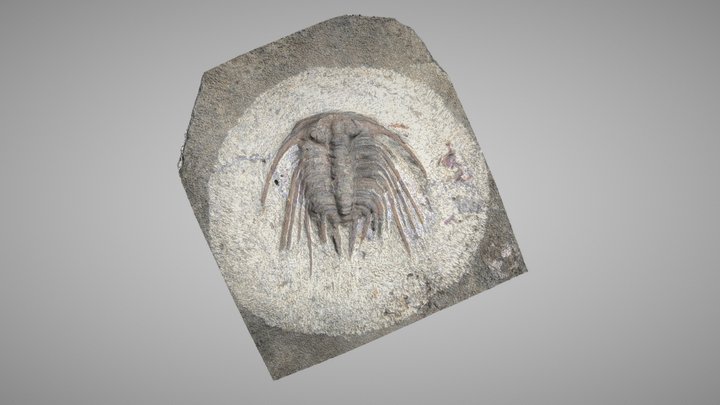
3D model
- Source
- Sketchfab
- Licence
- Free Standard
- Commercial use
- cannot be read from the licence given — check the record
This entry was cached before the site began recording what Smithsonian Open Access and MorphoSource did, so a search that failed cannot be told from one that found nothing.
The description on this site
- Licence
- CC BY-SA 4.0
This is what the site found, which is not the same as what exists.
Keep going
What may have been alongside itOdontopleuridae through timeFormations of the OrdovicianThe world it lived on
Occurrence data from the Paleobiology Database, CC BY 4.0. Hawle and Corda 1847