Demospongiae
Demosponges or common sponges are sponges of the class Demospongiae, the most diverse group in the phylum Porifera which include greater than 90% of all extant sponges with nearly 8,800 species worldwide. Being siliceous sponges, they are predominantly leuconoid in structure with an endoskeleton made of a meshwork of spicules consisting of fibers of the protein spongin, the mineral silica, or both. Where spicules of silica are present, they have a different shape from those in the otherwise similar glass sponges. Some species, in particular from the Antarctic, obtain the silica for spicule-building from the ingestion of diatoms.

Twilight Zone Expedition Team 2007, NOAA-OE · Public Domain · via Wikipedia/Commons. May be a photograph of a specimen, or an artist’s reconstruction — an interpretation of a skeleton, since colour and soft tissue are almost never preserved.
On record
Recorded, not inferred- Also called
- demospongePBDB
- Sits inside
- PoriferaPBDB
- Diet
- suspension feederPBDB
- Life habit
- intermediate-level epifaunalPBDB
- Motility
- stationary, attachedPBDB
- Vision
- blindPBDB, for Porifera
Time the record covers
At least 538 million years on record.
The record covers at least 538.8 Mya to 11.7 ka. No occurrence read is dated outside 635 Mya to 0 Mya.
9,383 occurrences of Demospongiae on record, most of them in the Permian. The Paleobiology Database records this as a living group. Bar height is expected occurrences, not a count: each fossil is spread across the span it is dated to, so a tall narrow bar means tight dating and a low wide one means loose.
When
9,383 occurrences- Cambrian5%
- Ordovician7%
- Silurian2%
- Devonian2%
- Carboniferous2%
- Permian34%
- Early Triassicunder 1%
- Middle Triassic3%
- Late Triassic16%
- Early Jurassicunder 1%
- Middle Jurassicunder 1%
- Late Jurassic10%
- Early Cretaceous3%
- Late Cretaceous12%
- Paleoceneunder 1%
- Eocene1%
- Oligoceneunder 1%
- Mioceneunder 1%
- Plioceneunder 1%
- Pleistoceneunder 1%
- Holoceneunder 1%
These are dates about fossils, not the animal: the record can only begin after it arose and end before it died out, so either end may reach further. Shares are expected occurrences: a fossil dated to a span is counted partly in each period it straddles. More on what this infers.
Found in
712 formations
- Capitan Limestone Formation844
- Capitan Formation275
- Jasna Gora Formation252
- Nayband Formation232
- Saikra Biohermal Complex Formation226
- Burgess Shale Formation · Chancellor Group201
Loading coastlines…
The named rock units Demospongiae has been recovered from, largest first. Drawn where the rock is now, not where it formed. 688 further formations hold fewer occurrences each and are not listed. 2,442 occurrences have no formation on record, which is common for older literature.
Demospongiae and its relatives
PermianWhere Demospongiae and its relatives were recorded in the Permian.
Found in the same rock
1,953 taxa- Cliona143 sites
- Exogyra (Exogyra) costata115 sites
- Serpula90 sites
- Anomia argentaria79 sites
- Bryozoa79 sites
- Veniella conradi78 sites
- Crassatella vadosa76 sites
- Gryphaeostrea vomer70 sites
- Turritella69 sites
- Crenella serica66 sites
- Idonearca capax65 sites
- Turritella vertebroides65 sites
- Vertebrata65 sites
- Cubitostrea tecticosta61 sites
- Pycnodonte vesicularis59 sites
- Cyprimeria50 sites
- Syncyclonema48 sites
- Hamulus onyx47 sites
- Pseudolimea reticulata45 sites
- Cardium44 sites
- Neogastropoda44 sites
- Turritella trilira44 sites
- Drilluta43 sites
- Anchura42 sites
The Paleobiology Database records at least 804 sites for Demospongiae, and this reads 240 of them. The number is how many of those sites it was catalogued from too. The 24 sharing the most are listed.
This is not a list of everything alive at the time. It is only what has come out of the same ground as this animal and been written down.
Entered from
954 references- Sponges of the Permian Upper Capitan Limestone, Guadalupe Mountains, New Mexico and Texas985
- Upper Permian inozoid, demospongid, and hexactinellid sponges from Djebel Tebaga, Tunisia557
- Die Kieselspongien der oberen Kreide von Nordwestdeutschland, Teil 1 Tetraxonia, Monaxonia und Silicea incert. sedis [Upper Cretaceous sponges from north-western Germany, part 1 Tetraxonia, Monaxonia and Silicea incert. sedis]337
- Lower to Middle Oxfordian sponges of the Polish Jura252
- Boiko et al., 1991214
- Upper Permian segmented sponges from Djebel Tebaga, Tunisia191
- Catalogue of the fossil sponges in the Geological Department of the British Museum (Natural History)184
- Upper Jurassic siliceous sponges from the Swabian Alb: taxonomy and paleoecology141
- Hypercalcified sponges from the Upper Triassic (Norian-Rhaetian) reefs of Sicily118
- Siliceous sponges from the Upper Cretaceous of Poland, part 1: Tetraxonia118
- Late Paleozoic sponge faunas of the Texas region: The siliceous sponges108
- Sphinctozoan and Inozoan Sponges from the Permian Reefs of South China102
Each of the 9,383 occurrences read was entered from one of these publications, ordered by how many each accounts for. This is not a search for papers mentioning the name. 942 further references are not listed. Entries link to doi.org where the Paleobiology Database holds an identifier, and to its own record where it does not. Relayed as the Paleobiology Database holds them, not checked against what they resolve to.
Media and terms
Media content1
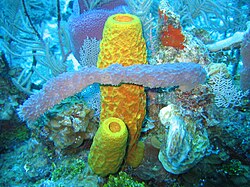
Picture of Demospongiae
- Source
- Wikipedia/Commons
- Credit
- Twilight Zone Expedition Team 2007, NOAA-OE
- Licence
- Public Domain
- Commercial use
- the licence allows it
No 3D scan of Demospongiae was found in MorphoSource and Sketchfab.
Smithsonian Open Access was not reached for this taxon, so this list is what the others held rather than everything there is.
The description on this site
- Source
- Wikipedia, “Demosponge”
- Licence
- CC BY-SA 4.0
This is what the site found, which is not the same as what exists.
Keep going
What may have been alongside itPorifera through timeFormations of the PermianThe world it lived on
Occurrence data from the Paleobiology Database, CC BY 4.0. (Sollas 1875)